
Surface treatment
The handle polished to a shine
Automated surface processing. Automation specialist SHL has developed a combined system for grinding, scotching and polishing that improves the automated processing of door handles at FSB. This shortens throughput times, ensures reliable processes and achieves a perfect appearance.
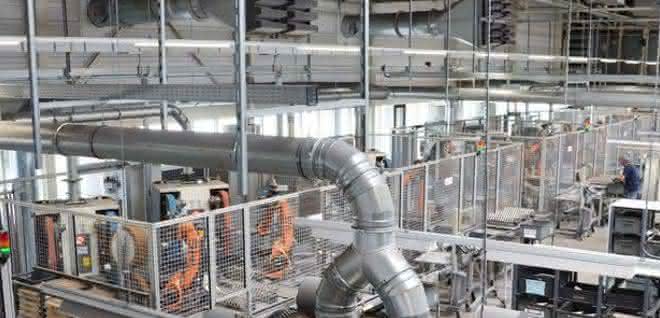
FSB, based in North Rhine-Westphalia, manufactures stainless steel and aluminum door and window hardware for the premium sector. The company places the highest demands on the quality of the surfaces. In order to meet the growing number of variants and increase flexibility, the company wanted to automate the machining process. FSB received support from SHL. The automation specialist from the Swabian town of Böttingen installed a combined system for grinding, fine grinding (scotching) and polishing door fittings.
FSB attracted particular attention with the development of the so-called Schneider lever handle in the 1950s. The product with the designation 1051 was sold millions of times and is on display at the Museum of Modern Art in New York. Today, in addition to door and window fittings, electronic access control systems as well as ergonomic handles and holders for bathrooms and wheelchairs are produced on an area of around 80,000 square meters. FSB supplies architects, takes part in public tenders and supplies the specialist trade.
The company is particularly proud of its high level of vertical integration. "We are the only company in this sector that produces entirely in Germany," says Carsten Menge, Head of Production and Processes at FSB. This applies to the processing of raw materials from bars or coils as well as production in the company's own aluminum foundry. "We are active in the premium sector. That's why the quality requirements in terms of look and feel are very high."
According to Menge, the market has changed significantly in recent years. "The number of variants has increased and customers are placing strict demands on delivery times." FSB has responded to this with a modular system. Semi-finished products are produced from stock, and customer-specific solutions are created in final assembly. For Menge, process improvements can ensure survival in the high-wage country of Germany. This is why FSB employees are aiming for greater automation in stainless steel production.
FSB used to produce eight different models on one machining center. These made up 70 percent of the stainless steel lever handles. Sebastian Rothkegel, Head of Stainless Steel Production at FSB: "In order to cope with the large variety of items, the level of automation had to be increased. We simply had to become much more flexible." Two years ago, he began working with employees to develop a concept on how to optimally grind as many lever handle models as possible using robots.
It was clear from the outset that only SHL could be considered as a partner. "FSB has been a customer from the very beginning," says Wilhelm Tillinger, Technical Sales at SHL. "We installed the first system for grinding and polishing aluminum lever handles in 1990," says Tillinger. "When it comes to large projects, no other supplier comes into play. We know the SHL technology and can be sure that we will receive quality," says Sebastian Rothkegel. SHL has supplied a total of 64 systems since 1990, and 26 are currently in operation.
The partners also worked closely together on the latest project. The direction of travel and target processing times were determined in strategy discussions. The challenge was to reorganize the production infrastructure and install the system during ongoing production. "It was open-heart surgery," Carsten Menge sums it up. "The system has been running reliably for a year to our complete satisfaction without any downtime," says Matthias Arendes, Head of Plant Maintenance.
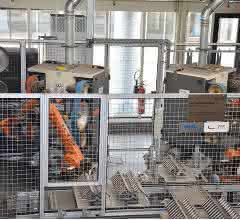
SHL has set up six machining cells in Brakel, each with two robots for grinding. In addition, six cells with a total of nine robots are available for fine machining using scotching, as well as a robot cell for polishing for a special variant. In the standard process, the fittings are placed on SHL pallets after welding from prefabrication and transported to the cell.
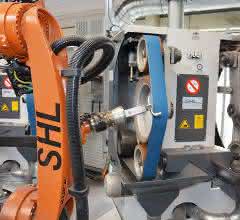
The first robot picks up the handle and swivels it to the measuring station. This is followed by processing on the DKS double free belt and contact roller grinding machine from SHL. The robot then moves to the gripping station and places the workpiece on a square pin. Once approval has been given, robot number two takes over, initiates the rest of the grinding process, also on a DKS, and places the pusher on a conveyor belt. Employees check the workpiece and regrind it by hand. At the Scotch cell, a handling unit removes the pusher from the pallet and transfers it to the robot. The robot first feeds the workpiece to the SHL P 1000 ROB polishing machine. This is followed by fine scotching on the P 550 machine. Once the process is complete, the robot picks up the presser and sets it down in a defined position.
The renewed investment in SHL technology has paid off for FSB. "We were able to speed up our processes and have become much more flexible," summarizes Sebastian Rothkegel. Today, FSB processes 35 different handle models on the SHL system and achieves a demand coverage of more than 80 percent. Further models are to be added in the future. "The automation rate used to be 70 percent, while we had to grind 30 percent by hand, which was time-consuming and laborious," he explains. Currently, the degree of completion is 90 to 95 percent, and the proportion of manual work has been minimized. "This investment has also significantly improved ergonomics at the workplace."
FSB processes 70 percent of its stainless steel models using the SHL system. With the previous solution, it was only 25 percent. "We can cope with the wide range of variants and can also process smaller quantities economically," says Rothkegel happily.
The precise knowledge of SHL technology that FSB now has brings practical advantages. "We can carry out most of the work on the systems ourselves or SHL helps us via remote maintenance," explains Matthias Arendes. He cites the programming of the robots for the demanding 3D processing as an example. "Depending on the model, up to 150 program records have to be entered. As we are well instructed, we do the teaching ourselves down to the last detail." as


You might also be interested in
Nomination Products of the Year 2024
Schrempp: Intelligent function handles with IO-Link interface
Nominated in the handling, assembly and production logistics category in the competition for the products of the year 2024 are the function handles with integrated signal surface and/or configurable keypad and feedback LEDs with IO-Link interface...
 read more...
Norelem supports VDI Racing Camp
Mastering the challenges of e-mobility
Promoting young talent has been a priority at Norelem for many years: the company supports young talents with components and the necessary know-how and provides schools with illustrative material.
read more...Three-point internal rapid action switch
High-precision internal measurements on drill holes
Feinmess Suhl has expanded its product range with the new 8480 three-point internal rapid probe. The probe has been specially developed for high-precision internal measurement of through and blind bores.
read more...Standardized machine elements
Flexibility is required in mechanical engineering for the rubber industry. Rubicon Gummitechnik und Maschinenbau uses standard and operating parts from Norelem for this purpose.
read more...Carry out cutting work with precision
Schukat now stocks all cutting pliers from the Electronic Super Knips series from the German manufacturer Knipex.
read more...Secure locking
Heinrich Kipp has added a series of snap locks to its range that are designed for flush installation in doors, flaps or drawers.
read more...Cobot for final aircraft assembly
The collaborative colleague works on the airplane fuselage
Together with Fraunhofer IGP and aircraft manufacturer Airbus, Tox Pressotechnik investigated the question of how final aircraft assembly can be made more productive and ergonomic.
read more...Industrial vacuum cleaner with a long service life
A powerful vacuum cleaner for coarse, fine, flammable and moist materials is in demand across all industries. Easy handling and a long service life are the most important criteria for regular use.
read more...Enough space for a cool head
What to do when an ergonomic lifting aid is required but the room height is too low for conventional crane systems? Schmalz has a modular flat jib made of aluminum in its product range that is used by Erkodent, a manufacturer of dental thermoforming...
read more...