
Simple programming
Fast integration
The advantages of intelligent automation solutions are obvious: manufacturers can streamline their production and make it more efficient.
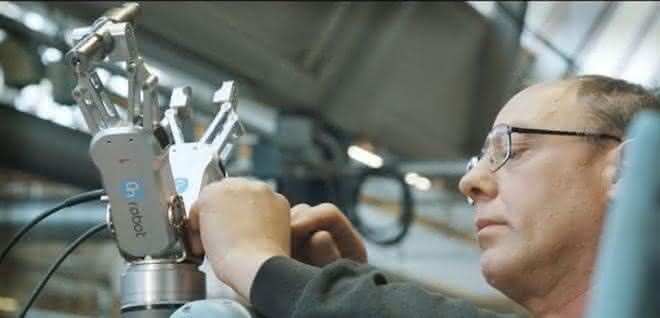
In addition to the costs for the product itself, there are also the costs associated with integrating the robot into the existing production environment. Because every minute that production has to stop for this reason costs money. The same applies to the time that employees need to familiarize themselves with the application. Training or external service staff to assist with system integration are further cost factors. The longer it takes to integrate a robot, the more expensive the entire purchase becomes. This can be a particular problem for small and medium-sized companies with limited resources. In some cases, these concerns may prevent manufacturers from investing in automation solutions and making their production fit for the future.
The time it takes to program a robot is therefore a key factor in determining its profitability. In order for companies of all sizes to benefit from automation, applications must be available that pay for themselves quickly. Manufacturers such as Onrobot therefore offer robotics solutions with short integration times. Installation using the plug-and-play method is particularly beneficial. It also gives users the option of flexibly varying attachments and thus choosing from a wide range of applications. This is particularly advantageous in production environments where requirements change quickly. For example, if an electronics manufacturer is confronted with a daily changing order situation, the rapid variation of applications can help them to react accordingly.
The compatibility of the products with those of other manufacturers also favors flexible usability and expands the functionality of the robotics application. Users can choose from a wider range of potential end-of-arm tooling and have more combination options. It is also possible to equip robotic arms from different manufacturers with products from the same gripper manufacturer, which simplifies purchasing, setup and operation. The gripping systems and sensors from Onrobot, for example, are all compatible with the robot arms from Universal Robots and in some cases with those from Kawasaki, Kuka and Fanuc. At the same time, users benefit from the easy-to-learn control of the respective devices. Ultimately, it is the user-friendliness of the overall application that counts: Both the end effector and the robot arm must be intuitive to operate in order to make it easy for the end user to use.
Robot manufacturers often equip their products with pre-programmed software packages that help to speed up installation. Ideally, they contain all the information a system integrator needs to install the device independently. This makes configuring the robot a matter of minutes. Some manufacturers, such as Universal Robots or Onrobot, provide the necessary software updates on USB sticks so that updating is also easy.
This uncomplicated handling means that even factory employees without programming knowledge can operate the products quickly. As a result, there is no need for training so that employees can concentrate on more important tasks instead. At the same time, the robots relieve them of strenuous, monotonous tasks.
Such experiences often have a positive effect on how the workforce reacts to automation measures. Employees can see the benefits for themselves and are more willing to go along with the cultural change on their own initiative. Especially in smaller companies with a family atmosphere, this can prove decisive for success.
A short integration time means that an investment also pays off more quickly in economic terms. As soon as a robot goes into operation, it increases productivity and product quality, while its use reduces production costs. The respective company benefits noticeably from this. This high return on investment therefore makes automation a realistic option for small and medium-sized companies too. pb
Fast ROI enables automation
One example: Danish gear manufacturer Osvald Jensen, a family-owned company, loads and unloads its CNC machines using collaborative robot arms from Universal Robots. RG2 double grippers from Onrobot are mounted on these arms. They were installed using an uncomplicated plug-and-play process. Commissioning took place quickly and production became significantly more efficient. The purchase paid for itself after just three months.


You might also be interested in
Fraunhofer IOSB Opens Humanoid Robots Lab
The Fraunhofer IOSB is opening a Humanoid Robots Experience Lab in Karlsruhe, Lemgo, and Ilmenau. Companies and organizations can use these facilities to test potential applications for humanoid robots and develop pilot projects.
 read more...
Artificial Intelligence in Manufacturing
Trumpf and IPAI Are Expanding a European AI Network for Industry
The high-tech company Trumpf is an official partner of the IPAI AI network in Heilbronn. Together, the partners aim to exchange experiences, develop new AI applications for industrial use, and advance the development of artificial intelligence in...
read more...Case Study: Networked Manufacturing Platform for Toolmaking
Using a networked manufacturing platform, Escha GmbH & Co. KG, a manufacturer of industrial fastening technology, has comprehensively modernized its toolmaking operations.
read more...Barcelona Declaration on Robotics and...
Robotics Associations Adopt Global Automation Strategy
The global robotics industry is stepping up its collaboration. The associations AER Automation, A3, IFR, and VDMA Robotics + Automation have formed a long-term alliance by signing the “Barcelona Declaration on Robotics and Automation 2026.” The...
read more...Jane Heffner is the new president of the International Federation of Robotics
Jane Heffner is the new president of the International Federation of Robotics. Adrien Brouillard has been appointed vice president of the global federation.
read more...Greater Transparency in the Robotics Market
RoboFinder Launches as an Independent Comparison Platform
Launch at Gitex Europe: 'RoboFinder' aims to bring more transparency to the professional service robotics market. In this interview, founder and CEO Brian Engels discusses market potential, challenges, and the goals of the new platform.
read more...Artificial Intelligence for the Physical Space
Alibaba Expands Qwen Model Family with a Robotics Suite for Physical AI
Alibaba is expanding its Qwen model family with a robotics suite for Physical AI. The three models—for manipulation, navigation, and simulation—are designed to assist autonomous robots with complex tasks in real-world environments.
read more...International Federation of Robotics
U.S. Robotics Industry Sees Double-Digit Growth
In the U.S., sales of industrial robots rose by 11% compared to the previous year: 38,000 units were newly installed in 2025. This significant recovery is driven by robust growth in the food industry and other non-manufacturing sectors. However, the...
read more...Development Collaboration for Humanoid Robotic Hands Launched
Schunk is entering into a new development partnership with Robert Bosch Robotics. Their shared goal is to develop an industrial-grade robotic hand that can be integrated into various humanoid robot systems.
read more...