

Robot programming
Optimum robot programming
Robotics is moving towards simple programming and installation. In practice, there are many alternative methods and procedures. This article lists criteria to help you decide which programming method best suits the operator's experience, requirements, application and general conditions.
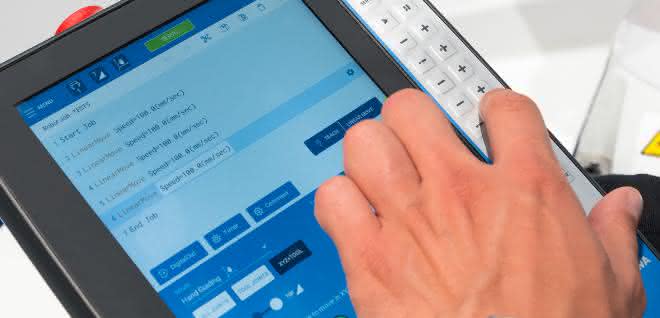
Robot applications are programmed either during commissioning, usually by the system integrator, or during subsequent operation and adaptation by the operator. More and more robots are being installed as assistants in smaller companies and operated by skilled workers who are familiar with the process but do not have the programming knowledge required for complex robot programming. One example of this is the "Weld4Me" robot assistant for manual welders. Here, the welding task changes daily and the operator becomes the programmer.
Two different approaches
In classic industrial robotics, automation tasks are approached from a planning perspective. Experienced system integrators specify the task and the boundary conditions together with the customer, create concepts using professional simulation and planning tools, select suitable automation components on this basis, set up the system and program everything using experienced PLC or robot programmers.
An alternative iterative approach to robotics has emerged from the cobot world - and now also for industrial robots. Users start automation projects by simply selecting a robot model that promises simple operation and installation. Then, step by step, they approach a finished robot solution by adding components and making intuitive adjustments. This non-planning approach relies on the simplest possible programmability and configurability (plug & play) throughout the entire integration chain - including robots, grippers/tools, sensors, devices, parts provision, safety and HMI.
Which programming method is the best?
Which programming method is really the best depends - like many things in life - on the boundary conditions. Robots are used in a wide variety of applications, ranging from handling and testing tasks for feather-light components weighing several tons to the smallest and largest components, as well as fast pick & place processes, complex assembly, spot/laser and arc welding, additive manufacturing and much more.
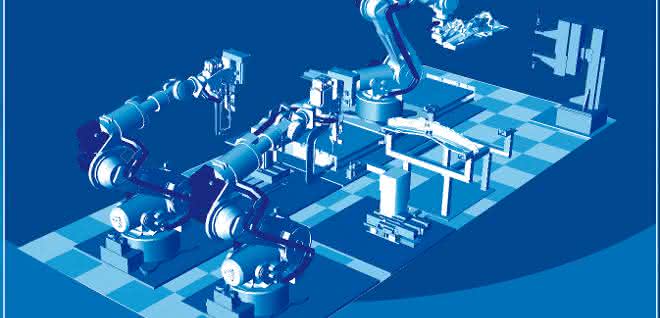
Niche suppliers, for example in small robotics with simple handling applications, naturally offer programming solutions that are particularly simple for their product, its typical range of applications and the typical user group. Robot manufacturers with a full product range, such as Yaskawa, cover a wider spectrum and support not just one, but a correspondingly wide range of programming solutions.
Who programs robot applications?
Experienced robot programmers and system integrators value broad functionality and efficiency during commissioning and therefore prefer the classic robot teach pendant. The user interface may not always be as graphical and intuitive, but here robot positions can be taught and optimized very precisely, logic and parameters can be called up quickly in menus and function keys, and command parameters can be set up quickly in a line-oriented syntax. Advanced programming options at high-level language and tools for deep integration and customization of interfaces, protocols and functions are highly appreciated. For the subsequent operator, apps for easy operation and visualization can be set up either on an operating PC or on the touchscreen of the hand-held pendant station.
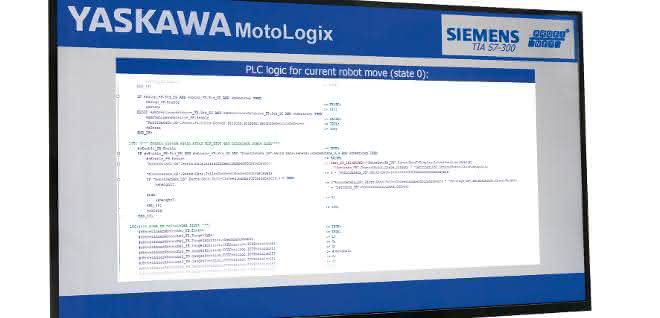
In plant engineering, there are often many PLC programmers, but only a few robot programmers, so there is a requirement to program the robot directly via PLC function blocks in your familiar PLC IEC programming environment (Siemens, Beckhoff, Rockwell, Yaskawa). This is possible with MotoLogix, an IEC-compliant PLC interface. From their experience with the graphically oriented PC and smartphone world, operators without a programming background increasingly find line-based programming "old school" and cumbersome and prefer the much more intuitive manual control of the robot or a smart counterpart.
Integrating robot programming into the digital process chain
If CAD data for the workpieces is available, CAD/CAM tools can be used to automatically generate robot paths using software and transfer them to the robot. Typical applications for this are milling, deburring, painting and additive processes such as WAAM or 3D printing. If planning tools such as offline simulation are used from the outset and virtual commissioning is to be supported with a digital twin of the robot, large parts of the robot program are generated in the virtual world and then loaded into the real robot. Suitable software tools at various performance levels (robot, cell, line or at a higher factory level) are offered by the robot manufacturers themselves or by third-party providers, whereby the robots and virtual controllers of leading robot manufacturers such as Yaskawa are available in the libraries of such tools.
The robot programs itself
If the position, location or number of workpieces is constantly changing, positions cannot be taught in advance. This is where sensor technology is used to guide the robot, such as 2D, laser-supported 3D image processing or force sensors. Thanks to intelligent pattern recognition and AI, image processing is increasingly able to handle parts that the robot has not seen before (pick & place, reaching into the box). Application examples for path processes include the automatic finding and guiding of welded or glued seams.
Cross-manufacturer programming environments and tools are often easy to use and offer the advantage of a uniform programming environment across many robot models from different manufacturers. However, compared to the robot manufacturer's standard solutions, they must be purchased and, if necessary, installed separately, so that the investment must be justified in terms of reduced programming time or flexibility compared to the robot manufacturer's on-board resources.
So every task has its optimal programming method, and none of the methods listed is so difficult that it cannot be learned within a few days of training. There are around 3 million industrial robots in operation around the world, and over 400,000 new ones are added every year. Every single one of them has been successfully programmed so far. And anyone involved in programming robots, whether newcomer or professional, will confirm that robot programming - with the right method - can also be fun.
Dr. Michael Klos, General Manager Business Development, Yaskawa Robotics Division
Yaskawa, www.yaskawa.eu.com


You might also be interested in
ebm-papst is growing again thanks to AI and data centers
ebm-papst returned to a growth trajectory in fiscal year 2025/26. Air Technology, data center applications, and artificial intelligence are driving revenue and investment.
 read more...
SPE on the Verge of a Market Breakthrough
Single Pair Ethernet (SPE) has moved beyond the conceptual phase and is increasingly being implemented in industrial settings. The focus here is not only on higher data rates and simplified cabling, but above all on the issue of system integration...
read more...More than 900 exhibitors already registered
Around six months before the start of the trade fair, more than 900 companies have registered for SPS 2026 in Nuremberg. The trade fair focuses on industrial AI, cyber security and digital transformation.
read more...Virtual PLCs in practice: How vPLCs make production systems more flexible and scalable
The increasing networking of IT and OT is fundamentally changing industrial automation. The IT/OT Integration Summit shows how modern technologies can make production environments more efficient, flexible and future-proof. The event will focus on...
read more...Sales growth in a turbulent market environment
Thanks to innovations and a focus on strategic industrial markets, Sick was able to moderately increase its sales in the 2025 financial year. In a turbulent market environment, the company was able to maintain its position and gain market share with...
read more...Siemens presents new AI agent
Siemens is launching 'Eigen Engineering Agent', an AI for automation technology. The solution is integrated into the TIA Portal, has been tested with over 100 companies and is designed to significantly accelerate engineering processes.
read more...Schaeffler keeps sales almost stable
Schaeffler generated revenue of EUR 23.5 billion in 2025 and increased EBIT before special items to EUR 936 million. At 266 million euros, free cash flow was significantly above the prior year and forecast. Net income remained negative due to high...
read more...Advancing artificial intelligence together
Helukabel is stepping up its activities in the field of artificial intelligence and is now a member of the IPAI. The innovation and collaboration platform for companies, research facilities, institutions and administration has set itself the goal of...
read more...New impetus for ifm sales
Two new positions were filled at ifm at the start of 2026: Markus Wolf becomes Managing Director Sales Germany, Sven Quant takes over the position of Central Managing Director in the Process Sensors division within the ifm Group.
read more...