
Movikit Robotics
SEW software simplifies robot control
The Movikit Robotics software module for the Movi-C modular automation system from SEW-Eurodrive has been enhanced with new functions to optimize communication between the robot kinematics.
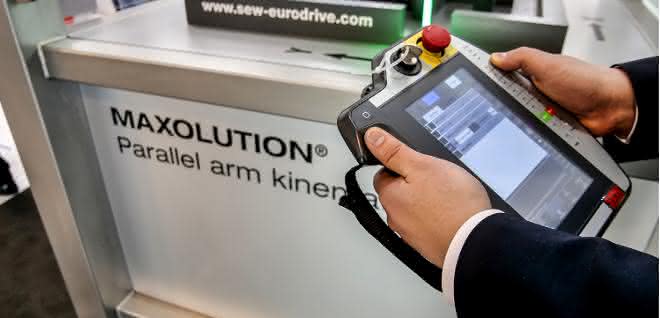
With the Movikit Robotics parameterizable software module, SEW-Eurodrive makes it easy to control universal robot kinematics; for example, when the worker quickly creates and edits robot programs without high-level language programming knowledge - even directly on the machine. SEW has now added new functions to the software module to make it easier to integrate the module into automation structures and open up additional possibilities.
TouchProbe measurement and distance-to-go positioning
The TouchProbe function enables an instruction to be triggered during a program by triggering a sensor or changing the state of a Boolean variable. The TouchProbe measurement outputs the Cartesian coordinates in the selected coordinate system. During distance-to-go positioning, the programmed path is continued by a certain length in the specified direction starting from the measured path point. If the length is greater than the programmed path, it is extended. The sensor can be connected to the inverter or directly to the Movi-C controller (e.g. via a digital input).
Time- and path-based path events
Path events are events that are triggered at a defined point on the robot's path or a defined time before or after reaching this point. For example, a glue application can be started and stopped at any point or the vacuum of a suction gripper can be switched on a certain time before reaching the end of the path. The path events switch independently of the processing of the robot program, i.e. the progress of the program pointer, at the parameterized position or the parameterized time before or after.
Standardized fieldbus interface
The standard profile can be used to move the robot along a path via a higher-level controller. The path is managed by the higher-level controller and transmitted to the software module. The interface and the corresponding, automatically generated robot program are permanently defined. The path is composed of path segments. Each path segment is defined by a target pose, an overtravel distance and a movement parameter set.
The track is run at the start. Further paths can then be transmitted and started. The path consists of movement sequences that are specified by the higher-level controller at runtime using path points and transfer areas. Various releases are used to control when the robot should perform which movement. The speed and acceleration with which the robot moves along these path segments is defined by preconfigurable motion parameter sets. The higher-level controller specifies the number of the movement parameter set to be used for each path segment. For example, data records can be defined for rapid traverse, creep traverse or gripping movements.
According to SEW, the software module is primarily used for handling applications such as picking, palletizing or transferring goods. It can be used in a variety of other areas, for example in plotter applications, adhesive applications or the positioning/cutting of food, the decoration of baked goods or the sorting of cutlery. as


You might also be interested in
Expanded range of products and services
Gear cutting specialist LMT Fette, a subsidiary of LMT Tools, is continuously expanding its range of products and services. New gear cutting tools, innovative solutions, additional production capacities and expanded know-how - including the...
 read more...
High performance in hardened steels
For the tough cases: Newly developed cutting material grade
Paul Horn GmbH has developed the new SG66 cutting material grade for turning processes involving workpieces with different hardness zones.
read more...Digitization - again?
In September, EMO in Hanover and Schweissen & Schneiden in Essen are two trade fairs for the metalworking industry that will focus on digitalization, among other things.
read more...Cutting solutions in 2D and 3D
Microstep showed 2D and 3D cutting solutions in action on sheet metal, tubes, profiles and container bases, including bevel cutting with plasma or waterjet and dynamic fiber laser cutting, as well as drilling, milling and marking demonstrations.
read more...Production, machine tools and robots
Support milling with tools and expertise
When outsourced manufacturing processes such as milling are brought back in-house, up-to-date skills and fresh expertise are often required.
read more...Welding solutions in the name of resource efficiency
At the Welding & Cutting trade fair in Essen (September 11-15), Fronius will be focusing on the major drivers in welding technology. Quality requirements are increasing in all industries, but the required welding specialists are scarce. In...
read more...Welding & Cutting 2023 brings digitalization to life
The world's leading trade fair Welding & Cutting is focusing on the advantages of the interaction between machines, humans, AI and software with an interactive rally. Under the motto "Get connected - get digital", it will connect participating...
read more...Transportation of sheet metal blanks
ACE industrial gas tension springs relieve the strain on blank grippers
Two medium-sized suppliers have joined forces to increase safety when designing a new blank gripper for the automotive industry.
read more...Precision mechanical engineering
Waterjet cutting in large format
With jet diameters down to 150 µm, micro waterjet cutting developed by the Swiss company Waterjet is more precise than the 800 µm technology commonly used in the industry.
read more...