
Service robot boom
Global sales figures increase by 32 percent to 11.2 billion US dollars
The sales value of professional service robots has risen by 32% to USD 11.2 billion worldwide (2018-2019). In the current year, the market is receiving further impetus from the COVID-19 pandemic.
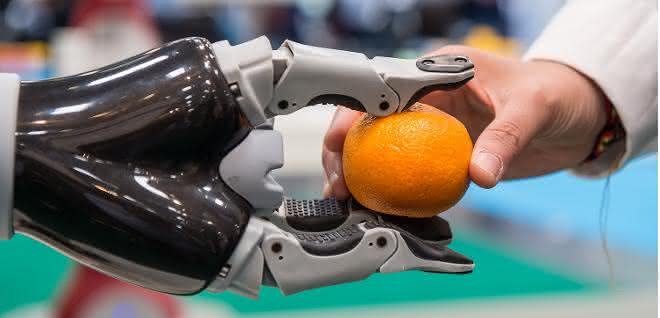
This is shown, for example, by the high demand for disinfection robots, logistics robots in factories and warehouses or robots for delivering goods to the front door. This is reported by the International Federation of Robotics (IFR) with the publication of the yearbook World Robotics 2020 - Service Robots.
The most profitable segment in professional service robots is medical robots, with a market share of 47% in 2019. This is mainly due to robot systems used in surgery, which achieve the highest individual prices. Sales of medical robots as a whole reached a new record of USD 5.3 billion - an increase of 28%. Around 90 percent of medical robots come from American and European suppliers. The IFR expects the market potential to remain high until 2022: turnover could more than double to 11.3 billion US dollars.
Logistics robots increasingly part of production
The market value of logistics robots sold or leased rose by 110% to 1.9 billion US dollars. Almost all of this turnover is generated with logistics robots that are intended for indoor use. Autonomous mobile robots initially only worked in warehouses. However, with digitalization, they are now increasingly becoming part of production in smart factories. The trend towards continued strong sales growth of 40% or more per year therefore seems possible.
"Investments in manufacturing processes with service robots for logistics pay off quickly," says Milton Guerry, President of IFR. "Assuming 24-hour operation, the investment pays for itself within two to three years - often much faster. With a service life of 15 years, the operating costs are around five percent of the annual investment. At the same time, sophisticated systems often offer operational availability in the region of 98 percent and more."
The trend is towards Robotics-as-a-Service (RaaS) business models, which lower the hurdles for customers to automate with robots. The advantage is that there is no need to invest in hardware. This means that companies are not burdened with fixed capital, fixed costs or additional personnel requirements. In non-manufacturing industries, the use of robotic logistics systems has been strongly driven by warehouse solutions for large e-commerce companies. There is strong potential in hospitals, which operate their logistics with the help of professional service robots. Around 90 percent of the logistics robots examined in the professional service robot segment are produced in Europe and North America - around ten percent in Asia.
Service robots for the home
Service robots for personal and domestic use are produced for a mass market - household robots achieve the highest sales figures. These include vacuum and floor cleaning robots, lawn mowers and entertainment robots. The total number of service robots for personal and domestic use rose by 34% to more than 23.2 million units sold in 2019. The sales value increased by 20% to USD 5.7 billion. Unit prices in the two main segments - robot vacuum cleaners and toy robots - have been falling for years. Simple vacuum robots already cost less than 100 US dollars today.
Three quarters of service robots for domestic use - vacuum cleaners, floor cleaners, lawn mowers and other household robots - were manufactured by American companies in 2019. Asian companies accounted for 19 percent - European companies for six percent.
Assistance robots for elderly or disabled people are also a growing market. The estimated sales value recently rose by 17% to 91 million US dollars. National research projects in many countries are already focusing on this enormous future market for service robots. In contrast to most entertainment robots, these assistants are genuine high-tech products.
"We assume that sales of professional and personal service robots will continue to grow strongly," says Milton Guerry.


You might also be interested in
"We are clearly different from the competition"
The IT company 21unity offers a range of hardware and software services, as well as traditional services. Andreas Mühlbauer spoke to Managing Director Anja I. Gondolf about the company's appearance at the Hannover Messe, its services and future...
 read more...
Think digital, act local
When it comes to industrial damping technology, on-site advice is often very valuable for engineers and designers.
read more...Plagiarius 2024 negative prize
On January 26, 2024, the Plagiarius campaign awarded its dreaded "Plagiarius" negative prize for the 48th time to manufacturers and retailers of particularly brazen counterfeits and fakes.
read more...Spindel Full Service records second-best...
Maintenance as an economic success factor
Spindel Full Service, the spindle repair specialist from Baden-Württemberg, can look back on its second-best financial year in its history - with 15% growth compared to the previous year. And the further forecast also looks good.
read more...Thyssenkrupp and Novelis cooperate
Platform for the circular economy
With a platform for the circular economy in the automotive industry, the two companies Thyssenkrupp Materials Services and Novelis want to set new standards for the recycling of used materials. The open platform will enable access to larger...
read more...How production can benefit from AI
Together with AI technology, IIoT networking makes it possible to better control machine parameters and optimize quality with predictive quality. Downtimes and set-up times can also be further minimized. Cloud platforms also make these technologies...
read more...Marco Ghirardello takes the lead
Fanuc has appointed Marco Ghirardello (48) as the new President and CEO of Fanuc Europe. Ghirardello succeeds Shinichi Tanzawa, who has led the company since 2016 and will take on a new role at Fanuc's headquarters in Japan.
read more...Efficient robot monitoring
Microchips are installed almost everywhere - whether in smartphones, washing machines or cars. With increasing digitalization, the demand for semiconductors has been growing rapidly in all areas of the economy for years.
read more...Everything on one platform
Functional and powerful tools are essential for professional work on the construction site, in the workshop or when carrying out repairs.
read more...