
MRK
Robots recognize gestures and facial expressions
The Fraunhofer Institute for Machine Tools and Forming Technology has developed a technology that makes working with large robots more intuitive. It enables robots to recognize gestures, faces and body postures.
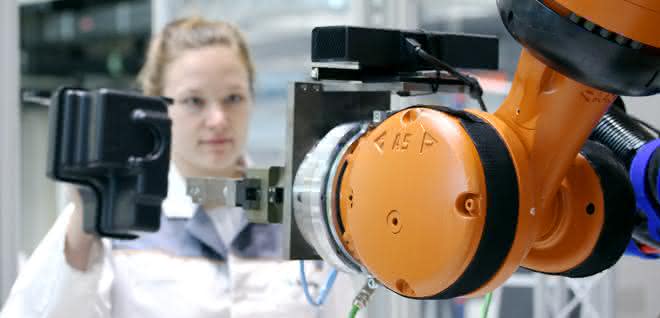
If you take a look at production halls, collaboration between humans and robots is commonplace. Or rather: working side by side. Although heavy-duty robots now work alongside their human colleagues without a safety fence, direct interaction is not possible. For safety reasons, the robot stops moving as soon as the human enters a large safety area around it.
Safe, effective and direct collaboration
A new type of technology from the Fraunhofer Institute for Machine Tools and Forming Technology IWU is now increasing the efficiency of this collaboration - and therefore of the entire production process. "We have added effective, safe and flexible interaction to the technology used to date," says Dr. Mohamad Bdiwi, Head of Department at Fraunhofer IWU. "For the first time, humans can communicate and cooperate directly with heavy-duty robots."
In production, this cooperation looks like this: When a person enters the work area around the robot, the robot recognizes their gestures, face and posture. The data is used to ensure safe collaboration and also for control purposes. For example, humans can give their metal colleague work orders using hand and arm gestures - the robot analyzes even complex movements. "Our technology brings gesture control to the industrial sector. Until now, it has primarily been used in gaming environments, such as consoles," adds Bdiwi.
In addition to the human's hands, the robot also keeps an eye on their face: if the human looks to the side or back because they are talking to a colleague standing there, for example, the machine knows that the arm movements are not directed at them. Humans and robots can work together directly and also pass workpieces or tools to each other. If the worker's hand is too close to his or her face, so that a handover would be dangerous, the robot recognizes this and waits until the worker extends his or her hand far enough. At the heart of this human-robot interaction are intelligent algorithms and 3D cameras that serve as the robot's "eyes". as


You might also be interested in
Basler acquires 76% of Indian image processor
Basler, supplier of image processing components for computer vision solutions, has acquired 76% of the Indian sales partner Alpha TechSys Automation.
 read more...
Process monitoring and fault detection
Cameras ensure quality during laser melting
Powder bed-based laser melting (PBF-LB/M) opens up new possibilities in additive manufacturing. Modern camera systems provide crucial process data to further increase quality and efficiency.
read more...Vision Sensor is three times faster than its predecessor
The 'CS-62' vision sensor from di-soric is around three times faster than its predecessor, the 'CS-60'. In combination with the 'nVision-i 25.1' software, it enables image processing solutions that were previously reserved for smart cameras.
read more...Thermal imaging cameras for quality control
Automated thermal imaging cameras are often suitable for quality control applications where temperature plays a role. However, while there are various solutions on the market for slow processes, it is challenging to select a camera that reliably...
read more...Easy entry into industrial VGA thermography
Reliable temperature measurement is a prerequisite for the success of many industrial processes. Berlin-based manufacturer Optris presents the Xi 640 infrared camera, a new member of its Compact Line, which enables non-contact temperature...
read more...Powder bed-based laser melting optimized
Aconity3D has set itself the goal of optimizing the stability of the manufacturing method of powder bed-based laser melting and thereby promoting its use in a wide range of industries. By using high-speed industrial cameras from SVS-Vistek, the...
read more...INDUSTRIAL Production Products of the year...
2nd place, category handling, assembly and production logistics: SICK
safeVisionary2 is the first 3D time-of-flight camera with Performance Level c safety certification. It enables safe three-dimensional environmental detection and won 2nd place in the competition for Product of the Year 2024 in the handling, assembly...
read more...Nomination Products of the Year 2024
SICK: Camera systems safeVisionary2
safeVisionary2 is the first 3D time-of-flight camera with Performance Level c safety certification. It enables safe three-dimensional environmental detection and has been nominated in the 2024 Product of the Year competition in the handling,...
read more...AI vision brings additional opportunities
The seamless integration of AI into the consumer sector has helped to improve our quality of life and make interactions with technology more efficient. In industry, AI vision with machine learning opens up new possibilities that are not covered by...
read more...