
Cobots and AI
Robots learn assembly
For many companies, especially small and medium-sized ones, the widespread use of robots in assembly or quality assurance is not easy to calculate. Even inexpensive robots require too much effort and are too inflexible. New control systems promise a remedy.
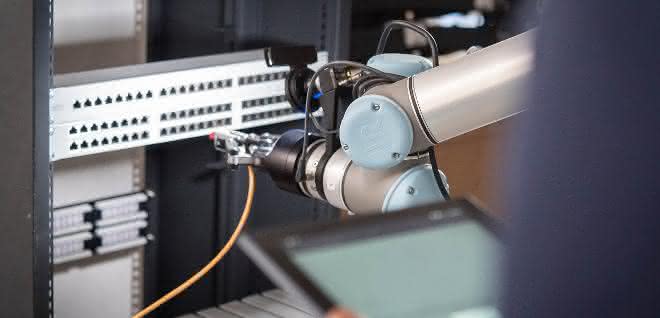
A classic example: a large brand, perhaps for household appliances, asks a small supplier: "Can you make this part for a new product of ours?" The supplier says yes, makes a sample, wins the order and sets up a few tables on which the part is assembled. The company doesn't have much to lose at the beginning, the investment remains manageable. Over the years, sales of the part grow and the assembly tables are busy. However, it becomes increasingly difficult to deliver consistent quality as the quantities increase, and the most reliable employees would be better employed on new products.
A large company would automate in such a situation. A supplier, however, is dependent on an end product whose success it has little influence on and therefore does not have the planning horizon of its customers. For a small company, the use of a robot in assembly therefore seems almost unthinkable. Not only does the hardware have to be purchased, it also needs to be programmed and put into stable operation. Last but not least, the knowledge about the application must remain available in case of malfunctions.
The biggest problem, however, is that nothing upstream of the assembly station in the value stream is "robot-compatible": there are trolleys for the material and the preliminary products have manufacturing tolerances that human employees don't even notice, but which are an insurmountable obstacle for robots. It would be enormously expensive to design the material feed so precisely that robots could cope with it. Workpiece carriers and precisely manufactured devices would have to be built or even constructive changes made to pre-products.
Robots themselves, at least for payloads of ten kilograms or less, have now become affordable and increasingly easy to program. Companies often get surprisingly far with a first test cobot and a little time for experimentation for a young employee. Anyone who has a little design know-how in the company and can produce small items such as fingers for an electric gripper themselves even has a chance of getting by without a system integrator.
However, the problem with precision remains: If the material is fed with tolerances in shape or position, or if it has to be inserted into a machine that doesn't always stay the same, it doesn't help that the robot is easy to program. If it is to work at all, a camera must be used to measure the workpiece.
AI-driven control instead of measurement
An alternative to measuring a situation or workpiece is AI-driven real-time control. This does not attempt to give a camera an error-prone pattern that it should find once in the image during measurement. Instead, a neural network searches for the features relevant to the correct movement itself and uses these features to continuously guide the robot through its path. Employees can generate the actual positioning capability even without AI knowledge. To do this, the robot only needs to be shown the target a few times in typically occurring variants. The AI controller derives a kind of movement intuition for the robot from camera images and the positions shown, which enables it to deal with unfamiliar situations.
With such an option, the automation of manual workstations, for example in assembly - as in the scenario outlined above - is within the realm of possibility. The costs for robots, tools and AI control are within the financial framework for projects that have to pay for themselves after just a few months, and system integration is not a big deal. Only the workstation needs to be changed and not the entire production process needs to be made robot-compatible. Small robots can also often be used in different locations or only temporarily. Since the AI controller can also learn as many skills as are needed, such robot configurations can be used very flexibly.
Today, such systems are mainly installed for handling, assembly or testing tasks such as inserting injection-moulded parts into devices for printing, attaching springs, removing metal parts for weighing, filling holes in unknown locations or testing the tightness of solder joints. Special tools are used on the robot for all of these applications; the machine and the AI control system can be configured by the operator on site for the respective tasks and tools.
The field is developing rapidly
The use of AI in industrial robotics is in its infancy. In the not too distant future, it will be even easier to transfer movement expertise from humans to robots. AI, cameras and force sensors are to robots what touchscreens were to cell phones: the natural way to tell them what you want them to do.
Ronnie Vuine, CEO of Micropsi


You might also be interested in
Basler acquires 76% of Indian image processor
Basler, supplier of image processing components for computer vision solutions, has acquired 76% of the Indian sales partner Alpha TechSys Automation.
 read more...
Process monitoring and fault detection
Cameras ensure quality during laser melting
Powder bed-based laser melting (PBF-LB/M) opens up new possibilities in additive manufacturing. Modern camera systems provide crucial process data to further increase quality and efficiency.
read more...Vision Sensor is three times faster than its predecessor
The 'CS-62' vision sensor from di-soric is around three times faster than its predecessor, the 'CS-60'. In combination with the 'nVision-i 25.1' software, it enables image processing solutions that were previously reserved for smart cameras.
read more...Thermal imaging cameras for quality control
Automated thermal imaging cameras are often suitable for quality control applications where temperature plays a role. However, while there are various solutions on the market for slow processes, it is challenging to select a camera that reliably...
read more...Easy entry into industrial VGA thermography
Reliable temperature measurement is a prerequisite for the success of many industrial processes. Berlin-based manufacturer Optris presents the Xi 640 infrared camera, a new member of its Compact Line, which enables non-contact temperature...
read more...Powder bed-based laser melting optimized
Aconity3D has set itself the goal of optimizing the stability of the manufacturing method of powder bed-based laser melting and thereby promoting its use in a wide range of industries. By using high-speed industrial cameras from SVS-Vistek, the...
read more...INDUSTRIAL Production Products of the year...
2nd place, category handling, assembly and production logistics: SICK
safeVisionary2 is the first 3D time-of-flight camera with Performance Level c safety certification. It enables safe three-dimensional environmental detection and won 2nd place in the competition for Product of the Year 2024 in the handling, assembly...
read more...Nomination Products of the Year 2024
SICK: Camera systems safeVisionary2
safeVisionary2 is the first 3D time-of-flight camera with Performance Level c safety certification. It enables safe three-dimensional environmental detection and has been nominated in the 2024 Product of the Year competition in the handling,...
read more...AI vision brings additional opportunities
The seamless integration of AI into the consumer sector has helped to improve our quality of life and make interactions with technology more efficient. In industry, AI vision with machine learning opens up new possibilities that are not covered by...
read more...