
Robot cleaning system
Robot in full wash cycle
Automatic washing cell. A Kuka robot from the KR Quantec Foundry family is installed in a washing cell at a car manufacturer in southern Germany. There it feeds components to the cleaning nozzles for cleaning with millimeter precision.
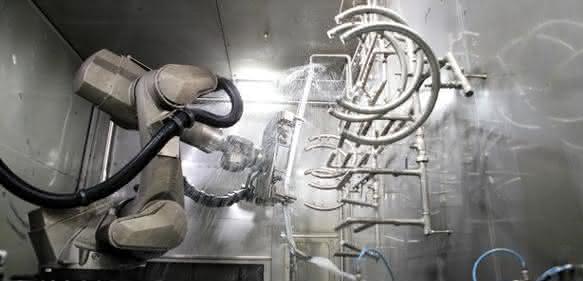
Robots are an integral part of automotive production. A Kuka robot at the BMW plant in Dingolfing is used in an environment in which other industrial robots can no longer work. The KR 120 R2100 nano F exclusive machine is located in a washing cell and is exposed to cleaning media with chemical additives, high temperatures and high cleaning pressures. This type of robot is specially designed for the extreme conditions in such washing systems. Cleaning media, high humidity and chemical additives cannot harm it.
Interlinking the washing cell with production
The robot feeds components, which are installed in the roof body in various vehicle models, to the nozzle holders for cleaning from forming media and dirt particles that can occur during the production process. The robot was integrated into the washing cell by Schnupp, a company based in Bogen in Lower Bavaria that specializes in plant and mechanical engineering and equips its customers in the processing industry and automotive manufacturers with complete solutions in areas such as automation and hydraulics. WK Systemtechnik was commissioned to design and implement the washing cell. The challenge during implementation was to integrate the robot washing cell into the robot interlinking. Due to the space available, it was not possible to install a continuous cleaning system.
In the first step, the KR Quantec nano F exclusively picks up the component from the inlet with a special multiple gripper. In step two, the cavity of the component is cleaned. To do this, the robot feeds it to the internal cleaning system with millimeter precision. After the first cleaning step, the component is moved on to the cleaning nozzles. This is where the external cleaning takes place. The interior of the component is then neutralized by a DI rinse. In the final step, the robot, which holds the component in the specified position during the entire washing process, places it on the outfeed transport unit. Before it is moved out of the washing cell, it is also rinsed on the outside.
Not orange this time for a good reason
The environment in which the robot carries out its work is not usually suitable for industrial robots, as the machines are exposed to large quantities of water to which three percent alkaline cleaning agents are added. In addition, temperatures of 60 degrees Celsius and more prevail in the washing cell, which leads to considerable water vapor. Special protective measures are in place to ensure that the robot is not damaged by the external influences: The robot's mechanics are completely encapsulated. In addition, the interior of the mechanics is pressurized. The cable set is completely enclosed. The protective surface is also resistant to alkalis, acids, heat and corrosion, which means that the robot is not painted orange. With its devices, it fulfills the requirements of protection class IP69.
Other aspects that spoke in favor of the Kuka robot for this application are its high flexibility and fast cycle times. For example, it is possible to limit the duration of the entire washing process to 45 seconds and to process components of different sizes; this was only possible with this special robot design. Due to the small installation space, the freedom of movement of a conventional robot with a protective robot suit would not have been sufficient. pb


You might also be interested in
Helu makes its first trade fair appearance under a new brand name
Helu Kabel will be presenting itself as Helu for the first time at Hannover Messe 2026, showcasing system solutions, Heluchain cables and new industrial luminaires.
 read more...
Strategic realignment with brand relaunch
In future, Helukabel will trade as Helu
The Helukabel Group is parting with part of its name: in future, the company will only operate under the Helu brand. With this step, the specialist for electrical connection technology is underlining its strategic development from a classic cable...
read more...Modular plant construction for corrugated board
Insight into the production of corrugators at BHS Corrugated: Automated, modular and equipped with Helukabel components.
read more...Best quality for the steel
Conditions in the steel industry are harsh and inhospitable. The machines used must be able to withstand the demanding environmental conditions in order to deliver the best quality at all times.
read more...If the standard cable is not sufficient
Lapp offers cables for countless applications - but not for all of them. From time to time, the developers have to modify a standard cable or develop a special cable.
read more...Slight decline in sales, strong investments
The Lapp Group has not been spared from the weakening global economy. However, the company only recorded a slight loss in the past 2024 financial year.
read more...Electrical connection technology
Cables and wires for industrial automation
Heukabel offers system solutions for cable routing from a single source. The subsidiary EKD Systems specializes in tailor-made cable drag chains made of steel, stainless steel and plastic, which are used in moving machines and systems as well as in...
read more...Lapp relies on Ultramid from BASF
Mobile charging of electric vehicles
The automotive industry is currently undergoing the biggest transformation in its history. The boom in battery electric vehicles in particular is presenting the industry with major challenges. Lapp, as a supplier of cables and connection...
read more...Cable handling application
At this year's Motek, ArtiMinds Robotics is showcasing a robot-based automation solution for the sensor-assisted assembly of flexible cables in connector housings.
read more...