
Research project
Interactive robotic system for emptying sea containers
With the "Interactive Robotic System for Emptying Sea Containers" (IRiS) project, the Bremen Institute of Production and Logistics at the University of Bremen (BIBA) is working with BLG Handelslogistik, Schulz Systemtechnik and Framos as development partners to research the automated unloading of 40-foot standard containers. In future, intelligent robots will be used to automate this heavy and previously predominantly manual task.
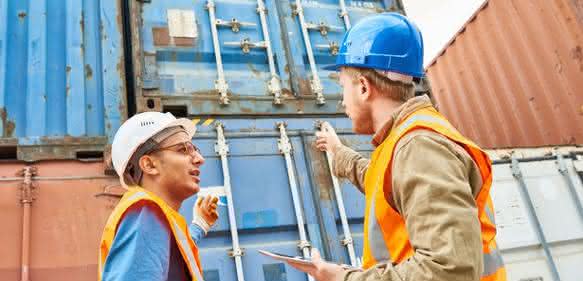
The majority of all sea containers shipped worldwide are loaded and emptied directly in the port. With a volume of 65 cubic meters and a payload of 26 tons, they can hold up to 1,800 parcels weighing up to 35 kilograms each. In the high-tech logistics chains, emptying these standard containers is one of the last non-automated processes. The high level of complexity and demanding packing and unloading scenarios have made fully automated unloading impossible to date. The aim of the IRiS project is to improve working conditions and increase the efficiency of handling processes at seaports. A mobile robot should be able to unload sea containers independently within a very short time and without any changes to the existing infrastructure.
The robot will move autonomously between the gates, drive into the container and have an innovative gripper system. With the help of machine learning methods, it can independently classify different packing scenarios and unload the containers optimally. Based on artificial intelligence, Framos is developing state-of-the-art methods within the IRiS project for reliable classification of packing scenarios and analysis of the container contents.
"Object recognition is based on 2D/3D image data. It uses state-of-the-art image processing methods and combines these with machine learning, such as deep learning," explains Dr. Simon Che'Rose, Head of Development at Framos. "This enables the system to recognize whether a container can be unloaded fully automatically or whether manual control of the robot is required in special situations. The position and orientation of the contents are fully analyzed in advance and enable optimal planning of the unloading process."
Human-machine interfaces enable simple and agile interaction between robots and employees as well as intuitive monitoring and control of one or more robots. Employees can monitor the robots from a control station at any time and intervene quickly and without programming knowledge in the event of faults. This minimizes the risk of cost-intensive system downtimes. A prototype is due to be completed as early as 2019 and will demonstrate what reliable cooperation between man and machine in the unloading of sea containers can look like. All development partners in the IRiS project are thus focusing on relieving the burden on port workers, reducing unloading times and maximizing handling capacity. Framos' machine learning technology is based on self-learning 3D algorithms and innovative sensor technology, including Intel RealSense technology, which is used in the IRiS project. The 3D cameras and depth modules as well as the intelligent algorithms developed by Framos can be applied to a wide range of scenarios in all industrial sectors. The detection, measurement and analysis of situations and objects using artificial intelligence and 3D technology supports industrial automation and robotics, quality control, security and surveillance as well as innovative solutions in the field of autonomous vehicles, drones and new consumer solutions. sw


You might also be interested in
Basler acquires 76% of Indian image processor
Basler, supplier of image processing components for computer vision solutions, has acquired 76% of the Indian sales partner Alpha TechSys Automation.
 read more...
Process monitoring and fault detection
Cameras ensure quality during laser melting
Powder bed-based laser melting (PBF-LB/M) opens up new possibilities in additive manufacturing. Modern camera systems provide crucial process data to further increase quality and efficiency.
read more...Vision Sensor is three times faster than its predecessor
The 'CS-62' vision sensor from di-soric is around three times faster than its predecessor, the 'CS-60'. In combination with the 'nVision-i 25.1' software, it enables image processing solutions that were previously reserved for smart cameras.
read more...Thermal imaging cameras for quality control
Automated thermal imaging cameras are often suitable for quality control applications where temperature plays a role. However, while there are various solutions on the market for slow processes, it is challenging to select a camera that reliably...
read more...Easy entry into industrial VGA thermography
Reliable temperature measurement is a prerequisite for the success of many industrial processes. Berlin-based manufacturer Optris presents the Xi 640 infrared camera, a new member of its Compact Line, which enables non-contact temperature...
read more...Powder bed-based laser melting optimized
Aconity3D has set itself the goal of optimizing the stability of the manufacturing method of powder bed-based laser melting and thereby promoting its use in a wide range of industries. By using high-speed industrial cameras from SVS-Vistek, the...
read more...INDUSTRIAL Production Products of the year...
2nd place, category handling, assembly and production logistics: SICK
safeVisionary2 is the first 3D time-of-flight camera with Performance Level c safety certification. It enables safe three-dimensional environmental detection and won 2nd place in the competition for Product of the Year 2024 in the handling, assembly...
read more...Nomination Products of the Year 2024
SICK: Camera systems safeVisionary2
safeVisionary2 is the first 3D time-of-flight camera with Performance Level c safety certification. It enables safe three-dimensional environmental detection and has been nominated in the 2024 Product of the Year competition in the handling,...
read more...AI vision brings additional opportunities
The seamless integration of AI into the consumer sector has helped to improve our quality of life and make interactions with technology more efficient. In industry, AI vision with machine learning opens up new possibilities that are not covered by...
read more...