

Research
Virtual world conquers production
Virtual world conquers production. Fraunhofer IPA offers solutions for various stages of the industrial value chain.
The Fraunhofer IPA in Stuttgart, for example, realistically implements material flow simulations. Mobile robots, which are networked with each other via the cloud, map their environment cooperatively and plan their routes with the help of the virtual image of production (digital shadow). Spontaneously occurring obstacles are avoided with a predefined safety distance without causing traffic jams or collisions.
Reaching into the box is getting better and better
Automated handling technology is also becoming increasingly efficient. Felix Spenrath's team is working on the bp3 software, which forms the basis of the successful grip-in-the-box, and is developing it further. Thanks to improved algorithms and new sensor technology, industrial robots can now even recognize and grip flat, unsorted sheet metal parts. The information provided by modern 3D sensors is therefore optimally utilized. The intuitive user interface simplifies and speeds up programming to such an extent that the investment costs for a handling cell are amortized after just two years.
Machine learning is currently being used to further refine object recognition and the separation of disordered components. A virtual learning environment is currently being created in the "Deep Grasping" research project. In this environment, robots practise different gripping processes on the workpieces they will later work with during operation before they are commissioned. Neural networks learn from these simulated grasps and thus continuously improve their process knowledge.
Software drag&bot simplifies robot programming
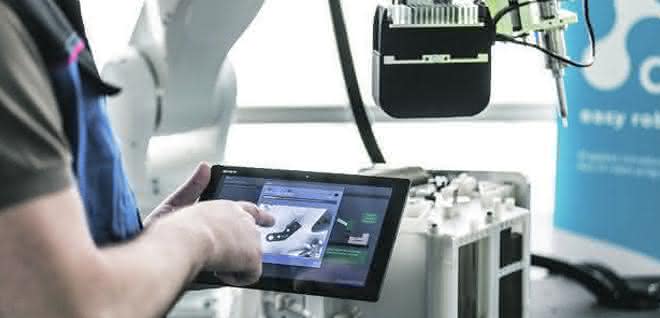
Robots are rarely used in small and medium-sized companies. The reason: the manufacturer-specific programming languages are complex; external specialists usually have to be commissioned to introduce a robot to new tasks. In times of intuitively operable smartphones and tablets, however, such time-consuming and cost-intensive robot programming is no longer progressive, say the researchers at Fraunhofer IPA. They have developed the drag&bot software, which reduces the programming effort to a minimum. drag&bot provides ready-made program modules that can be quickly and intuitively combined into complex robot applications via a graphical user interface. In addition, operating and input aids simplify the parameterization of the modules. This means that expert knowledge is no longer required to reprogram robots from different manufacturers.
ROS-Industrial: Open source software in industrial quality
Thanks to a reusable software infrastructure, the Robot Operating System (ROS) makes it easier to create software for both robots and robot systems that perform complex tasks. Standardized interfaces are also a major simplification. This is because ROS puts all robotics on a common basis - just like Linux for computers or Android for smartphones. End users and system integrators do not have to keep developing complex functions from scratch, as these are provided by the open source software ROS - especially in the areas of mobile navigation, gripping and robot motion planning, simulation and image and sensor processing. A growing number of highly developed software components are freely available and now meet the quality requirements of the industry. Others are grouped by the developers into extensive libraries that incorporate their experience from many different research and industrial projects. ROS-Industrial is an initiative that is managed in Europe by Fraunhofer IPA and promotes the technology transfer of ROS into the industrial environment.
An "e-bike to put on"
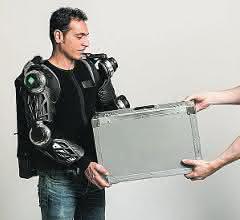
The IPA researchers want to help relieve the physical strain on employees in production. This can be achieved with the exo-jacket presented, an upper body exoskeleton. It provides the wearer with additional strength without restricting them. The developers have integrated drive modules at the elbows and shoulders that support movements with high torque. Impedance control using pressure sensors in the arm shells ensures that the exoskeleton moves smoothly. An articulated chain with five axes of rotation is attached to the shoulder section. The chain follows the shoulder joint group in every position. The drive element is therefore always positioned where the shoulder is. This enables complex movements in three directions: upwards, backwards and inwards. Even overhead installations can be managed in this way. The modules only become active when they are actually needed. In the medium term, the Stuttgart-based developers want to develop a module box for different areas of application. A motion data-supported development and simulation workflow is being set up for this purpose. pb


You might also be interested in
ESTIA aims to strengthen Europe's cloud
New tech alliance for EU sovereignty
Twelve companies, including Dassault Systèmes, are founding the European Sovereign Tech Industry Alliance (ESTIA). The initiative aims to strengthen Europe's technological independence and define requirements for sovereign cloud services. The start...
 read more...
Deutsche Telekom and Nvidia launch one of Europe's largest AI factories
With the Industrial AI Cloud in Munich, Deutsche Telekom and NVIDIA are creating one of the largest AI factories in Europe. Companies can train AI models, carry out simulations and access 10,000 GPUs.
read more...Leveraging data potential with AI and streaming
Huge data treasures are still lying dormant in many manufacturing companies. And yet it is high time that these treasures were unlocked. There is often a lack of resources and capacity to make data usable in real time. Streaming production data can...
read more...More awareness of noise
Dematic offers solutions that are tailored to different cloud environments and reduce environmental impact through reduced material consumption and improved energy efficiency.
read more...Generative AI in the automation environment
The mechanical engineering and automation industry is undergoing profound change. This transformation is being driven by more volatile global trade, geopolitical crises and increasing market pressure, which demands greater agility, technological...
read more...Rigid data structures have had their day
The traditional data center is no longer the center of data. A hybrid cloud storage approach enables manufacturing companies to both meet the current requirements of data-intensive processes and future-proof their infrastructure.
read more...Software as a service in three stages
CIM Database Cloud is a new out-of-the-box solution from Contact for end-to-end digital product development.
read more...How production can benefit from AI
Together with AI technology, IIoT networking makes it possible to better control machine parameters and optimize quality with predictive quality. Downtimes and set-up times can also be further minimized. Cloud platforms also make these technologies...
read more...More expertise for digital engineering
Altair, a computational science and artificial intelligence (AI) company, has acquired OmniV, a technology from Michigan, USA-based software company XLDyn.
read more...