
EU research project Spirit
Profactor researches inspection robots without programming
The research company Profactor has landed the three-year EU research project Spirit. Together with eight partners from science and industry, the aim is to develop a new generation of inspection robots that can be used without programming.
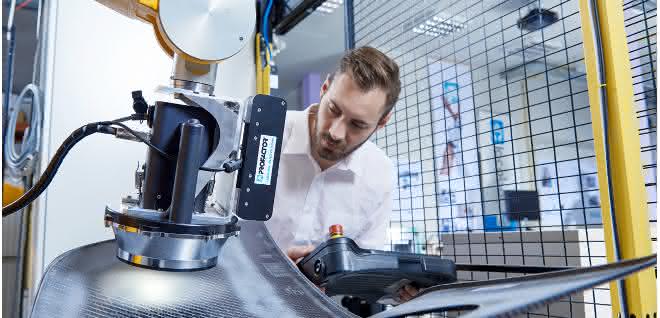
"The aim of the project is clear: to move away from time-consuming and expensive programming and towards simply configuring a task for the machine," says Christian Eitzinger. He heads the Machine Vision department at Profactor. The company has experience with both industrial image processing for quality control and robotics. In recent years, Profactor has dedicated itself to linking inspection and robotics. This includes the Thermobot project, in which crankshafts, for example, are inspected robotically. The challenge with components with complex geometries is path planning for the robot. It must guide the sensor in such a way that the entire surface of the component is detected.
Path planning is also highly dependent on the sensor technology used. Eitzinger: "A time delay is essential for heat flow thermography, but this is irrelevant for X-ray technologies, where the requirements for the sensor-guiding robot are completely different to those for cameras used for surface inspection, for example."
Surface inspection, crack detection, completeness check
The Spirit project aims to develop a robot that can be equipped with different inspection systems: Cameras for surface inspection, thermal imaging cameras for crack inspections, X-ray sensors, 3D sensors for completeness checks. Eitzinger: "We are developing the software that enables the robot to automatically plan the path for each of these different inspection tasks." The system is simply fed with the CAD data of the work cell - to avoid collisions - and the CAD model of the component and automatically calculates the path for the robot depending on the sensors and inspection task."
At industry partner Centro Ricerche Fiat, the component is even allowed to move during the test. In this specific case, it is an engine on the assembly line, where a 3D completeness check verifies that plugs, cables and hoses have been assembled correctly and completely.
In addition, the system should be able to react to necessary optimizations in real time using reactive path planning. This is the case if the CAD model deviates from the actual component - due to deformations, for example. This also includes the optimization of the sensor position - for example, in the X-ray inspection of honeycomb structures or similar inside a component.
Although the industrial partners in the research project are well-known corporations, the system is ultimately intended to benefit those companies - including small and medium-sized ones - that cannot afford automation due to small batch sizes and the often expensive programming of robots. as


You might also be interested in
Helu makes its first trade fair appearance under a new brand name
Helu Kabel will be presenting itself as Helu for the first time at Hannover Messe 2026, showcasing system solutions, Heluchain cables and new industrial luminaires.
 read more...
Strategic realignment with brand relaunch
In future, Helukabel will trade as Helu
The Helukabel Group is parting with part of its name: in future, the company will only operate under the Helu brand. With this step, the specialist for electrical connection technology is underlining its strategic development from a classic cable...
read more...Modular plant construction for corrugated board
Insight into the production of corrugators at BHS Corrugated: Automated, modular and equipped with Helukabel components.
read more...Best quality for the steel
Conditions in the steel industry are harsh and inhospitable. The machines used must be able to withstand the demanding environmental conditions in order to deliver the best quality at all times.
read more...If the standard cable is not sufficient
Lapp offers cables for countless applications - but not for all of them. From time to time, the developers have to modify a standard cable or develop a special cable.
read more...Slight decline in sales, strong investments
The Lapp Group has not been spared from the weakening global economy. However, the company only recorded a slight loss in the past 2024 financial year.
read more...Electrical connection technology
Cables and wires for industrial automation
Heukabel offers system solutions for cable routing from a single source. The subsidiary EKD Systems specializes in tailor-made cable drag chains made of steel, stainless steel and plastic, which are used in moving machines and systems as well as in...
read more...Lapp relies on Ultramid from BASF
Mobile charging of electric vehicles
The automotive industry is currently undergoing the biggest transformation in its history. The boom in battery electric vehicles in particular is presenting the industry with major challenges. Lapp, as a supplier of cables and connection...
read more...Cable handling application
At this year's Motek, ArtiMinds Robotics is showcasing a robot-based automation solution for the sensor-assisted assembly of flexible cables in connector housings.
read more...