
Palletizing robots
Please put the boxes on the pallet, James
Palletizing with collaborative robotics. At Gustav Hensel, a manufacturer of electrical installation and distribution solutions, a robotic arm from Universal Robots palletizes 1,200 packaging units per shift. In this way, the family business is increasing its process efficiency and at the same time freeing employees from this physically demanding task.
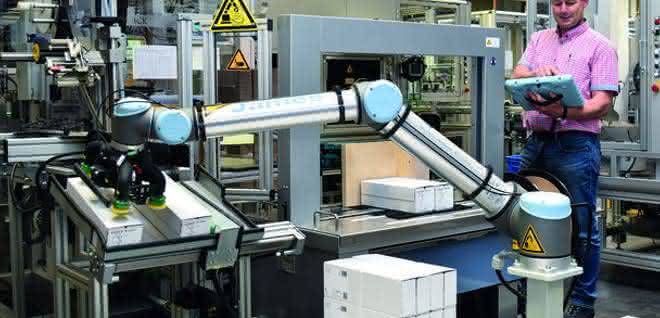
Gustav Hensel is a medium-sized family business based in Lennestadt with around 550 employees in Germany. In order to maintain high product quality and remain competitive in the face of global competition, the company manufactures according to the lean principle. Christoph Kaiser, Head of Plastics Production at Hensel, knows that it is crucial to deploy the workforce specifically for high-quality activities. This is only possible with automation.
In the production of cable junction boxes, huge amounts of man-hours were spent every day on palletizing packaging units. There was potential for optimization here, Hensel thought, and shortly afterwards became aware of the collaborative robots from Universal Robots at a trade fair. They met the company's clear requirements: the palletizing robot had to be able to be accessed directly at all times and a combination of reach and payload had to be optimally adapted to the packaging system. Kaiser adds: "Our aim was not to replace the employees, but to create more capacity for higher-value activities."
Together with UR partner Dahl, Hensel launched the "First Cobot" project in spring 2017. Due to its payload capacity of ten kilograms and its reach of 1.3 meters, the company opted for the largest robot model from Universal Robots: the UR10. "When the robot has to place the packaging units right at the bottom of a pallet, its extensive working radius is extremely important," explains Kaiser. The completion of its risk assessment also played an important role in the implementation of the UR10. Once this had been successfully completed, the robot arm can work in the immediate vicinity of its human colleagues without any protective housing. This is based on the patented safety systems of the Danish robotics pioneer.
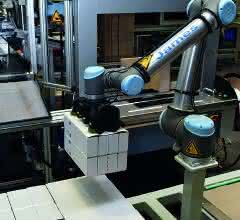
Overall, the integration of the UR10 at Hensel only took a few days. André Gödde, Sales Manager at Dahl, reveals: "Before we put a robot arm from UR into operation at our customers, we put the application through its paces in our own factory. This allows us to react quickly if, for example, motion sequences need to be optimized." On average, installation at the customer's premises is completed in one to two days.
At Hensel, the UR robot works in two-shift operation as the last component in a complex, fully automated system consisting of assembly and packaging machines for the production of cable junction boxes. Equipped with a suction gripper custom-made by Dahl, it palletizes around 1,200 packaging units per eight-hour shift. To do this, the system provides the robot arm with the packaged products in two boxes at a time. In a first step, the UR10 picks up the two packages and places them in a strapping machine. Once it has placed another pair of packages there for bundling into a four-unit, the machine straps them. The robot arm then stacks the cardboard bundles on a Euro pallet. "The UR10 lifts just under ten kilograms during this last process, which means we make full use of its load capacity," explains Kaiser.
To further increase efficiency, Hensel provides the UR robot with two Euro pallets. When one of them is full, the UR10 automatically continues stacking at the other pallet location. Kaiser is satisfied: "The employee then only has to move the full Euro pallet out, prepare the next one for the UR robot and continue. This allows us to achieve perfect utilization of the application overall." Furthermore, the robot arm can be reprogrammed for different package sizes in the system in under three minutes with just a few clicks. It can move four different carton sizes as required.
Optimizing the production process from injection moulding to palletizing is only one side of the coin. Another decisive factor is the noticeable reduction in workload for the workforce thanks to the UR10. Kaiser reports: "Around 2.5 tons of packages had to be moved per shift. Our employees are incredibly happy that the UR robot now relieves them of the stressful and monotonous stacking." Without further ado, the robot arm was christened James by its human colleagues. "Like the British butler who is always at our service," laughs Kaiser.
The company involved the workforce in the cobot project right from the start. First, two production employees completed the Universal Robots Academy in the visual classroom - an online training course that teaches basic robot programming skills interactively. Dahl then taught the users more in-depth robotics know-how in a further one-day training course.
In day-to-day production, two shift workers at Hensel interact directly with James. If interruptions occur, for example, they can simply deal with them themselves. If someone accidentally bumps into the robot arm and the UR's integrated safety stop function kicks in, the colleagues can restart it with just two clicks on the teach panel. The UR10 is designed to continue its normal cycle smoothly afterwards. While the UR10 is constantly palletizing, the employees are working more intensively on optimizing the assembly systems themselves, which increases overall productivity in the production of cable junction boxes.
Hensel will soon launch the "second cobot" project at the nearby branch plant in Würdinghausen. From autumn 2018, a new robot colleague will support the workforce there not only in palletizing, but also in the quality inspection of membranes. as


You might also be interested in
Helu makes its first trade fair appearance under a new brand name
Helu Kabel will be presenting itself as Helu for the first time at Hannover Messe 2026, showcasing system solutions, Heluchain cables and new industrial luminaires.
 read more...
Strategic realignment with brand relaunch
In future, Helukabel will trade as Helu
The Helukabel Group is parting with part of its name: in future, the company will only operate under the Helu brand. With this step, the specialist for electrical connection technology is underlining its strategic development from a classic cable...
read more...Modular plant construction for corrugated board
Insight into the production of corrugators at BHS Corrugated: Automated, modular and equipped with Helukabel components.
read more...Best quality for the steel
Conditions in the steel industry are harsh and inhospitable. The machines used must be able to withstand the demanding environmental conditions in order to deliver the best quality at all times.
read more...If the standard cable is not sufficient
Lapp offers cables for countless applications - but not for all of them. From time to time, the developers have to modify a standard cable or develop a special cable.
read more...Slight decline in sales, strong investments
The Lapp Group has not been spared from the weakening global economy. However, the company only recorded a slight loss in the past 2024 financial year.
read more...Electrical connection technology
Cables and wires for industrial automation
Heukabel offers system solutions for cable routing from a single source. The subsidiary EKD Systems specializes in tailor-made cable drag chains made of steel, stainless steel and plastic, which are used in moving machines and systems as well as in...
read more...Lapp relies on Ultramid from BASF
Mobile charging of electric vehicles
The automotive industry is currently undergoing the biggest transformation in its history. The boom in battery electric vehicles in particular is presenting the industry with major challenges. Lapp, as a supplier of cables and connection...
read more...Cable handling application
At this year's Motek, ArtiMinds Robotics is showcasing a robot-based automation solution for the sensor-assisted assembly of flexible cables in connector housings.
read more...