
Metal processing
Handling in the sintering furnace
Martin Mechanic has developed a robot-controlled solution for sintering carbide indexable inserts. The customer ordered two more when the first system was accepted.
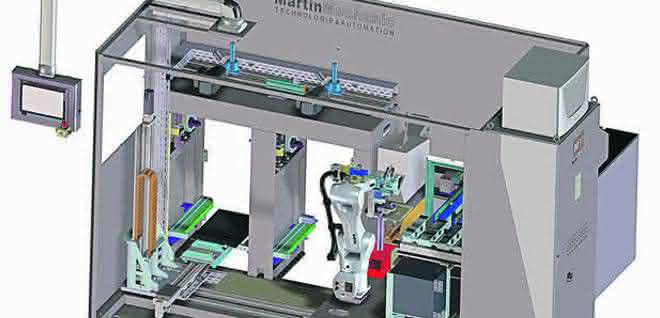
The MOB242306 can even be moved on its four heavy-duty rollers to provide enough space for servicing the sintering oven or changing the chain belt. It should be noted that the system weighs 2.5 tons with a footprint of ten square meters. A pan was firmly anchored to the floor so that it can find its way back to its starting position. The four cones attached to the work cell fit exactly into the corresponding openings.
The indexable inserts are delivered on 400 x 300 millimeter ceramic plates. For this purpose, a 1.20 meter high supply trolley is loaded with 40 ceramic inserts, which are always placed next to each other in pairs. Each ceramic plate is loaded with 48 indexable inserts measuring ten by 20 millimetres. The cycle time per ceramic plate provided is ten seconds. After delivery, the worker first scans the batch and material numbers from the production order. He then pushes two transport trolleys into the work cell. They are centered and lifted so that the three-axis gantry can safely remove the ceramic plates and place them on the staging area. A motor drives a ball screw for this purpose.
The Kuka KR10R1100 six-axis robot picks up two ceramic plates at a time with its vacuum double gripper to transport them to the transfer table and place them next to each other. To do this, it works its way up the transport carriage from bottom to top. Six capacitive sensors in the removal gripper check whether the robot has actually picked up all the ceramic plates.
On the transfer table, each panel is fitted with four spacer sleeves, which are fed in via a vibratory conveyor. They are fed to the robot via a hose and placed on the ceramic plates. For fast feeding, the hopper was positioned close to the robot at a height of 1.60 meters. A concave mirror above the hopper shows the worker when he needs to refill.
The spacer sleeves are 20 millimetres long and have a diameter of 15 millimetres, which is also checked. They ensure that there is sufficient space between the ceramic plates, four of which are always stacked on top of each other. If the spacer sleeves are too short or too long, they are automatically sorted out. Finally, a ceramic cover is placed on top of both stacks. The robot removes this empty plate from a drawer with a telescopic pull-out, which is regularly refilled by the worker. Once both transfer tables are fully loaded, which is the case every 80 seconds, they are automatically transported out of the system and over the chain conveyor of the oven. The transfer table now lowers to place both ceramic stacks on the accumulation conveyor chain. Here too, sensors check whether all the ceramic plates have been positioned correctly.
The chain belt of the system runs synchronously with the downstream oven belt, which is equipped with a rotary encoder. This measures the rotational movement, which it transmits to the system. If both belts run at the same speed, this ensures that the stacks do not slip. Two linear encoders check the width of the oven belt, the metal of which can shorten over time due to the heat. If the width falls below the limit value, the belt must be replaced.
The work cell is controlled by a Siemens S7-1500F. This PLC controller and the power electronics, which consist of the robot controller and six controllers for the servo axes, were housed in a centrally arranged control cabinet. The 15-inch touch display can be conveniently moved around the entire system on a crane arm, as its point of rotation is in the center of the cell roof.
Remote maintenance is possible via a secure internet connection. A key switch has been integrated for security. A technician is only authorized to access the system once this has been switched. as


You might also be interested in
ebm-papst is growing again thanks to AI and data centers
ebm-papst returned to a growth trajectory in fiscal year 2025/26. Air Technology, data center applications, and artificial intelligence are driving revenue and investment.
 read more...
SPE on the Verge of a Market Breakthrough
Single Pair Ethernet (SPE) has moved beyond the conceptual phase and is increasingly being implemented in industrial settings. The focus here is not only on higher data rates and simplified cabling, but above all on the issue of system integration...
read more...More than 900 exhibitors already registered
Around six months before the start of the trade fair, more than 900 companies have registered for SPS 2026 in Nuremberg. The trade fair focuses on industrial AI, cyber security and digital transformation.
read more...Virtual PLCs in practice: How vPLCs make production systems more flexible and scalable
The increasing networking of IT and OT is fundamentally changing industrial automation. The IT/OT Integration Summit shows how modern technologies can make production environments more efficient, flexible and future-proof. The event will focus on...
read more...Sales growth in a turbulent market environment
Thanks to innovations and a focus on strategic industrial markets, Sick was able to moderately increase its sales in the 2025 financial year. In a turbulent market environment, the company was able to maintain its position and gain market share with...
read more...Siemens presents new AI agent
Siemens is launching 'Eigen Engineering Agent', an AI for automation technology. The solution is integrated into the TIA Portal, has been tested with over 100 companies and is designed to significantly accelerate engineering processes.
read more...Schaeffler keeps sales almost stable
Schaeffler generated revenue of EUR 23.5 billion in 2025 and increased EBIT before special items to EUR 936 million. At 266 million euros, free cash flow was significantly above the prior year and forecast. Net income remained negative due to high...
read more...Advancing artificial intelligence together
Helukabel is stepping up its activities in the field of artificial intelligence and is now a member of the IPAI. The innovation and collaboration platform for companies, research facilities, institutions and administration has set itself the goal of...
read more...New impetus for ifm sales
Two new positions were filled at ifm at the start of 2026: Markus Wolf becomes Managing Director Sales Germany, Sven Quant takes over the position of Central Managing Director in the Process Sensors division within the ifm Group.
read more...