
Stäubli's four-axle series
Hygienic high-tech scaras are coming
The new TS2 four-axis series from Stäubli is a completely new development with JCS drive technology developed in-house. It enables short cycle times and a hygienic design that extends the range of applications in sensitive environments.
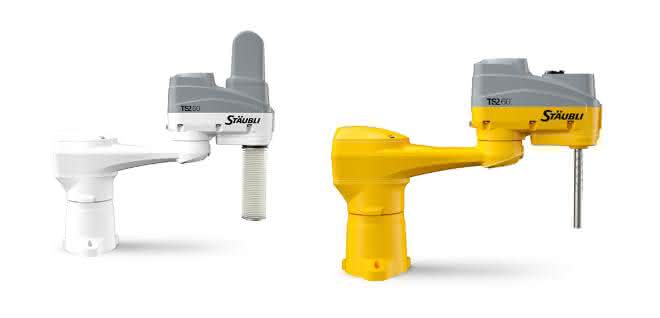
Stäubli Robotics will be presenting the completely redesigned machines at Motek. They now have a modular design and for the first time feature the company's own JCS drive technology, which is already used in the six-axis machines. Thanks to the hollow shaft design, this technology enables a clean room design in which external cables are finally a thing of the past.
Four models
The new robot family consists of four members. Specifically, these are the TS2-40 with a reach of 460 millimetres, the TS2-60 with a reach of 620 millimetres, the TS2-80 with a reach of 800 millimetres and the new TS2-100 with a working radius of 1,000 millimetres. The load capacity of all four machines is specified by the manufacturer as 8.4 kilograms.
The new machines are more compact and lighter. The new TS2-60 weighs 38 kilograms compared to the 55 kilograms of its predecessor, the TS60. This weight reduction of 35 percent means a performance gain for the machine. Further performance data in comparison: 30 percent less space required, 38 percent reduced height and 50 percent longer service intervals.
The new Scaras also have a compact, closed design with internal media and supply lines: no interfering contours, no sources of error and no unnecessary particle emissions. They have a completely sealed housing, the quill is optionally protected at the top with a cover and screwed on from below with special screws, the connections can be concealed under the robot base if required and dead spaces are consistently avoided.
Four-axis robots also for sensitive environments
Stäubli sees itself as the market leader in the life science sector and wants to further expand this position with the new Scara robot arms. The robots will soon be available in modified special versions for pharmaceutical, medical and food applications as well as UL and ESD variants. In addition, the standard robots can be qualified for sensitive production environments with simple modifications, where they should open up new application possibilities. The focus is on applications with strict hygiene or cleanroom requirements, from food and pharmaceuticals to photovoltaics. All TS2 models can be operated with food-grade H1 oil without any loss of performance.
Another innovation: for the first time, the four-axis robots can be ordered with an optional integrated tool changing system. This enables the fast robots to change grippers and tools automatically, which increases uptime in certain applications. Another advantage of this system: tools or grippers can also be changed manually in a matter of seconds using the bayonet lock. All media and signal connections are automatic.
Modular design
Thanks to the modular design, all machines have the same robot base, which the series shares with the six-axis TX2 generation. The forearms, axes and drives are also identical on certain models. Take the forearm, for example: the four models have two different forearm versions. The smaller version serves the TS2-40 and TS2-60 models, the larger one the TS2-80 and TS2-100. as
Hall 7, Stand 7306


You might also be interested in
ESD protection in electronics production
Work voltage-free
Electrostatic discharge (ESD) is an everyday phenomenon and usually harmless to humans. However, sensitive electronic components can be damaged or even destroyed as a result.
 read more...
Protection against electrostatic discharge
StoFloor ESD KU 614 from StoCretec: dissipative flooring with the latest technology meets all ESD standards, is economical, extremely durable, mechanically and chemically resistant. The surface can be adjusted to be slip-resistant. The system is...
read more...A new benchmark for collaborative robots
At this year's Automatica, Denso Robotics will be showcasing its innovations in the field of robotics. The collaborative Cobotta Pro product family will be the focus of the presentations. Visitors to the trade fair can see all variants in various...
read more...Four decades of robotics
Epson, manufacturer of Scara robots, will present the new Scara GX-B series at Automatica, the latest generation of high-performance Scara robots based on the existing GX series.
read more...Controlling machines more intelligently
At embedded world, Bopla Gehäuse Systeme will be presenting new HMI systems for customized machine control in the field of printed electronics. The focus is on complex interfaces via USB or RFID as well as an ultra-flat design and cost-effective...
read more...Process control with traceability through soldering tips with microchips
RS has added a new 300 W manual soldering platform to its range with the WXsmart from Weller. The station combines all soldering applications in a single device and comes with a new range of intelligent soldering tips. In this way, the WXsmart...
read more...Florian Becker is the new Managing Director at Krieg
Generation change at Krieg in Heimsheim: Andreas Krieg handed over the management of the company to Florian Becker on October 1, 2022. The company, which specializes in workplace systems and office furnishings, intends to focus even more strongly on...
read more...The fuel cell under control
The fuel cell is a serious solution for emission-free mobility. Having disappeared from the scene for a long time, it is now establishing itself as a viable option for zero-emission strategies.
read more...The modular system for pure production
Designing pure process environments quickly, modularly and safely - Item showed how this can be done at Cleanzone in Frankfurt. The company has added numerous components to its modular system.
read more...