
Fully automatic separation of aluminum strips
Robots save themselves
Robots can save themselves - they just have to be fast enough. This is the case with a Martin Mechanic system for separating aluminum profiles for the furniture industry, now in its third evolutionary stage.
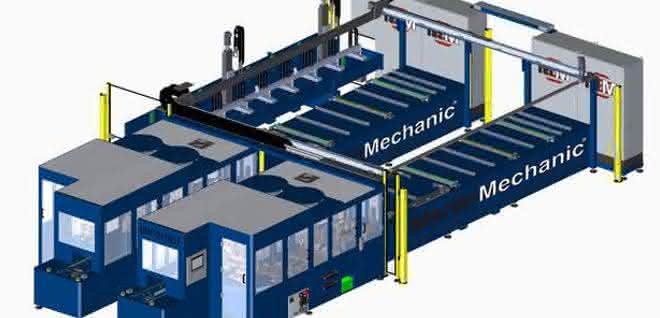
Where just over four years ago ten robots were still in use on the predecessor model of this system, today four fewer do the same job. The aluminum profiles, which the fully automatic MWT211637 from Martinmechanic separates into small pieces without cutting, are delivered six meters long in long cardboard boxes. They are stacked in layers, first next to each other and then on top of each other. To do this, the servo-electric two-axis gantry with its eight suction cups picks up a complete layer of up to 20 aluminum strips and places them on one of the four storage locations. The transport axis pushes the strips one by one to the profile preparation area.
The fully automated system was designed so that the cutting process can be carried out four times side by side to reduce the cycle time to half a second. Four Fanuc3SiA robots and two Omron-Yamaha robots are used for this purpose. The feed axis picks up the foremost tube to transport it to the inspection station first. Color sensors check the strips on both sides for colored markings. These indicate defects and signal to the system at which point the aluminum profiles need to be separated and which profile remnants will be sorted out later. Depending on the specifications, parts between 100 and 200 millimetres long can be produced. The camera, which recognizes the start of the aluminium strip and the first cutting slot, also checks the quality of the surface. It is installed in a cell with darkened panes to avoid interference from possible extraneous light. The image processing transfers the values to the feed-axis system, which can correct the position of the aluminum strip before the cutting process.
A linear feed always pulls the strips forward at the same distance. The electrically driven cutting blade cuts the aluminum strips into individual parts at the pre-punched slots. After the cutting stroke, the Fanuc robot uses its vacuum gripper to place the finished parts next to each other from above in the exchangeable drawer. These delta robots, which are mounted on the ceiling of the cell frame, accelerate particularly quickly thanks to their powerful servomotors and complete their placement tasks at top speed with four axes, a rotary axis and the compact gripper arm. Once the removable drawer is filled with 20 finished parts, it moves from the loading to the unloading position. Four-axis robots take over the handling here. Each of these two Scara robots, which are responsible for two production lines each, has a load capacity of 20 kilograms and a reach of one meter.
They take one complete layer at a time from the removable drawer and place it in a magazine provided. The two Scara robots stack a total of 25 layers on top of each other in parallel. Once a magazine is filled with 500 parts, it moves on to the worker's workstation. The operator removes the magazine and inserts an empty one in return. The system is equipped with three light grids and the operator is protected when feeding and cutting the aluminum strips. Profile cuts and leftover pieces of aluminum are automatically ejected into the remnant container. pb


You might also be interested in
Further simplify assembly processes
In addition to the proven racks with a length of one meter, Wittenstein alpha now offers optional two-meter racks for linear systems. They are particularly suitable for use in short axes, for example, in order to simplify assembly even further.
 read more...
Hiwin manufactures its own shaft gearboxes
Have you ever waited several months for an urgently needed corrugated gearbox? Hiwin has too. That's why the Offenburg-based drive specialist has decided to produce its own space and weight-saving reduction talent.
read more...Human-robot interaction at the trade fair
Sumitomo Drive Technologies is presenting its drive solutions for automation and robotics at Automatica 2023 together with the Lafert Group. The company will be showcasing two different applications of the Tuaka drive system for robot applications...
read more...Partial automation with robots
At Automatica, Promess will be showcasing its modular individual workstations and how these can be partially automated with robot support. The servo press manufacturer will also be providing information about the latest features of its Revolution X...
read more...A new benchmark for collaborative robots
At this year's Automatica, Denso Robotics will be showcasing its innovations in the field of robotics. The collaborative Cobotta Pro product family will be the focus of the presentations. Visitors to the trade fair can see all variants in various...
read more...Clamping system for a new milling machine
Investments in machinery often lead to further purchases - as is the case at Joma-Maschinenbau, whose modern production facility has recently been supplemented by a 5-axis milling machine.
read more...Schunk wants to simplify processes in automated production
The declared aim of automation specialist Schunk is to make its customers' processes comprehensible, simple and efficient. Data transparency plays an important role in this. It enables reliable processes and provides the basis for resource-saving...
read more...Festo and Hahn Automation develop battery tester for greater safety
The success and reputation of electric vehicle manufacturers depend on the safe and flawless functioning of batteries. Hahn Automation has therefore developed a battery tester that performs a fully automated 100% test of mobile energy storage...
read more...SPN Schwaben Präzision presents gearbox solutions for automation and industrial robotics
Short cycle times, robust technology, wear-free surfaces and compact designs have always been relevant for automation and robotics solutions. This year's Automatica trend topics include "Sustainable production" and "Digitalization and AI". SPN aims...
read more...