
Collaborating robots
Employees relieved, quality improved
The family-owned company Hofmann Glastechnik was faced with the challenge of finding new qualified specialists for glass production. At the same time, the company wanted to make better use of the potential of its existing employees and optimize its production processes. Today, Hofmann uses two collaborative robot arms from UR for machine loading.
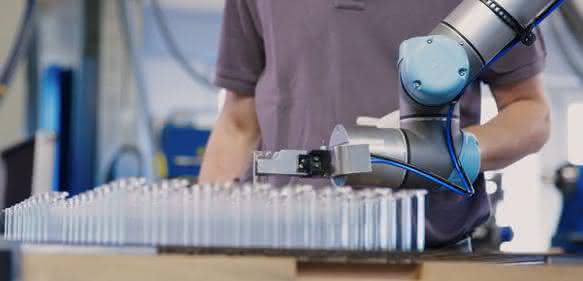
The UR robots handle highly sensitive glass tubes in a precise pick-and-place application. Their use stabilizes the production processes, improves the quality of the glass components and simplifies the work processes of the employees. Hofmann was able to increase its efficiency and production capacity in the application area by 50 percent. "The constant shortage of skilled workers has given us quite a hard time in recent years and has made us realize how important it is to fully utilize the potential of our existing employees. This gave us the idea of automating repetitive tasks such as machine loading. With the robots from Universal Robots, we have found an ideal solution for this," explains Robert Hofmann, Managing Director of Hofmann Glastechnik.
Unlike conventional industrial robots, the collaborative UR robots can work directly next to humans with no or minimal protective housing once a risk assessment has been successfully completed. This creates new opportunities for the automation of a wide range of processes, especially for small and medium-sized companies like Hofmann. Two UR robots are now in use here in the fully automated series production of glass cuvettes. The UR5 and UR10 robot arms, which are named after their payloads in kilograms, independently load the machines. In a precise pick-and-place process, the robot picks up highly sensitive glass tubes, feeds them to a PLC-controlled glass lathe, removes them from the lathe after processing and sets them down again.
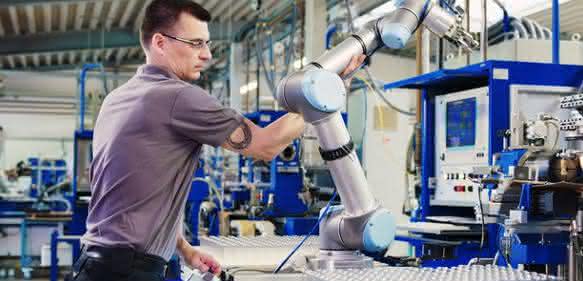
Glass as a material brings with it very special requirements in the forming process. Robert Hofmann knows the challenges: "The glass is extremely sensitive. Even the smallest temperature changes on the tools have an effect on the forming result." The production process must therefore be precise and stable for each part in order to achieve consistent quality of the glass components. To achieve this, the temperature on the machines must be as constant as possible. In the past, employees loaded the glass lathes manually. Even short interruptions in the work process caused the machines to cool down again and again. However, the first time the UR robots were used for this task, the results were excellent. "The quality of our glass components has improved enormously thanks to Universal Robots," confirms Robert Hofmann.
The UR robots perform tasks that require maximum precision with consistent accuracy. At Hofmann, they load the machines for up to eleven hours a day. Cycle times are adhered to and downtimes are reduced. Depending on the application, the UR robots at Hofmann now produce between 200 and 400 glass cuvettes a day. If required, the company can use the collaborating colleagues flexibly on different glass lathes. "It is very easy to 'redock' the robots. We have developed a device that allows us to easily move the UR robots between the different machines," explains Björn Uthe, Head of Machinery at Hofmann. Once such a changeover has taken place, the robot is immediately ready for operation.
Handling the UR devices is intuitive. The required movement sequences can be defined using touchscreen tablets. In "free-running mode", the user can simply grab the robot's arm and teach it new tasks by physically guiding it from waypoint to waypoint.
pb


You might also be interested in
ebm-papst is growing again thanks to AI and data centers
ebm-papst returned to a growth trajectory in fiscal year 2025/26. Air Technology, data center applications, and artificial intelligence are driving revenue and investment.
 read more...
SPE on the Verge of a Market Breakthrough
Single Pair Ethernet (SPE) has moved beyond the conceptual phase and is increasingly being implemented in industrial settings. The focus here is not only on higher data rates and simplified cabling, but above all on the issue of system integration...
read more...More than 900 exhibitors already registered
Around six months before the start of the trade fair, more than 900 companies have registered for SPS 2026 in Nuremberg. The trade fair focuses on industrial AI, cyber security and digital transformation.
read more...Virtual PLCs in practice: How vPLCs make production systems more flexible and scalable
The increasing networking of IT and OT is fundamentally changing industrial automation. The IT/OT Integration Summit shows how modern technologies can make production environments more efficient, flexible and future-proof. The event will focus on...
read more...Sales growth in a turbulent market environment
Thanks to innovations and a focus on strategic industrial markets, Sick was able to moderately increase its sales in the 2025 financial year. In a turbulent market environment, the company was able to maintain its position and gain market share with...
read more...Siemens presents new AI agent
Siemens is launching 'Eigen Engineering Agent', an AI for automation technology. The solution is integrated into the TIA Portal, has been tested with over 100 companies and is designed to significantly accelerate engineering processes.
read more...Schaeffler keeps sales almost stable
Schaeffler generated revenue of EUR 23.5 billion in 2025 and increased EBIT before special items to EUR 936 million. At 266 million euros, free cash flow was significantly above the prior year and forecast. Net income remained negative due to high...
read more...Advancing artificial intelligence together
Helukabel is stepping up its activities in the field of artificial intelligence and is now a member of the IPAI. The innovation and collaboration platform for companies, research facilities, institutions and administration has set itself the goal of...
read more...New impetus for ifm sales
Two new positions were filled at ifm at the start of 2026: Markus Wolf becomes Managing Director Sales Germany, Sven Quant takes over the position of Central Managing Director in the Process Sensors division within the ifm Group.
read more...