
Safe human-robot collaboration
Cobots safely in a team
Collaborative robots stand for flexibility. But also for risks. This makes the topic of occupational safety important - and challenging. TÜV Süd provides information on safety concepts and standards.
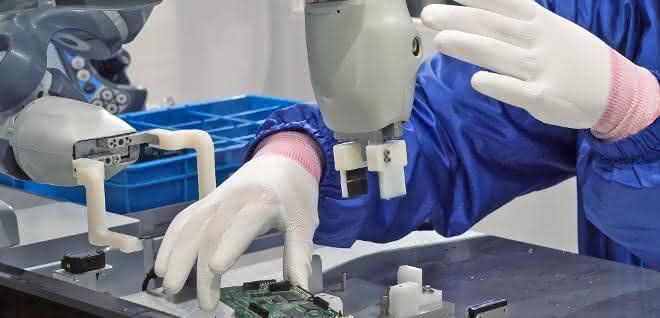
Cobots work directly with people without a safety fence. They are lightweight, transportable, easy to program, adaptive, flexible to use and space-saving. The associated infrastructure is compact. However, these advantages bring challenges in terms of safety. Because:
How can flexible collaboration be designed safely? The prerequisite is a comprehensive, application-specific risk assessment. In the case of human-robot collaboration (HRC) without a safety fence, this is complex. It requires those responsible to have precise knowledge of the applicable standards and laws. Independent testing organizations can provide support if they have experience in the assessment of robot systems and knowledge of the planning and implementation of cobot applications. It should always be noted:
The design of cobots is fundamental to their safe use. The technical specification "ISO/TS 15066 - Robots and robotic devices - Collaborative robots" defines safety requirements for them and their working environment. It also supplements the normative requirements and instructions in ISO 10218-1 and ISO 10218-2 for the operation of collaborative industrial robots. For collaboration between humans and cobots, "EN ISO 12018 Industrial robot safety requirements" defines four basic safety objectives:
1. a safety-oriented, monitored standstill. 2. human control of the robot. 3. speed and distance monitoring to prevent dangerous human-robot contact. 4. power and force limitation if contact is required.
If the final safety check confirms that it is safe and legally compliant, the robot application receives a CE mark.
The monitored standstill and other safety objectives are implemented using electro-sensitive protective equipment (ESPE). As soon as the distance falls below the required minimum distance, the ESPE - light curtains, laser scanners or pressure-sensitive systems - react. According to "DIN EN IEC 62046 Safety of machinery - Application of protective devices for detecting the presence of persons", they must be tested during commissioning and annually. In addition, the systems must be inspected regularly for damage or soiling. The entire installation situation, the triggering process and the overtravel must always be included in the safety assessment.
Flexible safety zones, biomechanical limit values
BWS are not very adaptable. They always react in the same way when they are executed conventionally. If the distance between the employee and the cobot is less than the programmed minimum distance, an ESPE stops the machine and interrupts the work process - even if the human and machine are already moving away from each other. These illogical patterns can be reduced, for example by using the dynamic safety zone approach. Safety systems analyze and evaluate the behavior of humans and cobots and the resulting hazards. However, it is almost impossible to predict the interactions during operation, especially when environmental and process conditions are variable. In future, software-based approaches should overcome these challenges.
There are specific risks of injury where cobots and employees have to come into direct contact. Manufacturers and operators should take sensible countermeasures based on specific measurements of the forces that occur or combine various measures - such as reducing the speed, limiting the forces, increasing the contact surface or a partial enclosure. In addition to contact with the upper body and arms, hits to the head are particularly dangerous: The BG/BGIA recommendations for "Risk assessment in accordance with the Machinery Directive - Design of workplaces with collaborative robots" specify biomechanical limit values: 90 Newtons as the maximum permissible impact force, 20 Newtons per square centimetre as the maximum value for surface pressure.
Ensuring safety in line with requirements
The adaptive safety of cognitive production systems is a concept - developed in the context of Industry 4.0 - that is of particular importance for HRC. The basic idea is to ensure safety as required without restricting production as much as possible. Adaptive safety of cognitive production systems is implemented with the help of learning (multi-agent) systems with algorithms for controlling sensors and actuators. In order to ensure the safety of employees at all times, even when they are working closely together, the systems should predict the development of dynamic processes and control the cobots accordingly. Availability is also important in smart factories; production systems are assembled on a modular basis as required. The modified system configuration usually has to be reassessed afterwards, which is often associated with production downtimes. Automated certification processes can minimize these effects by determining whether the interlinked machine system complies with standards at runtime if possible. At the end, systems should automatically issue approvals for the entire system - according to clearly defined rules.


You might also be interested in
Protection against electrostatic discharge
StoFloor ESD KU 614 from StoCretec: dissipative flooring with the latest technology meets all ESD standards, is economical, extremely durable, mechanically and chemically resistant. The surface can be adjusted to be slip-resistant. The system is...
 read more...
Cables and wires from Helukabel
Food cultivation on a new level
Vertical farming - cultivation in multi-storey greenhouses - is considered one of the most exciting trends in food production. One of the pioneers in this field is the Romanian start-up Ultragreens. The company relies on solutions from Helukabel to...
read more...Further training for specialists to become security experts
With the "CESA - Certified Expert for Security in Automation" qualification, automation expert Pilz offers a two-day expert course designed to provide participants with compact security knowledge in line with the latest standards.
read more...Meaningful data on the service life of the seal
Seals prevent substances from penetrating or entering technical components. The intelligent seals from Freudenberg Sealing Technologies can significantly expand this core task in the future: the seal itself is also a sensor and becomes a "smart...
read more...Online stud configurator according to drawing
For standard bolts, with head, thread or hole
For standard bolts, with head, thread, bore or as a version with recess, mbo Osswald configurators map the standard specifications, are very easy to use, take a lot of work off the user's hands and save a lot of time.
read more...Safe palletizing with the Cobot
Verla-Pharm's medicinal products and food supplements have been available for decades. Ever-increasing throughputs result in ever-increasing logistics costs, whereby optimum utilization of the available production space is necessary.
read more...The tiger among processors
Since the move towards the Industrial Internet of Things (IIoT) and Industry 4.0 has picked up speed, processor boards and modules must be able to process exponentially growing amounts of data.
read more...VDWF publishes "Sustainability Compendium"
Nowadays, nobody can avoid "sustainability": In addition to a far-reaching presence in the media, it is also becoming increasingly important for companies in the tool and mold making industry to develop and implement appropriate concepts.
read more...More transparency and synergies with QM software
Weber, manufacturer of wood and metal sanding machines and extruders, has reorganized its quality management with ConSense IMS Professional. The software solution enables transparent documentation and more efficient processes.
read more...