
Production logistics
Cobots for the warehouse
In warehouse technology, cobots can help to speed up processes.
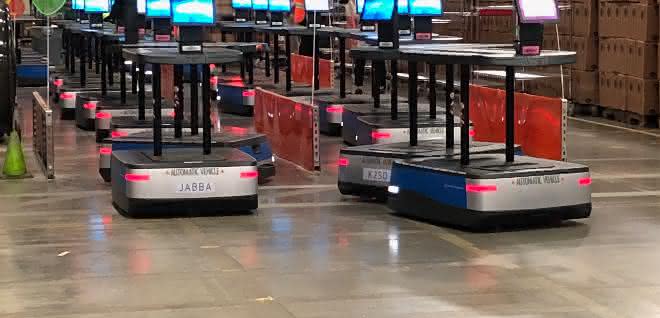
In times of booming e-commerce, logistics companies are faced with the challenge of meeting increasing customer expectations for fast delivery times with innovative warehouse technology despite the prevailing labor shortage. Above all, logistical efficiency means minimizing the time from order acceptance in the online store to delivery of the parcel from the warehouse. Customers have high expectations in terms of quality and accuracy. Returns and corrections are not only costly, but also jeopardize the relationship between consumers and brands as well as the contracts between warehouses and their customers. In addition, as orders become smaller and smaller, warehouses are shifting from case picking to piece picking. The result is expensive and labour-intensive processes, which is why the demand for optimization in terms of workflow, delivery, inventory and employee training is growing rapidly.
Manual or automatic order picking
The majority of orders in the warehouse are still processed manually today. One of the most time-consuming processes is order picking. Traditional person-to-goods methods such as manually operated picking trolleys have proven to be inefficient in the past due to the high mileage that employees have to perform. In order to reduce distances and increase pick rates, many logistics companies are therefore turning to traditional automation solutions. With this approach, the goods are brought to the employee (goods-to-person). Sorting systems and conveyor systems, for example, are used to quickly transport bulky and heavy loads and materials within an area. AS/RS systems (Automated Storage and Retrieval Systems) retrieve goods from the shelves and deliver them to an order picker's workstation, whereby the items are placed in assigned Stock Keeping Unit (SKU) bins depending on their size. Autonomous mobile robots (AMR) transport entire shelves directly to a picking and packing station.
What all these solutions have in common is that they significantly reduce human intervention and walking distances in the warehouse, thereby increasing productivity rates. The disadvantage of these systems is that they require a lot of infrastructure and storage space, which makes them difficult to change and inflexible. Implementation is expensive, takes a lot of time and only becomes profitable after a few years - which is why a retrofit in an existing warehouse is hardly worthwhile. Accordingly, large automation systems are best suited to warehouses that are being planned and built from scratch, or for companies with very large budgets that can afford to make major capital investments and a long implementation period. Furthermore, once a fixed infrastructure has been installed, the warehouse can only react to seasonal changes in order volumes to a limited extent.
Optimized picking with cobots
Fulfillment in today's e-commerce warehouse must therefore be highly scalable and flexible and guarantee reliability. This demand has driven the growth of modular and transportable warehouse solutions in recent years. One solution that combines the flexibility of manual picking with the performance of traditional automation is cobots: collaborative mobile warehouse robots such as "Chuck" from the American logistics provider 6 River Systems (6RS). These cobots use machine learning and AI to optimize warehouse routes in real time based on current orders. By guiding employees to storage locations and directing them through their tasks, the cobots reduce the long distances between picking areas and between picks during picking within the respective areas. This increases both productivity and the safety of the work processes. Thanks to the reduced steps between individual tasks, employees are relieved and can complete more tasks in the same amount of time. The technology holds huge potential, especially for small and medium-sized companies.
End-to-end fulfillment with robotic solution
However, in order to meet the increasing demand and high standards of e-commerce customers, an intelligent solution should not only optimize the picking process, but also all other tasks in the warehouse. Solutions for end-to-end fulfillment accompany all processes from goods receipt and storage to picking, packing and shipping. 6 River Systems has developed its Cobot Chuck into the only robotic solution on the market that intelligently optimizes the entire fulfillment process from launch to packing. A fleet of cobots helps employees optimize the three key warehouse processes: Preparing, picking and unloading.
Chuck communicates with the software and intelligently groups orders together. Via an interface between the container freight system and the warehouse WMS, the cobot is strategically assigned work based on order profiles and available labor. Chuck then travels autonomously to an employee to begin a picking process. Once an employee has completed their orders, Chuck passes them on to another cobot. In the meantime, the first Chuck moves autonomously to another picking zone or to a fully automated robotic arm called Fast Lane™. This fully automated stationary robot integrates seamlessly into the process to fully automate the picking process for fast-moving items with medium or large picking volumes. This allows warehouse staff to perform tasks and functions with higher priorities. The final steps in the 6RS end-to-end fulfillment solution are sorting and packing. Chuck travels autonomously to the Mobile Sort™ sorting station. There, employees are visually guided through a put-to-light system to distribute the goods delivered by Chuck into the correct containers. At the Packout™ station, the picked containers are finally delivered and the employee is guided through the steps of checking, packing, labeling and sealing orders for subsequent shipping. This system also increases the turnover rate at goods issue and completes the fulfillment process.
No additional infrastructure required
Fulfillment cobots impress with their configurable setup, which supports a wide variety of stock keeping units (SKUs). No additional infrastructure is required and implementation during ongoing warehouse operations causes no interruption to warehouse operations. The modular system also allows functions to be added quickly and easily to respond to changes in demand. Because 6 River Systems offers flexible rental pricing structures, warehouses can purchase enough chucks for average order levels and rent additional units during peak periods to meet increased demand. This allows warehouse operators to compensate for order fluctuations and reduce capital costs in the long term.
With end-to-end fulfillment that combines mobile collaborative robots with fully automated features, picking performance can be increased along the entire supply chain. Logistics providers receive a flexible automation solution that requires no additional infrastructure, is compatible with any warehouse management or ERP system and can be integrated into any warehouse layout in just a few weeks. It therefore offers an intelligent and adaptable alternative to traditional warehouse automation, which is usually complex and financially risky, as well as incurring high planning, installation and maintenance costs. Thanks to the effective collaboration between humans and cobots, the demands that growing e-commerce places on warehouse logistics can be met without great effort.


You might also be interested in
Fraunhofer IOSB Opens Humanoid Robots Lab
The Fraunhofer IOSB is opening a Humanoid Robots Experience Lab in Karlsruhe, Lemgo, and Ilmenau. Companies and organizations can use these facilities to test potential applications for humanoid robots and develop pilot projects.
 read more...
Artificial Intelligence in Manufacturing
Trumpf and IPAI Are Expanding a European AI Network for Industry
The high-tech company Trumpf is an official partner of the IPAI AI network in Heilbronn. Together, the partners aim to exchange experiences, develop new AI applications for industrial use, and advance the development of artificial intelligence in...
read more...Case Study: Networked Manufacturing Platform for Toolmaking
Using a networked manufacturing platform, Escha GmbH & Co. KG, a manufacturer of industrial fastening technology, has comprehensively modernized its toolmaking operations.
read more...Barcelona Declaration on Robotics and...
Robotics Associations Adopt Global Automation Strategy
The global robotics industry is stepping up its collaboration. The associations AER Automation, A3, IFR, and VDMA Robotics + Automation have formed a long-term alliance by signing the “Barcelona Declaration on Robotics and Automation 2026.” The...
read more...Jane Heffner is the new president of the International Federation of Robotics
Jane Heffner is the new president of the International Federation of Robotics. Adrien Brouillard has been appointed vice president of the global federation.
read more...Greater Transparency in the Robotics Market
RoboFinder Launches as an Independent Comparison Platform
Launch at Gitex Europe: 'RoboFinder' aims to bring more transparency to the professional service robotics market. In this interview, founder and CEO Brian Engels discusses market potential, challenges, and the goals of the new platform.
read more...Artificial Intelligence for the Physical Space
Alibaba Expands Qwen Model Family with a Robotics Suite for Physical AI
Alibaba is expanding its Qwen model family with a robotics suite for Physical AI. The three models—for manipulation, navigation, and simulation—are designed to assist autonomous robots with complex tasks in real-world environments.
read more...International Federation of Robotics
U.S. Robotics Industry Sees Double-Digit Growth
In the U.S., sales of industrial robots rose by 11% compared to the previous year: 38,000 units were newly installed in 2025. This significant recovery is driven by robust growth in the food industry and other non-manufacturing sectors. However, the...
read more...Development Collaboration for Humanoid Robotic Hands Launched
Schunk is entering into a new development partnership with Robert Bosch Robotics. Their shared goal is to develop an industrial-grade robotic hand that can be integrated into various humanoid robot systems.
read more...