

Bending cell
Precise bending of springs for measuring devices
Automation cell with hydraulic press. The MPA242226 automation cell from Martin Mechanic is equipped with the Fanuc LRMate 200iD robot and a hydraulic press. According to the manufacturer, this facilitates the "sensitive" bending of springs for precision measuring devices in the electronics industry.
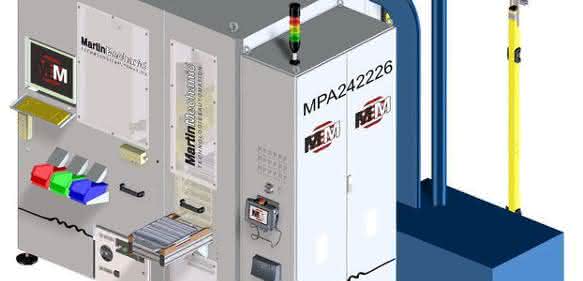
However, manual work is still required when feeding the cylindrical blanks with a length of up to 120 millimetres. This is because some special spring variants are used that cannot be fed automatically due to their complex output symmetry. The system can therefore be loaded in two different ways. This applies both to loading the raw parts and to collecting the finished bent springs.
Cylindrical blanks, which are quite simply shaped, are fed into the work cell via a magazine shaft. There are 300 pieces per pack. The worker places very complex parts manually on a pegboard. This holds 48 pieces at a time. The Fanuc robot, which is equipped with a quadruple gripper, operates from the magazine shaft or pegboard. Even with the gripper arm extended to a length of 700 millimetres, it can still lift a weight of seven kilograms. It uses the first gripper to pick up the springs from the magazine or from the pegboard in order to insert them into the center of the press's two-stage forming tool. Due to the upstream processing steps, however, the parts can be of different lengths. Initial image processing therefore checks the position and length of the springs in order to calculate any offset required for the gripper position. The measured value is transmitted to the robot, which uses this data to correct its position independently in the hundredths of a millimeter range.
The springs are bent three times in succession until they have the right shape. The other three grippers are used for this, with the blank moving upwards step by step in the forming tool of the press. A second camera was installed in the press. This checks whether the spring to be bent has been correctly inserted into the die. This prevents faults in the production process from the outset. Should a fault occur, the system would stop automatically and alert the worker. He can usually rectify the fault in a few simple steps. The finished bent springs go into three different ejection chutes: one for the parts that are OK, a second for those that are not OK and the third for the statistical process control (SPC). The worker can request any component at will from the running production operation in order to check it. If the quality does not meet the requirements, he intervenes in the production process to correct it.
Alternatively, the robot places the finished bent springs, which are deemed to be in order, in rack drawers. The system stacks up to ten such drawers, each filled with 48 springs, on top of each other in a lift system. The operator can call up the status at any time via the control panel to see which magazine is already fully loaded. He then removes this manually from the lift. The MPA242226 automation cell was equipped with a Siemens S7 PLC controller and a second-generation mobile panel, the MOP277. sw


You might also be interested in
ebm-papst is growing again thanks to AI and data centers
ebm-papst returned to a growth trajectory in fiscal year 2025/26. Air Technology, data center applications, and artificial intelligence are driving revenue and investment.
 read more...
SPE on the Verge of a Market Breakthrough
Single Pair Ethernet (SPE) has moved beyond the conceptual phase and is increasingly being implemented in industrial settings. The focus here is not only on higher data rates and simplified cabling, but above all on the issue of system integration...
read more...More than 900 exhibitors already registered
Around six months before the start of the trade fair, more than 900 companies have registered for SPS 2026 in Nuremberg. The trade fair focuses on industrial AI, cyber security and digital transformation.
read more...Virtual PLCs in practice: How vPLCs make production systems more flexible and scalable
The increasing networking of IT and OT is fundamentally changing industrial automation. The IT/OT Integration Summit shows how modern technologies can make production environments more efficient, flexible and future-proof. The event will focus on...
read more...Sales growth in a turbulent market environment
Thanks to innovations and a focus on strategic industrial markets, Sick was able to moderately increase its sales in the 2025 financial year. In a turbulent market environment, the company was able to maintain its position and gain market share with...
read more...Siemens presents new AI agent
Siemens is launching 'Eigen Engineering Agent', an AI for automation technology. The solution is integrated into the TIA Portal, has been tested with over 100 companies and is designed to significantly accelerate engineering processes.
read more...Schaeffler keeps sales almost stable
Schaeffler generated revenue of EUR 23.5 billion in 2025 and increased EBIT before special items to EUR 936 million. At 266 million euros, free cash flow was significantly above the prior year and forecast. Net income remained negative due to high...
read more...Advancing artificial intelligence together
Helukabel is stepping up its activities in the field of artificial intelligence and is now a member of the IPAI. The innovation and collaboration platform for companies, research facilities, institutions and administration has set itself the goal of...
read more...New impetus for ifm sales
Two new positions were filled at ifm at the start of 2026: Markus Wolf becomes Managing Director Sales Germany, Sven Quant takes over the position of Central Managing Director in the Process Sensors division within the ifm Group.
read more...