
Assembly automation
The potential lies in the app
Assembly automation with robots. Researchers at Fraunhofer IPA have developed an app that allows users to analyze their own automation potential.
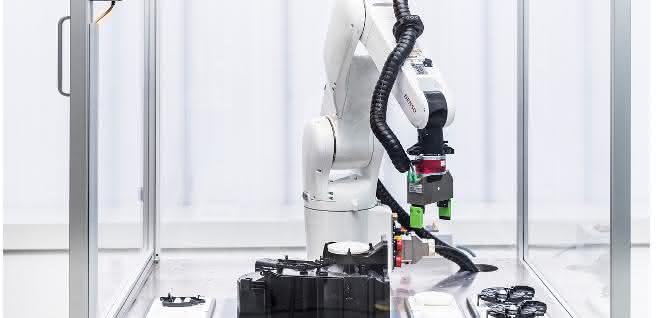
Many companies are concerned with the extent to which they can automate their assembly tasks. A new app from Fraunhofer IPA now helps with this. It guides the user to analyze their own assembly processes in detail, evaluates the answers and provides information on the potential for automation.
In the app, the IPA experts have digitally processed their knowledge, which they previously provided in a personally conducted automation potential analysis (APA). They are presenting the new version 2.0 of the APA app at Motek and are looking for the first users and testers. They can try out the app with a simple license agreement.
"With our APA app, anyone can become an expert in the evaluation of assembly processes," explains Alexander Neb, who works as a research assistant at Fraunhofer IPA and co-developed the app. The app is not intended to be limited to assembly. An application with human-robot cooperation (HRC) can often be useful instead of full automation. This is why the IPA researchers want to integrate this topic into the app. It could also provide support for inspection and maintenance in the future. Inquiries from interested companies are welcome for these further developments.
Another IPA exhibit at Motek is the Pitasc software solution for programming force-controlled assembly processes. It makes it possible to automate processes that were previously carried out manually in an economically viable way. "Previously, it was necessary to largely reprogram a robot system for each application. With our software, once tasks have been modeled, they can be quickly transferred to new product variants, products and even robots from other manufacturers," says Frank Nägele, group manager at Fraunhofer IPA. The software contains many ready-to-use and reusable program modules that can be individually compiled and used directly when setting up a robot system. Pitasc is ready for use in pilot applications, which the IPA researchers would like to implement together with companies.
At Motek, the software will also be integrated into a robot system that can be quickly assembled from hardware modules. The modules, for example a robot arm, tools or devices, are simply and precisely placed on perforated grid tables. The modules also include the program components required to carry out an assembly task and the necessary information such as tool positions and geometries. This allows the user to set up or convert a robot cell with little programming effort. This demonstrator is a result of the EU project "RAMPup". The aim of the project was to integrate hardware and software into automation modules that allow a robot cell to be set up and converted quickly for specific applications and variants. as
Hall 7, Stand 7128


You might also be interested in
From ERP System to AI Platform
RNA, based in Aachen, manufactures up to 2,000 custom-designed feeding systems annually and handles all order processing through a central ERP platform.
 read more...
Predictive Maintenance in the Powertrain: Stöber Is Gradually Expanding Its Approach
Step by step, the company is continuing to develop predictive maintenance: from monitoring to predictive maintenance to smart powertrains.
read more...Predictive maintenance in retrofit
Predictive maintenance pays off. This is because early detection of impending failures means that systems can be serviced in a targeted manner before production downtime occurs. But how complex is it to integrate such a maintenance concept into an...
read more...Maintenance with a view to efficiency
At Maintenance, RS offers an overview of its range of products and services. From consumption meters and frequency inverters to power supplies and measuring and testing devices, the company provides support in the selection of products and solutions.
read more...Record number of exhibitors expected at trade fair for maintenance and process technology
The maintenance Dortmund and PumpsS & Valves 2026 trade fairs start with record participation: Over 310 exhibitors are expected. They will be presenting solutions for industrial maintenance, digital assistance systems and process technology.
read more...3D printing for unplanned requirements
The material fails and the machine suddenly stops? Then you need to take the right measures to be able to resume production quickly. Material failure in the form of faulty components or material wear in the frame are a risk for any production.
read more...High demands in terms of safety, application and robustness
Demanding work in the electrical trade and energy supply as well as smooth processes in production require innovative and customized measurement technology that scores points for safety, ease of use and resilience.
read more...Maintenance in Munich: Multimeters and...
Measurement technology for professional maintenance
The maintenance trade fair will take place on October 29 and 30 in Munich. At Conrad, the trade fair for industrial maintenance is all about efficient procurement solutions with a special focus on professional measurement technology.
read more...Challenges in maintenance
In collaboration with Contact Software, Fraunhofer IPK surveyed industry experts on maintenance. The results reveal challenges and potential.
read more...