
Tools for micromachining
Small-format high-performance tools
Small-format tools for particularly demanding tasks are a niche market. Here, comprehensive know-how and the willingness to deal intensively with the special requirements of the respective production process are more important than mass production with the sale of corresponding quantities. An interview with senior employees of a tool manufacturer from the Swiss Jura.
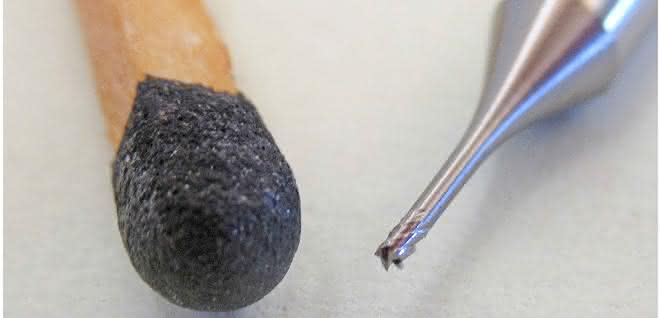
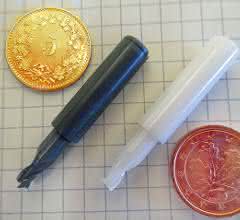
Arnaud Maître, Director of Louis Bélet S.A. in Vendlincourt (Switzerland): "We are here in the heartland of Swiss precision machine and watch manufacturing and have been developing tools for this very demanding clientele since 1948." These users often have to deal with unusual tasks that require a great deal of effort and ingenuity. This is less interesting for mass manufacturers who focus on the large-volume requirements of traditional industries. The company has built up a good reputation in this specialist field and acts as a development partner for numerous well-known companies in areas such as mechatronics, watchmaking, mechanical engineering, medical technology and automotive manufacturing. The core area includes, for example, tools for special internal threads for jaw implants or micro-ceramic milling cutters, which can be used up to 30 times longer than conventional solid carbide versions. As a contact for special tasks, the company is now a partner for users throughout Europe and supplies its tools as far away as China.
Thread whirler for triaxial use
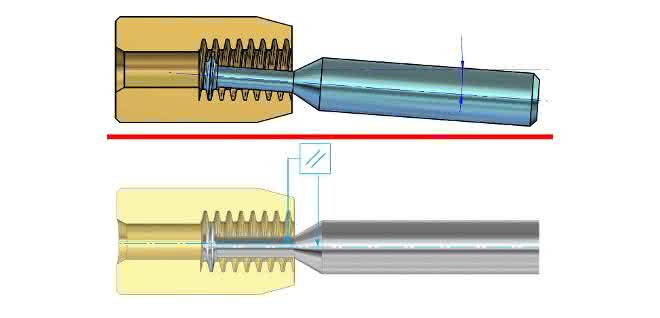
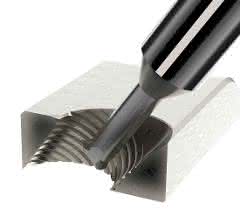
"Internal thread whirling is used when particularly demanding thread forms, difficult materials or micro-internal threads need to be cut," says Pierre Falbriard, Head of Research and Development at Louis Bélet. Important areas of application include the automotive industry and threaded bushes as implants for medical technology. In contrast to classic thread cutting with taps, a tool similar to a T-slot cutter is used here. Its diameter is smaller than that of the threaded hole so that it can also be moved radially within it in order to machine the features of the thread. This means that very complex thread geometries and even conical threads can be cut. One of the disadvantages of the process to date has been that the complex tool paths required an approach angle of the milling cutter. This limited the depth to which the thread could reach into the material and sometimes required the use of a machine tool with at least five NC axes.
By working intensively on the process sequence, it was possible to develop a special "compensated" geometry for the milling cutter that no longer requires an adjustment. This has two advantages. It provides greater degrees of freedom for the production of sophisticated threads. In addition, a three-axis machine tool is sufficient for machining, which enables savings in investment and operating costs. The medical technology sector is also interested in this solution, which was originally developed for the automotive industry.
Tools for special threads
"In certain areas of application, ISO threads are not even used. There are also numerous other standards, tapers and multi-start threads," adds Arnaud Maître. This applies not only to medical technology, but also to the watchmaking industry and certain areas of application in the automotive industry. For the production of the corresponding special tools, this means that suitable tool shapes, machining strategies and application parameters must be found. One example of this is angled multi-start threaded bushes with a conical base for bone implants, which enables the surgeon to center the screw easily when inserting it. For such cases, the tool, machining strategy and recommended application parameters must be developed together as a complete package. The customer is supported in such projects by specialists, who also become active on site if necessary. Trials are carried out in Vendlincourt using our own test facilities. The customer therefore receives a tried and tested tool that can be used immediately. This is supplemented by on-site support should any problems arise.
Numerous materials, coatings and geometry variants
"As our customers often use materials that are difficult to machine, such as stainless steel, titanium or lead-free brass alloys, we also have a great deal of expertise in the area of materials for milling cutters," reveals Falbriard. Optimization for a specific application begins with the selection of the most suitable carbide variant and the corresponding coating; alternatively, tools made of PCD diamond or boron nitride are also manufactured.
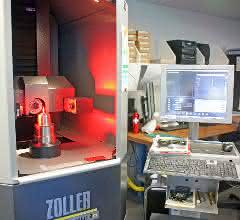
One of Louis Bélet's specialties is the production of forming and stepped tools on machines specially designed for this purpose. In addition, there are specially adapted cutting edge geometries, for example to prevent the formation of long chips, as well as progressive flutes for optimum chip removal. The result is often a service life that is several times longer than can be achieved with conventional tools. The results with ceramic tools are particularly remarkable, where the durability when machining non-ferrous metals is sometimes 30 times better, while the machining quality of the workpieces remains consistently high.
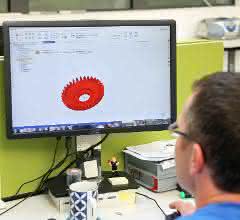
"Another example of our innovative capacity are slim micro-milling cutters with load-optimized geometry for Torx recesses in bone screws," explains Maître. The Torx profile in the head must be very precise and also deeply recessed. Due to the geometric specifications of the Torx profile, this requires milling cutters with a very small diameter and long lateral cutting edges to enable the deepest possible penetration into the material. In addition, bone screws are difficult to machine materials such as titanium, stainless steel or chrome-cobalt, which is why adapted cutting geometries had to be developed for the various materials. In addition, the milling cutters must be able to withstand high forces in order to minimize geometric deviations due to lateral displacement. For this reason, and to avoid vibrations, the shank of the milling cutter must be designed to be as rigid as possible. For this reason, a special shank geometry has been developed for this category of milling cutter, which ensures maximum rigidity even when plunging deep into the workpiece. Cutting edge lengths of up to 5 × Ø are possible. For a milling cutter with a diameter of 0.2 mm, the lateral cutting edges are therefore 1 mm long. By using these milling cutters, the final use of a cutting punch can be omitted when manufacturing the screws.
Standard tools for difficult materials
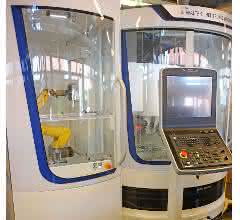
"For standard applications with difficult-to-machine materials, we have developed tool lines that are precisely optimized for the material," reveals Pierre Falbriard. These "Expert" tools are available in standard size gradations and a wide variety of designs such as drills, milling cutters, taps, saws or gravers. Depending on the design and application, variants in terms of material (carbide or PCD) or coating are also possible, and form cutters are also available on request. Expert tools are available for stainless steel, brass, titanium, aluminum and composite materials. Specific versions for sub-categories are also available for the individual materials. In the case of fiber composites, for example, a distinction is made between carbon or glass fibers, thermoplastic or thermoset matrix and honeycomb structure. An important advantage for the user is availability: in the interests of high supply availability, around 650,000 tools in more than 7,000 different designs are constantly kept in stock in Vendlincourt.
Klaus Vollrath, freelance journalist / ag


You might also be interested in
Protection against electrostatic discharge
StoFloor ESD KU 614 from StoCretec: dissipative flooring with the latest technology meets all ESD standards, is economical, extremely durable, mechanically and chemically resistant. The surface can be adjusted to be slip-resistant. The system is...
 read more...
Cables and wires from Helukabel
Food cultivation on a new level
Vertical farming - cultivation in multi-storey greenhouses - is considered one of the most exciting trends in food production. One of the pioneers in this field is the Romanian start-up Ultragreens. The company relies on solutions from Helukabel to...
read more...Further training for specialists to become security experts
With the "CESA - Certified Expert for Security in Automation" qualification, automation expert Pilz offers a two-day expert course designed to provide participants with compact security knowledge in line with the latest standards.
read more...Meaningful data on the service life of the seal
Seals prevent substances from penetrating or entering technical components. The intelligent seals from Freudenberg Sealing Technologies can significantly expand this core task in the future: the seal itself is also a sensor and becomes a "smart...
read more...Online stud configurator according to drawing
For standard bolts, with head, thread or hole
For standard bolts, with head, thread, bore or as a version with recess, mbo Osswald configurators map the standard specifications, are very easy to use, take a lot of work off the user's hands and save a lot of time.
read more...Safe palletizing with the Cobot
Verla-Pharm's medicinal products and food supplements have been available for decades. Ever-increasing throughputs result in ever-increasing logistics costs, whereby optimum utilization of the available production space is necessary.
read more...The tiger among processors
Since the move towards the Industrial Internet of Things (IIoT) and Industry 4.0 has picked up speed, processor boards and modules must be able to process exponentially growing amounts of data.
read more...VDWF publishes "Sustainability Compendium"
Nowadays, nobody can avoid "sustainability": In addition to a far-reaching presence in the media, it is also becoming increasingly important for companies in the tool and mold making industry to develop and implement appropriate concepts.
read more...More transparency and synergies with QM software
Weber, manufacturer of wood and metal sanding machines and extruders, has reorganized its quality management with ConSense IMS Professional. The software solution enables transparent documentation and more efficient processes.
read more...