
Surface treatment of aluminum
Skillful grinding of aluminum
Aluminum is a very special metal. The light metal is characterized by special properties during machining. Of course, this also applies to grinding. For optimum surface results, certain machining rules must be observed and grinding techniques applied.
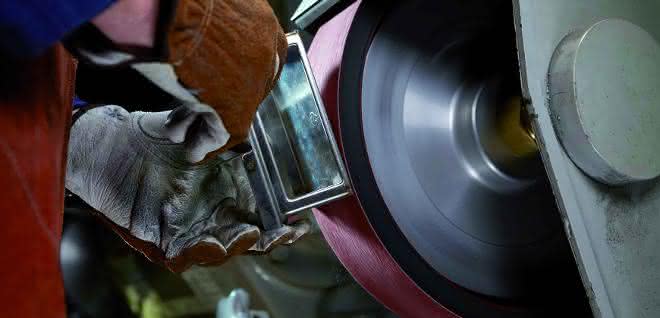
Aluminum is a light metal that has a strong tendency to smear during grinding, so open abrasive coatings or special coatings are used to prevent clogging. The machining behavior varies depending on the alloy, for example duralumin, as the material can be tougher or harder and more brittle depending on the application. The grinding pressure applied must be adjusted according to the hardness of the material. As a non-ferrous metal, aluminum has four times the thermal conductivity of iron-based metals, which means that the heat generated during grinding is dissipated more effectively.
For belt grinding applications on aluminum, the cutting speed should be set at 35 to 40 m/s higher than for ferrous metals, which in turn affects the stock removal rates and the service life of the tool used. High-performance sanding belts with precision-formed Cubitron II ceramic grain with grit sizes 36+, 60+, 80+ offer optimum sanding quality for heavy-duty stock removal and chamfering. Areas of use for mostly stationary sanding belt applications can be found, for example, in container construction or in aluminum foundries.
Rough cleaning wheels based on Scotch-Brite technology from 3M, for example, are suitable for removing corrosion, layers of paint or other adhesions on aluminum surfaces. The aim of the treatment is to remove the relevant layer with little pressure and at the same time minimize the risk of under-sanding, as deep sanding grooves would then have to be sanded out manually with great effort.
Any weld seams can be removed using an angle grinder with a fine 120+ grit fiber disc, for example. Cubitron II 787C fiber discs, available in grit sizes 36+ to 120+, are ideal for this. Fiber discs enable fast sanding processes with a high removal rate combined with a fast working speed and long service life.
Quick-change hook-and-loop discs such as the Cubitron II 947A Hookit (grit 40+ to 120+) for quick and easy replacement of the abrasive offer further advantages in terms of work efficiency.
Tip: Test a new sanding and polishing process on a sample part in advance.
Grinding aluminum - how it works
In principle, aluminum can be sanded in the same way as other metals. For larger, easily accessible surfaces on transportable workpieces, for example, processing on a long belt sander is ideal. Alternatively, angle and random orbital sanders are used for manual sanding. However, a few basic rules must be observed to ensure good sanding results on aluminum parts. The following section provides information on an exemplary manual machining process for aluminum sheets. Ultimately, the customer's requirements determine the sanding pattern to which the process is carried out.
- For a high removal rate, the sanding process is initially carried out with an 80 grit, which is refined in the subsequent work steps to remove the sanding marks from the previous pass. Unevenness can be avoided by switching to a random orbital sander using the cross sanding method at an early stage. To remove deep scratches, it may be necessary to work with slightly increased sanding pressure at the beginning.
- After each processing step, the surface should be cleaned of sanding particles using a cleaner and cloth.
- Hookit film wheels such as the 775L (grit 80+ to 400+) can be used for finer surfaces, while the 375L product range, for example, also offers the option of going up to 1500 grit.
- Polishing steps are possible from 800 grit. Depending on requirements, the polishing process can be continued in further steps up to a high-gloss finish.
Tip: When sanding aluminum workpieces, do not use tools that have previously been used for sanding other metals, especially iron and steel materials. Such grinding residues, which are worked into the aluminum in this way, can lead to corrosion later on.
Aluminium is normally matted to achieve a special visual effect. The aim is to retain the structure created during grinding, but to smooth the surface, as it is still relatively rough after processing with the abrasive grain. The peaks in the roughness profile in the form of surface burrs must therefore be removed by subsequent operations in the direction of the sanding stroke. Synthetic fiber nonwovens or nonwoven belts from the Scotch-Brite series, such as the SC-BL nonwoven belt, are primarily used for this purpose. In general, there are usually design or functional roughness depths (Ra, Rz, Rmaxinμm) that must be adhered to during surface treatment. This applies, for example, to hygiene requirements in the food industry.
Tip: When working with the angle grinder over several grit sizes, it is advisable to always maintain the same sanding direction within a sanding pass with the same grit size. Cross-sanding with the same grit should be avoided, as otherwise it is not possible to tell whether the next sanding pass, which is to be offset by 90°, has completely blended the previous sanding.
This visual inspection can only be used to a limited extent for eccentric sanding due to the irregular sanding pattern. In this case, it is recommended to measure the surface roughness to ensure that the grinding grooves from the pre-grinding have been successfully removed.
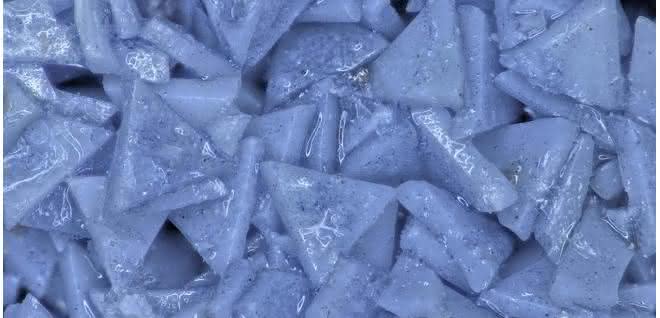
3M flap discs with Cubitron II (precision-formed grain with uniform triangular grain geometry and size) with good cutting performance are also available on the market. These grinding wheels are available in conical and flat versions.
With flap discs, flexible flaps with abrasives are arranged in a fan shape around the tool axis. They are suitable for grinding work on aluminum, for example in container and apparatus construction on components with radii, for deburring edges, contours and openings, for chamfering, for cleaning weld seams and for pre-grinding during flat processing.
Hand pads, for example from the 3M Scotch-Brite series, can also be used as an inexpensive option for simple manually produced grinding patterns. In conjunction with a hand sanding block, tarnish can also be removed in the area of TIG seams.
Safety first
Fine aluminum dust produced during brushing, grinding and polishing can form an explosive mixture in combination with atmospheric oxygen. A static discharge is often sufficient as an ignition source. This is particularly true for dust particles smaller than 500 µm. The following rules should therefore be observed when grinding aluminum:
- Collect dust immediately using suitable extraction equipment, e.g. wet dust extractor,
- remove all sources of ignition from the working area,
- grinding equipment used must comply with ATEX requirements,
- Avoid parallel processing of sparking materials in the vicinity,
- Use suitable personal protective equipment and have fire extinguishing equipment ready.
When handling potentially toxic aluminum particles of respirable size, there is a risk of chronic lung diseases such as aluminosis (aluminum asthma), cancer and damage to the central nervous system. Therefore, the use of suitable respiratory protection is strongly recommended to prevent inhalation of aluminum dust during sanding. 3M offers a wide range of occupational safety products and competent advice on the selection of suitable personal protective equipment.
Fynn Rosenau, Advanced Application Engineer at 3M / ag


You might also be interested in
Handling and storage solution from Viastore
Hardware and software for the fully automated warehouse
As part of the restructuring of its plant in Curitiba, Brazil, household appliance manufacturer Electrolux has switched to a fully automated warehouse. The literal verticalization of stocks increased productivity, reduced costs and standardized the...
 read more...
Drives for autonomous mobile robots
Fast delivery thanks to powerful drives
Knapp's Open Shuttles, autonomous mobile robots (AMR), enable the automation of in-house transportation without having to adapt the existing infrastructure. The installed drive solutions from Dunkermotoren and gearbox manufacturer Framo Morat enable...
read more...Radio networks for the flow of information
How do you integrate moving components and load carriers into the internal information flow? A radio-supported automatic material retrieval system (AMS) is available for this task, which also precisely records the stocks of goods in the (material)...
read more...Flexibility in the warehouse
Autonomous mobile robots make it possible to automate in-house transportation without having to adapt the existing infrastructure. The built-in drive solutions allow even bulky and heavy loads to be transported safely.
read more...Measure, report, optimize
Trouble-free system control is the basis for efficient production - and this in turn requires seamless, precise monitoring of important parameters.
read more...Modular storage concept
Gebhardt will be presenting the new Gebhardt Upstream at its LogiMat trade fair stand. The proven software solutions, warehouse technology solutions and conveyor technologies such as Galileo IoT, StoreWare and SpeedSorter can also be seen there.
read more...Four automation tips for SMEs
Cobots and mobile robots support automation projects in SMEs. What to look out for when taking the first steps.
read more...Scara robots change the profitability of automation
The introduction of low-cost robots to supplement human capabilities can increase the speed and quality of production. Yamaha uses the example of automated quality control of injection molded parts to show how this can be achieved.
read more...Energy supply, motors and drives
Customized drive technology for intralogistics
ABM Greiffenberger will be presenting complete drive solutions at LogiMAT (April 25 to 27). The system provider adapts these to specific applications and customers - always in close and cooperative partnership with the customer.
read more...