
Spindle row turret
Parallel machining of complex workpieces
In order to be able to reproduce all processing steps of complex workpieces with standard motor spindles, several machines are often required. As a result, time and accuracy are lost due to time-consuming reclamping. A spindle row turret offers a more flexible solution for multi-spindle parallel machining of complex workpieces.
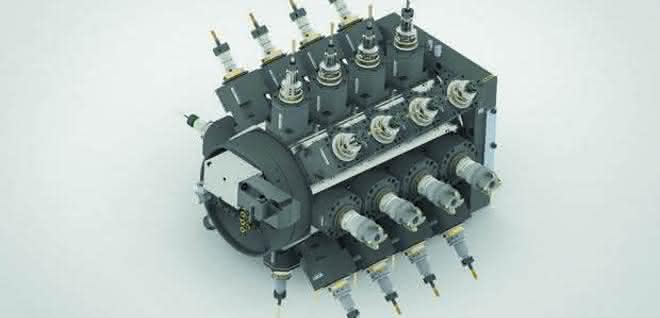
Automotive manufacturers produce small to medium-sized components in large to very large quantities in transfer centers. In order to be able to map all processing steps for a series, manufacturers often require several processing machines that are coupled in series. The reason for this is that spindles are often used that all have to be driven individually. As a result, it is often not possible to integrate the required number of spindles for simultaneous complete machining of several components into one machine in a sensible and collision-free manner. This has an impact on the quality and speed of the production process: if several machines are required to manufacture the workpieces, the blanks have to be reclamped several times, which results in a loss of time and accuracy. In automotive production, which has to meet the highest quality standards, efficiency requirements are increasing significantly. Machine manufacturers are therefore called upon to offer the industry alternatives to conventional machining centers.
Four direct drives for 32 tools
In collaboration with Elha-Maschinenbau, Sauter Feinmechanik has developed the first spindle row turret. The machine has the typical characteristics of a direct-drive tool turret, is gearless, wear-resistant and can be kept in continuous operation 24 hours a day, seven days a week. In addition, the spindle row turret has several working positions connected in series: two to four spindle rows, each of which is set in motion by a water-cooled direct drive. This allows up to four tools to be driven simultaneously - one per row. Eight tools are available in each spindle row for machining a workpiece. As soon as a machining step is completed, the spindle row turret swings to the next position within 0.8 seconds and a new tool is used in each row.
Currently, up to four spindle row turrets, each with four spindle rows and a total of 128 tools, can be integrated into one transfer center. This means that up to 32 machining steps per workpiece can be realized in just one machine without retooling. The reason for this high level of flexibility is that, while individual spindles require a drive for each spindle, eight tools are driven by a direct drive in the spindle row turret. "In addition to the quick changeover from one working position to the next, the large number of different tools is one of the major advantages of our spindle row turret. This means that the workpiece never has to be reclamped. This gives users a significant boost in productivity and increases the quality of their components at the same time," says Matthias Beck, Head of Design Tool Carrier Systems at Sauter.
High speeds and torques
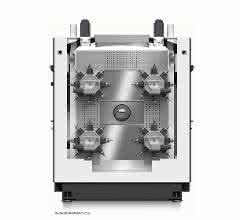
Not only the change between the machining steps, but also the duration of the individual processes is significantly accelerated by the spindle row turret. This is mainly due to the highly dynamic synchronous motors in the tool disks, which enable high speeds and torques. Users thus maximize their metal removal rates and massively reduce their workpiece times. To exploit this potential, Sauter has developed new safety systems: Before all four direct drives are engaged simultaneously, a three-part Hirth coupling locks the tool disks with micrometer precision and the desired tools are in the working position. This coupling profile ensures maximum process stability, enabling torques of up to 250 Nm to be achieved.
As soon as machining begins, the internal coolant supply with a pressure of 80 bar conveys coolant through the direct drive and the tooling to the tool cutting edges. If required, the spindle row turret can also be converted to minimum quantity lubrication. In this case, an aerosol is transported through the tool to the tool disk. As no cooling lubricant is used, minimum quantity lubrication is more environmentally friendly than conventional cooling.
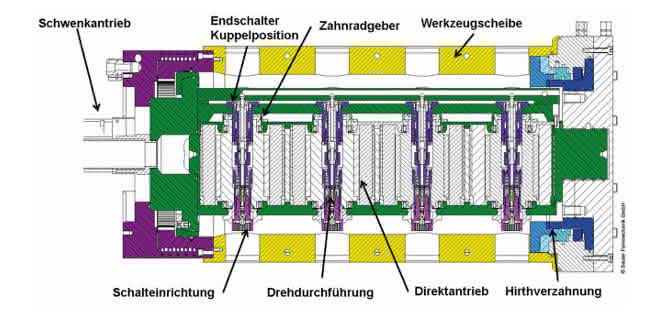
A new sealing concept is used in both variants, which dispenses with contact seals and reduces friction during use. This increases process reliability when transferring coolant between the tool turret and tooling and enables speeds of up to 16,000 rpm. Such results are possible because Sauter offers a complete tool technology package consisting of tool turret, tooling and set-up systems: "It is a central part of our philosophy to perfectly coordinate all components. This enables us to achieve consistently high quality. This is illustrated by our sealing concept, which is based on the interlocking of the tool turret and tooling," says Beck.
Long service life
The great value of the spindle row turret lies not least in its durability. If necessary, key components of the tool turret can be easily replaced. This means that it remains operational for a long time and can be flexibly adapted to changing requirements and technical possibilities. For example, the entire direct drive unit in the machine can be replaced in the event of wear or if a higher motor output is required. This means that the tool turret, which is optimally aligned on the machine, does not have to be moved again, which would result in a loss of accuracy. Changes to the tooling are also straightforward - in contrast to machines with fixed spindles. Users gain a high degree of flexibility. "When designing the spindle turret, we paid particular attention to ease of maintenance and repair. The tool turret has a very long service life thanks to the easy replacement of individual components. We therefore offer a particularly economical and sustainable solution," says Matthias Beck.
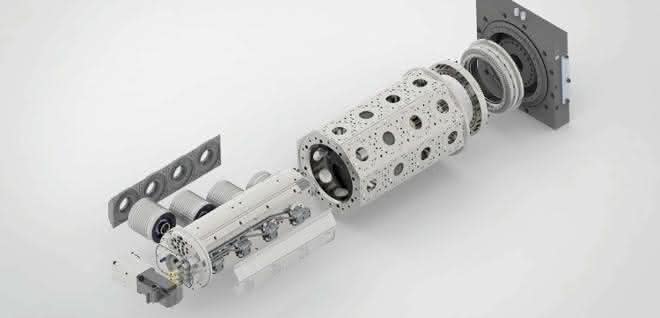
Users of the spindle series turret achieve high efficiency and quality in the large-scale production of complex automotive components. During operation, the tool turret changes from one tool to the next in less than a second. High metal removal rates can be achieved during machining thanks to the powerful synchronous motors. The result is very short workpiece times. The spindle row turret is also very flexible. Thanks to the large number of different tools, all machining steps can take place in one machine. This means that the workpieces do not have to be reclamped and there is no loss of accuracy, as is the case with conventional machining centers. This also benefits product quality. If necessary, individual components of the tool turret can also be easily replaced. The spindle turret therefore has a long service life and supports the user for many years with the most demanding tasks in multi-spindle machining.
Felix Schöller, Sales Manager (CSO) at Sauter / am


You might also be interested in
Motors, gearboxes and encoders: Faulhaber expands Ø 16 mm portfolio
Faulhaber is expanding its portfolio with new DC motors from the SXR and GXR family, a 16 mm planetary gearbox and the IEX3 magnetic encoder for compact drive solutions.
 read more...
New drive solutions for industrial automation and robotics
Faulhaber presents drive solutions with the new GXR and SXR motor family, which offer high efficiency and flexibility in combination with powerful gearboxes and encoders. These optimized components open up new possibilities for applications in...
read more...Marco Altherr becomes new Chief Financial Officer
The Supervisory Board of Ziehl-Abegg has appointed Marco Altherr as the company's new Chief Financial Officer (CFO). Altherr will take up his post in May 2025.
read more...Hydrogen storage in metal hydride
With its focus on storage systems for green hydrogen in solid form (metal hydride), GKN Hydrogen presents itself as a pioneer in safety and efficiency for the industry. GKN Hydrogen offers safe storage systems for green hydrogen and focuses on two...
read more...INDUSTRIAL Production Products of the year...
2nd place, Robotics category: EGS Automation
The SUMO automation systems from EGS Automation - economical standard solutions for automating a wide range of processes in plastics and metalworking - took second place in the robotics category in the competition for Product of the Year 2024.
read more...More productivity with Drive Intelligence
The trends in automation are productivity, sustainability and connectivity. Baumüller is launching new products on the market that address these trends, including new tools for smart energy monitoring, condition monitoring in the drive and new...
read more...Intelligence in Motion
At SPS, Koco Motion will be showcasing its expertise in customized drive solutions based on DC and BLDC motors, stepper motors, servo motors, linear drives and controllers.
read more...Nomination Products of the Year 2024
EGS Automation: SUMO automation systems
The SUMO automation systems from EGS Automation, economical standard solutions for automating a wide range of processes in plastics and metalworking, have been nominated in the Robotics category in the competition for Product of the Year 2024.
read more...Transport technology from the modular system
Many transport tasks can be realized with the help of linear technology. Pre-configured solutions are available to simplify the interaction between the linear unit, motor, gearbox and controller. This minimizes the effort required for research and...
read more...