
Turning centers
Optimize processes automatically
With three new turning centers from DMG Mori, the Mapal subsidiary WTE Präzisionstechnik has taken a major step forward in process optimization in the production of clamping, drilling and shrink fit chucks.
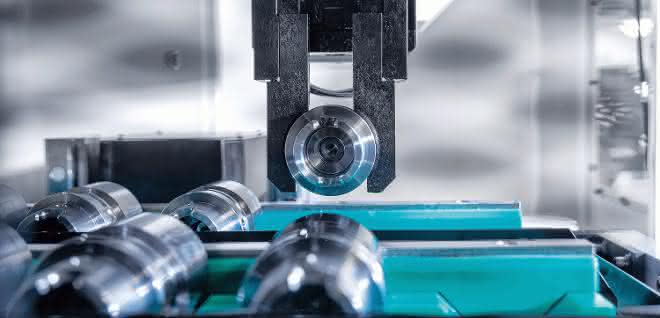
The history of WTE Präzisionstechnik from Ehrenfriedersdorf began in 1999 with twelve employees producing the first precision drill chucks. Through steady growth and integration into the Mapal Group in 2008, the company has grown into a 170-strong competence center for clamping technology. Like the parent company, this site has also relied on machine tool technology from DMG Mori for many years - 17 machines in total. As recently as 2019, three new turning centers were installed to expand capacity: an NZX 2000 and an NLX 2500, which operate automatically via gantry loaders, as well as an NLX 2000 with bar loader.
Clamping, drilling and shrink fit chucks
"The innovative clamping technology from WTE Präzisionstechnik was the main reason for the integration into the Mapal Group," recalls Ralf Wackenhut. The Managing Director of the subsidiary was still working at the headquarters in Aalen at the time and knows the motivation: "We have thus completed the product portfolio and can now act as a complete supplier on the market." WTE Präzisionstechnik manufactures a wide range of clamping, drilling and shrink fit chucks for large customers as well as for the commercial business. "This means that, on the one hand, we have production quantities that are easy to plan for the trade, while on the other hand we have to be able to react flexibly to short-term orders in direct customer business."
Maintaining quality-oriented production under these conditions is a challenge for which Ralf Wackenhut - initially as Technical Manager - moved to Ehrenfriedersdorf. "Intelligent processes are the be-all and end-all," he says. WTE Präzisionstechnik uses DMG Mori machining centers and lathes to achieve DIN final contour dimensions in soft machining. "Growth through hardening is calculated in such a way that the reworking effort in hard machining is reduced to a minimum."
Unmanned night and weekend shifts
Ralf Wackenhut sees additional process optimization in automation: "We mainly produce in batch sizes of one hundred components, so automated processes have great rationalization effects - especially in unmanned shifts at night and at weekends." Multi-machine operation is also an important factor. The NZX 2000 and NLX 2500 purchased in 2019 are both equipped with a GX 10 T gantry loader, which loads the respective work area and removes and places finished parts. While the NZX 2000 processes the more demanding front side of the base bodies, the NLX 2500 is responsible for the comparatively fast processing of the taper on the back. "To
To utilize the free capacities, we also feed workpieces from other machines into the system," explains Ralf Wackenhut. All the operator has to do is push a shelf with the components into the automation system. When it comes to automation, WTE Präzisionstechnik relies on standard machines and standard components: "On the one hand, the gantry loaders are simply tried and tested, and on the other, it makes designing and purchasing the systems easier." This also applies to the NLX 2000 with bar loader: "The two gantry solutions only process pre-sawn piece goods. On the smaller machine, we then have the option of processing components from the bar in a largely automated process."
Efficient machining in a single clamping operation
In view of the complex chucks that WTE Präzisionstechnik manufactures, the versatile machining options of the turning centers - i.e. turning and demanding milling operations in a single set-up - were also decisive for Ralf Wackenhut: "We used to need several process steps on different machines for the same components. The reduction to front and back machining has significantly reduced throughput times in favor of our responsiveness."
Wackenhut is optimistic that WTE Präzisionstechnik will grow in the future: "We have sufficient space available and we can also find good skilled workers if required." Or we train them ourselves. Three to four apprentices are taken on each year. "More and more of them are women," says the Managing Director, pleased with the interest shown by female applicants in technical professions.
In terms of technology, Ralf Wackenhut is also looking to the future. "We see great potential in additive manufacturing," he says, referring to the Lasertec SLM machines from DMG Mori. One example is the hydraulic expansion technology from WTE Präzisionstechnik. Hydraulic expansion chucks have internal channels in which pressure is built up with oil, which clamps the tool. The technology dampens vibrations, ensures high concentricity and is very low-maintenance. The production of small hydraulic chucks is not possible using conventional methods due to the extremely fine channels: "Manufacturing in a powder bed is a very interesting alternative here."


You might also be interested in
New Trade Show for the Turned Parts Industry
The Association of the German Turned Parts Industry has given a positive assessment of the first Make-to-Order (MTO) Days: With 184 exhibitors and approximately 1,400 trade visitors, the inaugural event proved to be a successful platform for...
 read more...
In-house exhibition Bielefeld 2026
How DMG Mori thinks about the factory of the future
DMG Mori will be showcasing turning and milling expertise, automation solutions and additive manufacturing along the Machining Transformation (MX) at the Bielefeld 2026 in-house exhibition.
read more...Association of the German Turned Parts...
Turned parts industry looks cautiously to the future
Rising order intake, new members, cautious optimism: the members of the Association of the German Turned Parts Industry are confident. At the spring conference in Leipzig, around 150 participants discussed current market developments, strategic...
read more...World premieres at the EMO 2025
From September 22 to 26, 2025, Grob will be presenting several innovations at EMO Hannover. The focus of the trade fair appearance will be on the latest 4- and 5-axis universal machining centers and the associated automation solutions.
read more...Efficient complete machining
Index-Werke will be bringing the Index G220 turn-mill center and the Traub TNA400 universal lathe to Intec.
read more...Digitization of process chains
CAM system Hypermill in practice
At EMO 2023, Open Mind will focus on turning, milling and the importance of CAM software and MES in networked production environments.
read more...High-speed spindle in handbag format
Modules for milling and turning
At Weiss, the focus is on the new 1.5 kilogram micro-mill spindle, which rotates at up to 60,000 revolutions per minute.
read more...Handling and workpiece clamping
Networked production starts with the component
Schunk is coming to Hanover with a 360-degree portfolio covering all aspects of machine tools. The focus will be on more sustainable production, connectivity and e-mobility.
read more...Stroll through the city
DMG Mori is inviting visitors to take a stroll through the city at EMO: In a specially constructed DMG Mori City, the machine tool manufacturer is concentrating on its focus topic of Machining Transformation (MX).
read more...