

Machine tool industry 2019/2020
VDW expects production to fall by 18 percent
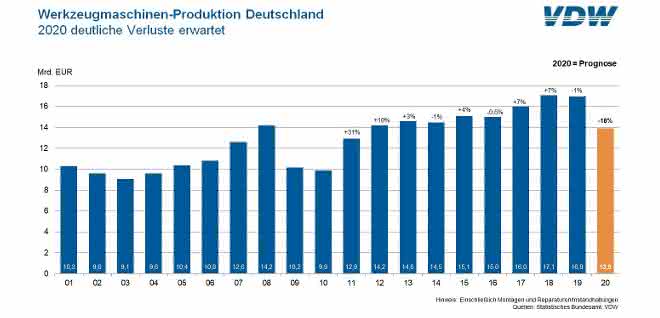
Although 2019 was better than expected, the VDW is forecasting a decline in production of 18% for the current year. The reasons are a combination of structural change, economic policy and unforeseeable developments.
"You see us today with a smile and a tear in your eye. Laughing, because in the end 2019 went better than expected; crying, because 2020 and the following years hold greater challenges for our industry than we have seen for a long time," was how Dr. Heinz-Jürgen Prokop, Chairman of the VDW, began the VDW's annual press conference in Frankfurt am Main on February 13.
After the decline in demand in the machine tool industry began in the second half of 2018, the downturn continued in 2019. Nevertheless, production was almost at the previous year's level: only a decrease of 1% was recorded in 2019. Machining in particular, which accounts for the largest share of machine production at 80%, saw an increase. Repairs and maintenance also increased slightly.
"The main pillar was domestic sales, which rose by 16 percent. In contrast, exports fell by 9 percent. This is mainly due to the 11% drop in deliveries to Asia and 16% to America. Here it is the two largest markets China, down 13%, and the USA, down 15%, that dominate the regional result. Europe, the largest sales region, which accounts for more than half of German exports, held up comparatively well at minus 5 percent. The bright spots are France, Switzerland, the Netherlands and Hungary, which were able to grow among the top 15 markets," says Prokop, summarizing the figures.
Significant decline expected, no improvement in sight for the time being
A significant decline in production of -18% is expected for the current year. "In 2019, the industry still benefited from full order books and high capacity utilization. Both melted away over the course of the year. The decline in demand, which began in the second half of 2018, really picked up speed in 2019. The double-digit decline of more than a fifth - which applies to a similar extent to both domestic and foreign demand - sets the course for the 2020 production result," says Prokop. The industry, which had been booming in recent years, had not seen this for a long time.
The VDW cites a combination of a cyclical economic downturn, structural change in the automotive industry, turbulence motivated by trade strategy and, last but not least, the coronavirus as the reasons for the global slowdown in investment. According to Oxford Economics, the VDW's forecasting partner, capital expenditure is expected to increase by less than 1 percent this year. Only smaller markets such as Vietnam, Thailand, Slovakia, Hungary and Poland are faring much better. They are in no way able to compensate for the reluctance of the major customer countries China, USA, Italy or France. The result is a correspondingly large drop in all key figures for the German machine tool industry in the current year, production, exports, imports and demand.
"The lean period will continue for large parts of industry in Germany," predicts Prokop. Industrial production in this country will fall again, while capital investment in the main customer industries will only increase marginally. After a slight decline in the previous year, machine tool demand is expected to fall by a fifth in 2020.
The Ifo Institute's business climate and Markit's purchasing managers' index, both leading indicators for future development, are showing an upward tick in many areas at the current margin. However, according to the VDW, this is no more than a glimmer of hope, as many curves are still deep in the red. "Unlike in previous downturns, it is therefore unlikely that things will pick up again very quickly," expects Prokop. Rather, the machine tool industry will only see a certain bottoming out of incoming orders in the second half of the year, but this will probably not be enough for a turnaround. Production will therefore only recover slowly and will take a while to return to the level of previous years.
Brexit and Trump - no all-clear in sight
"It would be helpful if the international trade policy turbulence calmed down, as this is one of the main causes of the weak demand and continues to lead to great uncertainty among customers. However, with Brexit, US-China, Russian sanctions, Iran and many more - the keywords have been mentioned many times - there is no all-clear in sight. As a manufacturer, there is very little we can do to change these politically driven influences," says Prokop, summarizing the trade policy conflict situation. Prokop emphasized that a free trade agreement with the UK must now be negotiated quickly in order to ensure that bilateral business continues to run smoothly. Customs duties, the smooth handling of goods transports, the functionality of supply chains, the secondment of employees and much more must be regulated.
"The trade agreement between China and the US is initially encouraging. However, it is far too early to sound the all-clear. And it is by no means certain that a potential election victory for US President Donald Trump in November will not lead to a resumption of the conflict. An end to the Russia sanctions is also not in sight. The Iran conflict continues to escalate. From our point of view, it is important to keep urging politicians to address the value of free trade internationally and to campaign for its preservation," says Prokop.
Driving forward digitalization and sustainability
The machine tool industry now has the opportunity to reinvent itself to some extent. As a core component of industrial production, machine tools can make a decisive contribution to meeting climate targets. Prokop: " The industry's own initiatives and close links with research into production technology are launching many ideas that will lead to more sustainable products and more efficient processes. However, this cannot hide the fact that these are only individual building blocks to compensate for the losses to some extent."
Digitalization also offers opportunities for new business models and efficient production. "The European machine tool association Cecimo has determined that just 5% of small and medium-sized manufacturing companies in Europe have networked their machines, plants and systems across the board. And only one in three companies are taking or planning their first steps in this direction. This shows what potential is still hidden here," says Prokop, explaining the opportunities for the industry.
At the moment, predictive maintenance is the technology that offers clear advantages both economically and ecologically. According to the industry association Cecimo, digitalization can also reduce the total downtime of machines by 30 to 50 percent while increasing the service life of the machines by 20 to 40 percent. "In critical times, customers are becoming more aware of these aspects again and are also prepared to pay for improvements," says Prokop.


You might also be interested in
E-scooter with customizable damping
The startup Scuddy has significantly improved the flexibility, performance, customizability and ergonomics of its second-generation foldable e-scooter of the same name - thanks in part to damping technology from ACE.
 read more...
Hurdles on the road to success
Welding is one of the most complicated processes in the manufacturing process, and it is becoming increasingly difficult to find suitable personnel. Can this problem be solved by automating processes? Can or should the robot colleague replace the...
read more...New plug-and-play solutions for the warehouse
Exotec announces a new Skypath conveyor system, the optimized Skypicker picking robot and Deepsky, another proprietary storage software. All three products can be seamlessly integrated into the manufacturer's Skypod system.
read more...Production automation
At Motek, Weiss will be presenting solutions for the linear and rotary movement of workpieces that can be easily integrated into the overall system of hardware and software.
read more...Solutions for surface hardening
Many industrially used components require a combination of a tough core and a hard surface layer so that they can better withstand the stresses of use. Hardening is achieved by rapidly heating the surface and then cooling it quickly.
read more...Wheel bearings and wheel bearing sets
Low-friction rolling behavior
Hecht Kugellager offers a wide range of bearing technology for use in the automotive industry, commercial vehicles and mobile machinery.
read more...Simulation in product development
The Munich-based start-up Spyra significantly shortens the development time of its production by using Solidworks simulation solutions.
read more...Doubling production capacity by 2026
Nabtesco is investing in a third production site, doubling its production capacity to two million precision gearboxes per year by 2026.
read more...Counterbalance trucks with lithium-ion technology
Clark has relaunched the GEX and GTX series.
read more...