
High Dynamic Turning
All turning options with one tool
With High Dynamic Turning, or HDT for short, Ceratizit has developed a turning technology that, in combination with the dynamic free-turn turning tools, makes it possible to perform all turning operations such as roughing, finishing, contour turning, face turning and longitudinal turning with a single tool.
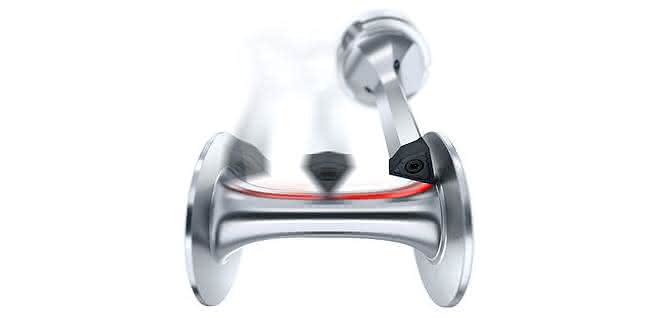
Although new cutting materials, new chip grooves and in some cases new tool systems have been invented time and again to optimize the turning process, the actual turning process has basically remained unchanged. Even today, a contour is still produced with an indexable insert at a fixed angle to the workpiece, although the number of controllable axes in modern turn-mill centers has changed. The company has taken advantage of the system of these turn-mill centers and developed High Dynamic Turning. The idea behind HDT: simply position and adjust the tool in the machine in a completely different way to conventional turning.
Use of the milling spindle for 360° degree of freedom
Instead of the classic, static positioning of the insert by the clamping holder, the milling spindle is now used to create the corresponding angle to the workpiece. By using the spindle drive in conjunction with the slim, axial tool design of the free-turn tools, a degree of freedom of 360° is created without the risk of collision. Rotation around its own tool axis means that the cutting edge can be changed without interrupting the machining process. The approach angle is also freely variable and can be changed during machining. This offers flexibility in the workpiece contour, optimized chip breaking, higher feed rates and an increase in tool life. Depending on the machine options, the technology can be used functionally in all planes. By incorporating the milling spindle on turn-mill centers, the Y/Z-plane approach is widely used, allowing machining from above and below, for example. Depending on the machine room and workpiece size, this freedom can be an important criterion.
Indexable insert with several features
For High Dynamic Turning, static turning tools will be replaced by dynamic ones in the future. One such dynamic tool is the Free Turn. The tool holder and the slim shank, which directs the force into the spindle thanks to the axial concept, form a stable unit. A multi-sided indexable insert is located on the front, which is simply screwed on. The highlight: The patent-pending free-turn indexable insert can consist of several cutting edges with different properties. For example, different point angles, corner radii or chip grooves - even different coatings and cutting materials are possible. This means that the tool can be adapted to the machining process and replace several tools. This in turn leads to savings in tool change times, tool magazine locations and tools themselves. Another feature is that components with highly complex contours can be produced without restriction using just one free-turn tool.
Ceratizit was recognized for its HDT technology at Intec 2019.


You might also be interested in
Further simplify assembly processes
In addition to the proven racks with a length of one meter, Wittenstein alpha now offers optional two-meter racks for linear systems. They are particularly suitable for use in short axes, for example, in order to simplify assembly even further.
 read more...
Hiwin manufactures its own shaft gearboxes
Have you ever waited several months for an urgently needed corrugated gearbox? Hiwin has too. That's why the Offenburg-based drive specialist has decided to produce its own space and weight-saving reduction talent.
read more...Human-robot interaction at the trade fair
Sumitomo Drive Technologies is presenting its drive solutions for automation and robotics at Automatica 2023 together with the Lafert Group. The company will be showcasing two different applications of the Tuaka drive system for robot applications...
read more...Partial automation with robots
At Automatica, Promess will be showcasing its modular individual workstations and how these can be partially automated with robot support. The servo press manufacturer will also be providing information about the latest features of its Revolution X...
read more...A new benchmark for collaborative robots
At this year's Automatica, Denso Robotics will be showcasing its innovations in the field of robotics. The collaborative Cobotta Pro product family will be the focus of the presentations. Visitors to the trade fair can see all variants in various...
read more...Clamping system for a new milling machine
Investments in machinery often lead to further purchases - as is the case at Joma-Maschinenbau, whose modern production facility has recently been supplemented by a 5-axis milling machine.
read more...Schunk wants to simplify processes in automated production
The declared aim of automation specialist Schunk is to make its customers' processes comprehensible, simple and efficient. Data transparency plays an important role in this. It enables reliable processes and provides the basis for resource-saving...
read more...Festo and Hahn Automation develop battery tester for greater safety
The success and reputation of electric vehicle manufacturers depend on the safe and flawless functioning of batteries. Hahn Automation has therefore developed a battery tester that performs a fully automated 100% test of mobile energy storage...
read more...SPN Schwaben Präzision presents gearbox solutions for automation and industrial robotics
Short cycle times, robust technology, wear-free surfaces and compact designs have always been relevant for automation and robotics solutions. This year's Automatica trend topics include "Sustainable production" and "Digitalization and AI". SPN aims...
read more...