
Electromechanical release unit
Releasing without air and oil
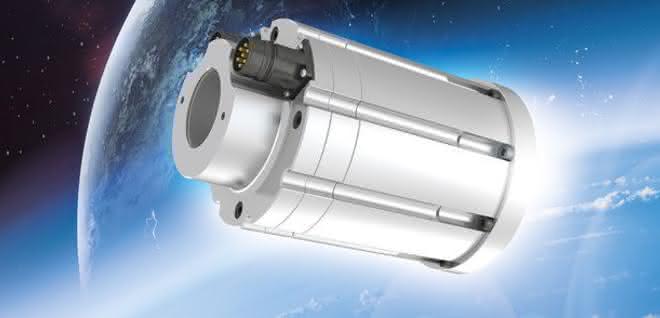
Ortlieb Präzisionssysteme recognized and followed the trend towards electric drives at an early stage. With its EML electromechanical release unit, the company is meeting the demand from customers in the machine tool and spindle construction industry for "fluid-free machines".
With a 30 percent shorter release time for the tool holder, productivity can be increased, which, in addition to the advantages of fluid-free operation, also contributes to the interest in purchasing a suitably equipped machine tool - even if this is associated with higher acquisition costs. The increase in productivity is particularly significant where parts with short cycle times per tool are machined.
The tool is clamped by springs via a force-enhancing mechanism. To release it again, a force must be applied against the spring. The EML requires a smaller installation space than pneumatic solutions. Hydraulic units require a lot of energy and also carry the risk of leaks. The use of EML, on the other hand, guarantees leakage-free operation and also opens up new possibilities in the area of chip detection and clamping force control. The electrical input and output variables can be easily measured. Further processing of the process data in line with Industry 4.0 ensures improved production, control of tool life and optimized throughput times.
Hollow shank taper clamping systems
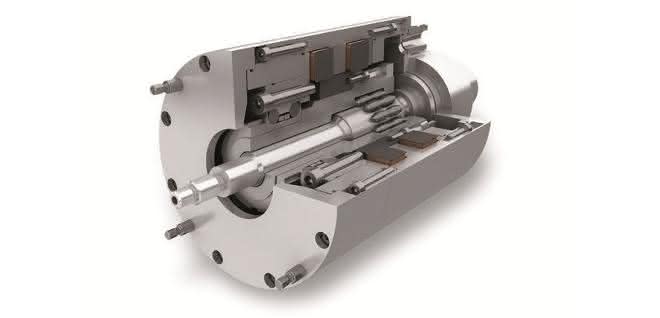
Hollow shank tapers (HSK) as tool holders are not only suitable as a separation point within the tool system, but also as an interface for direct mounting in machine spindles and tool carriers. The spring assembly is supported on the bearing shaft and presses the threaded bush to the right. This is bolted to the drawbar and thus exerts a tensile force on it. The tension bolt is attached to the other end of the tension rod. The clamping segments grip into the hollow cone of the tool insert and are spread open by the draw bolt, pulling the hollow cone into the fit. Due to the special geometry, the force is increased and the threaded bush is pushed to the left when the tool is changed. The draw bolt also moves to the left. The clamping segments loosen and contact the draw bolt. The draw bolt then docks onto the tool insert and presses it out of the taper seat.
The role of the release unit
The release unit now has the task of moving the drawbar against the spring force during tool changes. Due to the high rotational speeds during milling, it has proven useful to arrange the release unit in a stationary position. During the milling process, it is not in contact with the rotating parts. As cooling lubricant must be supplied during machining, a rotary feed-through is required, which is usually located behind the release unit. The release unit must therefore have a bore through which a rotating pipe leads to the rotary union.
The core drive element of the EML is the planetary roller gear spindle (PWG) with its high force density and stability. Its simple design makes it possible to develop high axial forces from low motor torque with just a few components in a small installation space. With these so-called ASCA servo spindles, Ortlieb offers a technology that was originally developed by the German Aerospace Center and made ready for series production by Ortlieb. With the spindles, small pitches in the millimeter range can be achieved with a long service life. This allows new mechatronic drive solutions to be implemented that were previously not possible.
Jutta Jerabek, Marketing and PR at Ortlieb / am


You might also be interested in
Plagiarius 2024 negative prize
On January 26, 2024, the Plagiarius campaign awarded its dreaded "Plagiarius" negative prize for the 48th time to manufacturers and retailers of particularly brazen counterfeits and fakes.
 read more...
Ivalua honors winners of the Generative AI...
AI-supported "add-ons" for buyers within 48 hours
Ivalua, provider of cloud-based spend management solutions, announced the winners and innovations of the first Generative AI Innovation Cup. The competition took place in December 2023. It was open to all Ivalua partners and employees - more than...
read more...Efaflex celebrates 50 years of high-speed...
The emphasis is on "fast"
Since day one, Efaflex has wanted to use new technologies as early as possible and drive progress in the industry. This year, the family business is celebrating its 50th anniversary under the motto "Fast Forward".
read more...Security of supply even during power outages
In the winter of 2022, Germany was worried about energy shortages. The drugstore retailer dm did not paint any horror scenarios, but nevertheless saw the possibility of controlled, temporary, regional power cuts (brownouts).
read more...Safety technology in mechanical engineering
Modules with new functions
Euchner's product highlights at EMO 2023 include the communication-capable solenoid interlocks.
read more...Transforming the paper industry towards climate neutrality
Together with partners from industry and research, Voith is developing a project for the optimization of energy and material flows in paper production. The aim of the research project is to develop a digital framework that enables effective process...
read more...Up to 95 percent less flue gas thanks to direct extraction
The requirements for occupational safety measures and safety technology are also constantly increasing in welding technology. The Technical Rules for Hazardous Substances (TRGS) stipulate that welding fumes and harmful substances must be extracted...
read more...Competitive advantages with large machines
Whether 3D-printed components for machines and systems, prototypes or aids for design: additive manufacturing is almost indispensable for modern companies in mechanical and plant engineering and automation if they want to play in the premier league.
read more...Transport technology from the modular system
Many transport tasks can be realized with the help of linear technology. Pre-configured solutions are available to simplify the interaction between the linear unit, motor, gearbox and controller. This minimizes the effort required for research and...
read more...