

AMB 2022
CNC machining in large format
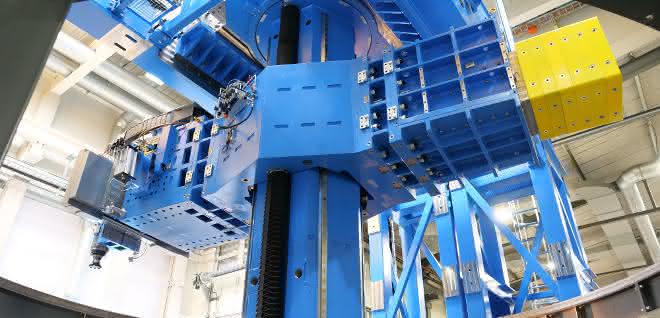
Two Swiss companies designed the world's largest mobile CNC machining center for the revision of power plant components with contours of up to 8,000 mm. The automotive and industrial supplier Schaeffler was responsible for designing the sophisticated bearing technology.
However, the development of the "Turningator 6000C" is also a story of people who repeatedly find innovative solutions to extraordinary challenges. While the Swiss company Wysshus was responsible for the entire project planning and organization, Bunorm, also based in Switzerland, took on all design tasks, production and assembly through to commissioning. The two companies previously developed the standard sizes of the Turningator: 2000, 4000 and 6000, and Schaeffler also supervised these projects in the past. The current Turningator 6000C, with a machining diameter of up to 8,000 mm, surpasses the previous machines and was to be completed in just under a year. However, the design of the Turningator had to be fundamentally adapted to the new dimensions and calculated.
Markus Havrda, project manager at Wysshus: "The normal, serial process, as is usual in mechanical engineering, was not possible for this project due to time constraints. Together with our suppliers, including Schaeffler, components and assemblies with long delivery times were identified and brought forward, designed and ordered early in the design phase." Knowing what the next steps are and what needs to be clarified and procured when is Wysshus Engineering's core business. Havrda adds: "This rather unorthodox but very effective project process was only possible because Bunorm and Schaeffler worked together optimally on design, engineering, production, procurement and assembly at the same time."
Always an alternative at hand
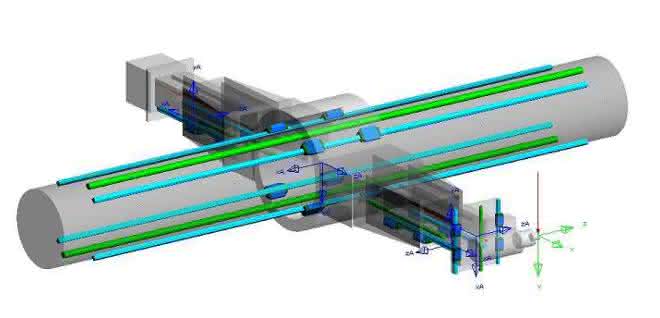
Werner Locher, Head of Field Sales at Schaeffler in Switzerland, recalls the initial concepts: "We discussed and calculated various bearing designs for the main axis. The starting point was YRT bearings, double direction thrust bearings with radial guide bearings, which have been used successfully for years in the two smaller machines, Turningator 2000 and 4000. However, these bearings were not available in the size of over 1,200 mm shaft diameter. In the end, we opted for the crossed roller bearing with an inner diameter of 1,270 mm." These bearings have a very small cross-section in relation to their load capacity. This was important because the main shaft and two ball screw drives had to be guided through the inner ring of the upper main bearing.
The electronically synchronized ball screws encapsulated in black bellows support and position the 20 t Z-axis. Locher explains: "With normal solutions for the axial bearing of the ball screw spindles of the suspended axis, you don't get very far with these forces. We have had good experience with double-row axial spherical roller bearings in projects with similarly high forces and therefore recommended them to the Bunorm designers." A special feature of this mobile processing machine compared to its stationary siblings is that the Turningator can be used with both vertical and horizontal main shafts. This has consequences for the bearing load: In the vertical position, the lead screws and double-row axial bearings of the Z-axis have to transmit the centrifugal forces and the cutting forces.
With the main axis horizontal, the weights of the Z-axis slides are superimposed on these forces: The double-row axial bearings of the threaded spindles are loaded once in tension and once in compression with each revolution by the weight of the axis. The challenge is to ensure by design that there is no play in the axial bearings under all load conditions and therefore no slippage or backlash. This is the only way to achieve precise machining in the meter range with H7 tolerance. "This requires a great deal of expertise," the specialists from Bunorm and Schaeffler agree.
Markus Havrda emphasizes: "Right from the start, our aim was to appoint a partner and expert who would help develop and manage all issues relating to the bearings. According to the motto 'Go for it, we rely on it to work'. And it did. Regardless of whether it was a question of the design and selection of bearing types and sizes, the layout, the structural design or the bearing fits. Werner Locher and Gil Schuhmacher from Schaeffler's calculation department also provided us with excellent support when it came to detailed questions about the optimum amount of grease, sealing solutions or the mounting process for the main bearing."
Bearing torque adjusted with calculation program
Schaeffler engineers do not just use their own Bearinx calculation program to design individual bearing positions. It can also be used to model complex bearing systems and vary their parameters automatically. This played a decisive role in the development of the Turningator 6000C, as Werner Locher explains: "After the initial assembly of the main shaft, the torque of the main bearing was too high. It was preloaded too far. The question now was how far the preload on the two-part inner ring had to be reduced using shims in order to achieve the desired torque. I called my colleague Gil Schuhmacher and asked him to carry out a parameter analysis in Bearinx. He did this straight away, as the machine had already been modeled in Bearinx. We were able to determine the necessary dimensions over the phone. Bunorm pulled the bearing, ground the corresponding shim to size, and after assembly it ran with the required torque. The whole thing was completed in just under four hours. It's that simple."
Markus Havrda continues: "You won't find this service in any catalog. Acting quickly and unbureaucratically is crucial in our project business, where there is enormous time pressure. The Turningator 6000C was completed as planned and we are already thinking about a follow-up project. We can very well imagine working together again."
Hall 2, Stand E21


You might also be interested in
"We are clearly different from the competition"
The IT company 21unity offers a range of hardware and software services, as well as traditional services. Andreas Mühlbauer spoke to Managing Director Anja I. Gondolf about the company's appearance at the Hannover Messe, its services and future...
 read more...
Think digital, act local
When it comes to industrial damping technology, on-site advice is often very valuable for engineers and designers.
read more...Plagiarius 2024 negative prize
On January 26, 2024, the Plagiarius campaign awarded its dreaded "Plagiarius" negative prize for the 48th time to manufacturers and retailers of particularly brazen counterfeits and fakes.
read more...Spindel Full Service records second-best...
Maintenance as an economic success factor
Spindel Full Service, the spindle repair specialist from Baden-Württemberg, can look back on its second-best financial year in its history - with 15% growth compared to the previous year. And the further forecast also looks good.
read more...Thyssenkrupp and Novelis cooperate
Platform for the circular economy
With a platform for the circular economy in the automotive industry, the two companies Thyssenkrupp Materials Services and Novelis want to set new standards for the recycling of used materials. The open platform will enable access to larger...
read more...How production can benefit from AI
Together with AI technology, IIoT networking makes it possible to better control machine parameters and optimize quality with predictive quality. Downtimes and set-up times can also be further minimized. Cloud platforms also make these technologies...
read more...Marco Ghirardello takes the lead
Fanuc has appointed Marco Ghirardello (48) as the new President and CEO of Fanuc Europe. Ghirardello succeeds Shinichi Tanzawa, who has led the company since 2016 and will take on a new role at Fanuc's headquarters in Japan.
read more...Efficient robot monitoring
Microchips are installed almost everywhere - whether in smartphones, washing machines or cars. With increasing digitalization, the demand for semiconductors has been growing rapidly in all areas of the economy for years.
read more...Everything on one platform
Functional and powerful tools are essential for professional work on the construction site, in the workshop or when carrying out repairs.
read more...