

Know-how
Feeding of belts
Working from a conveyor belt is an efficient method of producing components from sheet metal directly on site, i.e. on an assembly machine.

This eliminates the often expensive "sorting" handling process for parts with complicated shapes. Disruptions in the feeding process can also be significantly reduced.
What is the process? The strip (metal or plastic strip) is fed step by step in the rhythm of the work cycle. This is done by feed devices, which often work according to the clamping principle. Parts formed and cut free from the strip are gripped immediately and then installed. Some belt feed systems will be briefly described.
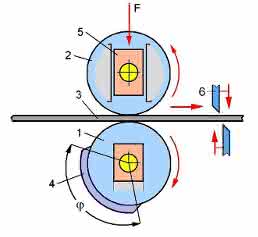
Figure 1 first shows the structure of a clamping plate mechanism. This achieves intermittent feeding of the belt. The belt material is clamped between the support and the spring-loaded pressure plate during feeding. This creates a frictional force during feeding. The belt is fed during this phase. Self-locking can occur if the distances a and b are selected unfavorably. The return stroke creates a feed pause. The clamping force is removed.
The roller feed is often used with high-speed presses. The rollers take the belt with them in pairs. The principle is not suitable for very thin belts. The roll diameter and angle of rotation determine the feed length. Figure 2 shows a solution for the discontinuous provision of a strip length. For this purpose, the lower roller has a segment attached to the side. This lifts the upper roller off the belt, which briefly removes the frictional connection between the belt and roller. The belt remains stationary for a short time despite the rotation of the roller. The feed length is determined by the roller circumference at an angle of 360 degrees minus the angle phy. The principle can be used for belts, strips and wire. During the feed pause, the strip stops and the cutting process can be completed.
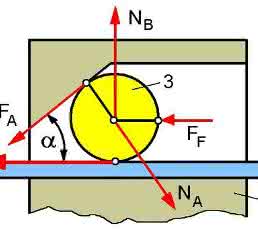
A roller clamping mechanism is shown in Fig. 3. A slider moves freely or in clamping mode. The wedge effect in the slider creates a frictional force. The skew angle alpha must be selected so that the mechanism does not block itself. Cyclical belt feeding naturally also implies unwinding technology, which can have a balancing effect. Technical solutions are needed that take care of the cyclical feed, but at the same time ensure continuous unwinding from the reel, which is also part of the system. The coil is initially heavy and should not be rotated jerkily. There are various tried and tested technical solutions for this requirement. Suitable devices are commercially available.
Finally, Figure 4 shows a belt feed unit that has been assembled from pneumatically driven modular elements. The two gripper units are used alternately for the feed. When the gripper G1 advances the belt a defined distance, the gripper G2 moves back with the jaw tension released. Longer feed lengths can be achieved by several successive feed steps. Of course, double roller feeders are also available in graduated sizes, possibly NC-controlled with regard to the belt length and as a finished series product. Belt feeders can also be equipped with automatic controllers that ensure a straight infeed into a machine by constantly scanning the belt edges with sensors and automatically readjusting the lateral belt run.
Stefan Hesse
Literature: Hesse: Fundamentals of Handling Technology, 4th edition, Hanser Verlag Munich 2016


You might also be interested in
Smooth cleaning
The K900 industrial robot cleans floors autonomously, without preparation time or programming effort - even where it is dangerous or even impossible for humans to do so. Lubricant-free linear guides, shafts, plain and flange bearings from Igus also...
 read more...
New pallet roller for the warehouse
Conveyor technology specialist Rulmeca is expanding its range of conveyor rollers for pallets and other heavy goods with the XPS series.
read more...ACE structural and crash dampers: Safety on the road 7
The seventh axis is used in manufacturing and production systems to make robots more agile and increase their reach. As an additional traversing axis, this linear axis brings robots quickly into the workspace or guides them precisely to parallel...
read more...Torwegge presents FlexO rollers
Visitors to the FMB - Supplier Fair for Mechanical Engineering can once again look forward to a new product at the Torwegge stand this year: the FlexO rollers.
read more...Koenig's discipline
AMF clamping technology pulverizes production times at the world's oldest printing press manufacturer Koenig & Bauer in Würzburg
read more...No damage on axis 7
The seventh axis not only makes robots in many production plants more agile, but also increases their reach. To prevent accidents from ruining this increase in productivity, Expert-Tünkers has been working with ACE shock absorber components for...
read more...Moving heavy loads easily
For a manufacturer of lift tables, the collaboration with Blickle has paid off in full. The wheel and castor specialist supplied castor solutions with the ErgoMove electric drive system.
read more...Support with the construction of a hot water tank
With the Hezinger BendingLine MG4R round bending machine, Hezinger Maschinen is supporting the construction of the hot water storage tank for the Rostock public utility company.
read more...When the spark ignites
The surface of car body parts in automotive engineering must be perfect. The basis for this are high-precision textured rollers that prepare the sheet metal parts for processing. Texturing machines process the rollers with high precision using...
read more...