
Handling metal sheets
Highly dynamic press interlinking
An interlinking system transports up to 16 formed sheets for vehicle bodies per minute from one press to the next with millimeter precision and high dynamics. This performance is made possible by gearboxes, servo actuators and rack and pinion systems from Wittenstein Alpha.
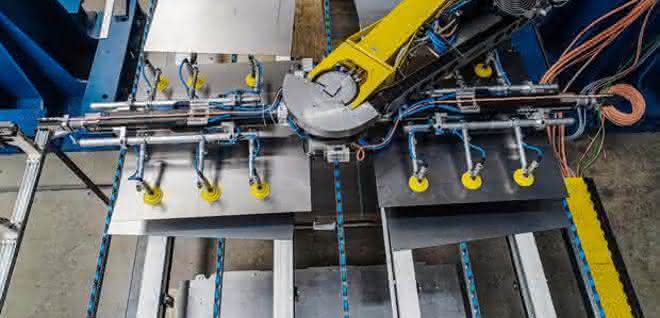
The first generation of the single-arm linking system from Strothmann Machines & Handling, the FeederPlus6, has established itself over more than ten years for the automation of press lines, primarily in the automotive industry. "Then as now, we only install components from quality suppliers in our systems," says Andreas Senge, Head of the Press Automation and Handling Systems Product Group at Strothmann Machines & Handling and responsible for the design and development of automation solutions. "If these manufacturers, like Wittenstein, then offer a portfolio with which we can fully map the requirements of the various machine axes, this is ideal. Drive design can be carried out quickly and conveniently with the Cymex 5 design tool. It also makes design, assembly, commissioning and servicing much easier." Wittenstein is also represented in all axes in the new FeederPlus 6neo - with compact and low-backlash planetary gearboxes, with fatigue-resistant racks that can be mounted quickly and without cutting, with planetary gearboxes in high-torque design, with torsionally rigid, compact and backlash-free Galaxie DF gearboxes, with bevel gearboxes and with servo actuators. "But to see this as just a component supplier would not do justice to our many years of trusting cooperation," says Andreas Senge, praising the expert support in the project planning and design of drive technology solutions.
The FeederPlus 6neo is used in a press line to link two presses - the longer the line and the more presses required to form sheet metal parts, the more linking systems are needed. The single-arm feeder removes a formed part from one press and inserts it into the next press for the following processing step. "The presses continue to run continuously, while the movements of the FeederPlus 6neo follow path curves that are synchronized with the presses," says Senge, describing the dynamics of component handling. The axes of the feeder and the tools of the press come within a few centimetres of each other at certain moments. "Depending on the axis, this requires low-backlash or even backlash-free gears with the highest possible torsional and tilting rigidity in order to avoid collisions caused by vibrations or inaccuracies in guidance and positioning." However, these requirements could not be at the expense of dynamics, as the FeederPlus 6neo was primarily developed to increase the output rate from 12 to 16 parts per minute.
Multi-body simulations provide a database for drive design
Strothmann analyzed the complex kinematics and the special requirements for the dynamics and precision of the drive components in the early stages of the development project using multi-body simulations. The force and torque curves determined and the initial predictions were verified and optimized by importing the data into the Cymex 5 design tool from Wittenstein. "This not only checked and validated our calculation, but also evaluated basic gearbox alternatives in terms of performance, installation space and costs," says Senge. For each gearbox application, the design limits could be explored, the appropriate gearbox identified and appropriate safety reserves defined in the gearbox design. "In this project, we were once again able to rely on the technical data of the gearboxes as well as the support and engineering expertise of our partner."
The rotational axes for the telescopic swivel arm (C1 axis) and the component holder (C2 axis) were a particular focus of the design. The C1 axis placed extremely high demands on rigidity. The challenge was to attach the swivel arm of the feeder directly to the C1 gearbox without an additional bearing. This placed particularly high demands on the gearbox bearing due to the large lever arm and the associated tilting moments. "The selected TP+2000 High Torque from Wittenstein Alpha is one of the few servo gearboxes available on the market that can absorb the required tilting moments," explains Andreas Senge. The C2 axis required a gearbox solution with an integrated motor that is as flat as possible, as this part of the feeder is immersed in the press chamber. At the same time, high torques are required for turning and depositing finished parts onto conveyor belts at the end of line. "The Galaxie DF110 drive system that we use here offers such high torsional rigidity and torque density in such a small installation space that no other motor-gearbox unit can match," explains Senge.
New functions save over one million euros
In addition to the basic interlinking functions of the FeederPlus 6neo, the low-backlash, torsionally rigid and highly dynamic drive components from Wittenstein Alpha made it possible to equip the feeder with functional extensions for the front-of-line (FoL) and end-of-line (EoL) areas of the presses. "The FeederPlus 6neo can now pick up blanks with positional deviations from the conveyor system, center them in line with the process and insert them into the first press, as well as remove finished parts from the last press and distribute them ergonomically rotated by 90° onto subsequent conveyor belts," says Senge. These functional enhancements, which were also made possible by the dynamics and precision of the drive technology, save more than 1 million euros per press line. "This is possible," explains Senge, "because robot and shuttle systems are no longer required at the beginning or end of the press line. This also eliminates the need for component-specific gripping tools and tooling change systems. The savings in FoL and EoL make the line shorter overall, which also means that steel construction and sound insulation are shorter and therefore cheaper. In addition to these direct cost savings, there are also indirect cost savings, for example for set-up times, installation and storage space, as well as for maintenance and servicing."
In September 2019, Strothmann presented the prototype of the FeederPlus 6neo for the first time at an in-house exhibition after around two years of further development work. Feeders of the new generation have also gone into operation in the press line of a well-known automotive plant. Thanks to its global presence, the manufacturer can rely on Wittenstein as a local service partner for the feeder's entire drive technology.
Peter Hempsch, Regional Sales Manager, and Andreas Grages, Application Consultant, both Wittenstein Alpha


You might also be interested in
New Trade Show for the Turned Parts Industry
The Association of the German Turned Parts Industry has given a positive assessment of the first Make-to-Order (MTO) Days: With 184 exhibitors and approximately 1,400 trade visitors, the inaugural event proved to be a successful platform for...
 read more...
In-house exhibition Bielefeld 2026
How DMG Mori thinks about the factory of the future
DMG Mori will be showcasing turning and milling expertise, automation solutions and additive manufacturing along the Machining Transformation (MX) at the Bielefeld 2026 in-house exhibition.
read more...Association of the German Turned Parts...
Turned parts industry looks cautiously to the future
Rising order intake, new members, cautious optimism: the members of the Association of the German Turned Parts Industry are confident. At the spring conference in Leipzig, around 150 participants discussed current market developments, strategic...
read more...World premieres at the EMO 2025
From September 22 to 26, 2025, Grob will be presenting several innovations at EMO Hannover. The focus of the trade fair appearance will be on the latest 4- and 5-axis universal machining centers and the associated automation solutions.
read more...Efficient complete machining
Index-Werke will be bringing the Index G220 turn-mill center and the Traub TNA400 universal lathe to Intec.
read more...Digitization of process chains
CAM system Hypermill in practice
At EMO 2023, Open Mind will focus on turning, milling and the importance of CAM software and MES in networked production environments.
read more...High-speed spindle in handbag format
Modules for milling and turning
At Weiss, the focus is on the new 1.5 kilogram micro-mill spindle, which rotates at up to 60,000 revolutions per minute.
read more...Handling and workpiece clamping
Networked production starts with the component
Schunk is coming to Hanover with a 360-degree portfolio covering all aspects of machine tools. The focus will be on more sustainable production, connectivity and e-mobility.
read more...Stroll through the city
DMG Mori is inviting visitors to take a stroll through the city at EMO: In a specially constructed DMG Mori City, the machine tool manufacturer is concentrating on its focus topic of Machining Transformation (MX).
read more...