
Fiber composites
Producing composites economically
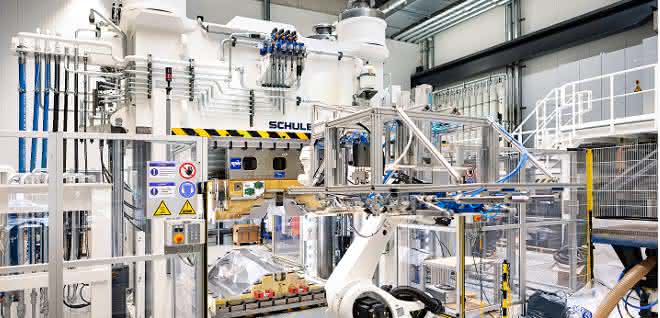
Fiber composites such as carbon are used primarily in lightweight automotive construction. However, they have not quite made the leap into series production yet, as the manufacturing costs for parts made of carbon fiber-reinforced plastic, or CFRP for short, are still too high. This is now set to change. The press manufacturer Schuler and other partners joined forces in the "iComposite 4.0" research project to solve the problem. Ultimately, they succeeded in reducing the cost of a prototype part by more than 50 percent and the throughput time by over 40 percent.
A floor panel mounted under the engine and passenger compartment of an English sports car served as a reference component. The requirements included that its structure must withstand a frontal impact and be designed for high torsional rigidity and seat load. Previously, the cost of such a floor panel was just under 400 euros. As part of the project, these costs were reduced to around 150 euros. The processing time was reduced from 73 to 46 minutes.
Interlocking processes
The Aachen Institute for Plastics Processing was responsible for the first production step: A robot injects the basic structure made of glass fiber. Next, an algorithm - developed by the Aachen Center for Integrative Lightweight Design (AZL) and CFRP supplier Teijin Carbon - calculates the individual tensile strength. Depending on this, another robot places the carbon fibers using a process developed by Siemens and Broetje Automation Composites, thereby compensating for fluctuations in the component properties. Optical control is carried out by a 3D measuring system from Apodius. A resin is then injected into this mat of composite fibers. This hardens under the high pressure of a hydraulic press from Schuler and is simultaneously molded into the desired shape. The press can specifically influence the deflection of the die to achieve the desired wall thickness. This means that good parts can be produced from a quantity of one, reducing waste to zero. Until now, manufacturers of fiber composite parts have used carbon mats as the starting material, which have to be cut to size. This means that almost half of the expensive carbon fibers become waste. In the research project, the required CFRP is used up completely. At the same time, the throughput time decreases while the output increases.
An RFID chip from ID-Systec ensures traceability. All components of the production line, which runs at the AZL at RWTH Aachen University, are networked with each other. The findings of the research project are now to be put into industrial practice.
According to documents from Schuler / ag


You might also be interested in
A quantum computer that performs calculations using oscillations
When it comes to storing information, quantum computers have so far run up against technical limitations. Instead of electromagnetic storage, researchers are now using mechanical vibrations. Their vibrating memory can store significantly more...
 read more...
Hydrogen Pipelines Put to the Test
New real-world lab tests safety and resilience
The Federal Institute for Materials Research and Testing (BAM) is opening a real-world laboratory to study pipelines and components for the safe operation of future hydrogen networks.
read more...Research Platform for the Energy Supply of the Future
For the first time, the Karlsruhe Institute of Technology (KIT) is bringing together key hydrogen technologies in a single research environment. The facility is intended to demonstrate how the production, storage, transport, and use of hydrogen can...
read more...When the quantum computer arrives
The Research Race to Ensure the Security of Critical Infrastructure
How can we protect our critical infrastructure from attacks by quantum computers in the future? As part of the QUEST project, Darmstadt University of Applied Sciences is researching new methods—post-quantum cryptography—designed to withstand even...
read more...VDE study on electrical engineering
More retirements than graduations
According to a VDE analysis, more than 30,000 electrical engineers will retire by 2029 without enough graduates to replace them. This is due to falling student numbers and high drop-out rates.
read more...Giving lightweight construction a profile
Pultrusion: A process that forms fibers under tension
Pultrusion is developing from a niche process into a key process for lightweight construction and sustainable fiber composite structures. The Fraunhofer IWU shows applications from energy to mobility.
read more...Green hydrogen directly from the sun and water
A start-up project at the Karlsruhe Institute of Technology (KIT) aims to fundamentally simplify the production of green hydrogen: Mass-produced photoreactor panels are to be used to produce hydrogen directly from sunlight and water - without...
read more...Fraunhofer shows industrial future between AI, data and new materials
At Hannover Messe 2026, the Fraunhofer-Gesellschaft will be presenting solutions for a resilient industry: from AI and data rooms to hydrogen technologies and material and recycling innovations.
read more...The bottleneck is in the system
Is the transformation of the industry failing due to "German Angst"?
A recent ISF study examines what is slowing down change in German industrial companies. According to the results of the study, the causes of innovation bottlenecks often lie in internal structures and a lack of strategic orientation.
read more...