
Signal processing
Record and process measured variables in the connector
Without a powerful, consistent infrastructure, digitalization quickly reaches its limits. Connectors and cables are also part of the infrastructure. Their importance will continue to grow in the future and will be reflected in "intelligent" connectors, for example.
The development of connectors is influenced by three trends: digitalization, decentralization and miniaturization. With decentralization, more and more functions in the industrial environment are moving to the device and field level, which means that there will be an increasing need for continuous connections between devices along the horizontal and vertical axis of the automation pyramid. This also includes the addition of intelligent functions. The integration of sensor and diagnostic functions directly into the connector opens up new fields of application and eliminates the need for additional sensors. Measured variables such as current, voltage, power and temperature can be recorded and saved and evaluated via an app, an ERP/Scada system or a cloud. Weidmüller is presenting such an intelligent connector at the Hannover Messe. The smart connector was developed as part of the "Intelligent electrical connectors and connection technology with electronic signal processing (ISA)" funding project of the BMBF (Federal Ministry of Education and Research).
Smart connectors in practice
Connectors and electrical connection technologies play a central role in the networking of tomorrow's production. They are the main interface between machines, control systems and data processing systems and therefore form the basis for the functions, ease of use and reliability of automation technology. The smart connector can be located in the connecting cables of production systems, modules or islands. It is used for power supply as well as signal and data connection to the SCADA or ERP level.
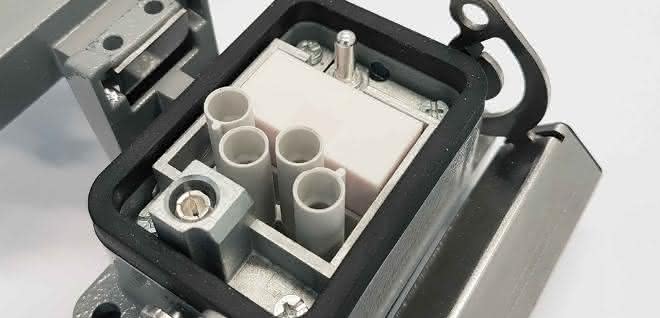
Current, voltage and power are recorded as measured variables in the smart infrastructure connector. The maximum current is 3 × 72 A. The voltage is measured directly at L1-L3 without galvanic isolation. Temperature detection is also integrated. The plug connector is also designed for industrial environments. Its temperature range is between -40 and 125 °C, the permissible voltage is 3 × 230 V AC at a signal frequency of 50 or 60 Hz. The current is measured using Hall sensors, i.e. without interrupting the circuit.
Plug-in cycle counter for safe operation
The number of mating cycles determines, among other things, the function and wear of a connector. Weidmüller therefore implements a counting function with an energy-autonomous piezo-based miniature system. This works as follows: The force applied during the mating cycle generates an energy to supply the downstream electronic system with power. The energy converter is located in the force flow of the mating system - in or on the connector. The energy supply activates the electronic counter. Plausibility criteria are used to validate whether the plugging process has been carried out safely. If validation is successful, the counter is incremented by one. The absolute value is saved in a non-volatile memory. When the specified maximum number of plugging cycles is reached, a visual mark is made on the measuring system. The meter reading can be read contactlessly via an RFID interface. The system is supplied with power via the RFID interface during the reading process.
With the functions of the intelligent infrastructure connector, Weidmüller enables an increase in efficiency during installation and commissioning as well as in the reliable operation of machines and systems. The smart connector from the ISA project therefore helps to improve production.


You might also be interested in
ESTIA aims to strengthen Europe's cloud
New tech alliance for EU sovereignty
Twelve companies, including Dassault Systèmes, are founding the European Sovereign Tech Industry Alliance (ESTIA). The initiative aims to strengthen Europe's technological independence and define requirements for sovereign cloud services. The start...
 read more...
Deutsche Telekom and Nvidia launch one of Europe's largest AI factories
With the Industrial AI Cloud in Munich, Deutsche Telekom and NVIDIA are creating one of the largest AI factories in Europe. Companies can train AI models, carry out simulations and access 10,000 GPUs.
read more...Leveraging data potential with AI and streaming
Huge data treasures are still lying dormant in many manufacturing companies. And yet it is high time that these treasures were unlocked. There is often a lack of resources and capacity to make data usable in real time. Streaming production data can...
read more...More awareness of noise
Dematic offers solutions that are tailored to different cloud environments and reduce environmental impact through reduced material consumption and improved energy efficiency.
read more...Generative AI in the automation environment
The mechanical engineering and automation industry is undergoing profound change. This transformation is being driven by more volatile global trade, geopolitical crises and increasing market pressure, which demands greater agility, technological...
read more...Rigid data structures have had their day
The traditional data center is no longer the center of data. A hybrid cloud storage approach enables manufacturing companies to both meet the current requirements of data-intensive processes and future-proof their infrastructure.
read more...Software as a service in three stages
CIM Database Cloud is a new out-of-the-box solution from Contact for end-to-end digital product development.
read more...How production can benefit from AI
Together with AI technology, IIoT networking makes it possible to better control machine parameters and optimize quality with predictive quality. Downtimes and set-up times can also be further minimized. Cloud platforms also make these technologies...
read more...More expertise for digital engineering
Altair, a computational science and artificial intelligence (AI) company, has acquired OmniV, a technology from Michigan, USA-based software company XLDyn.
read more...