
Robot cable
Robots reliably supplied
For use in industrial robots, Ethernet cables have to withstand a lot. However, when it comes to horizontal linear movements combined with torsion, standard Ethernet cables are often unable to cope with the load. A new solution from Lapp complies with the type R standard for Profinet cables on robots.
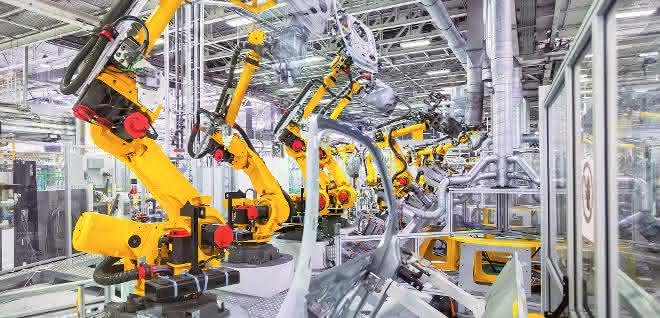
Robots continue to gain ground within automated manufacturing. While they used to be predominantly found in the automotive industry, robots are now increasingly penetrating other sectors and supporting the automation of manufacturing processes. Today, robots are an integral part of the symbol of a modern factory. They are no longer just performing monotonous motion sequences, but also provide access via the connection to the data network, which is required for process monitoring or remote maintenance, for example. Industrial protocols such as Profibus and Profinet are used to ensure seamless data communication of the feedback loops between the sensors on the robot arm, the robot system, the controller and its connection to the control level. The cabling required for network communication is carried out using flexible Etherline data cables.
However, the rapid movement sequences of the robot arms in three-dimensional space place a great deal of mechanical stress on the cabling, from the commissioning of the robot to the last cycle completed. This puts Ethernet data cables in particular to the test: with a twisted pair structure of the wires, double shielding and transmission parameters that are critical for successful data communication, these are among the more technically demanding cables.
Designers of robot applications often have to choose between data cables that are designed either for linear, horizontal travel paths - as typically found in drag chains - or for torsional motion sequences. The main reason for this is the different internal structure of the cables. Lay lengths within the wire pairs must be precisely maintained and coordinated. Adjacent wire pairs must not interfere with each other and interference signals must be prevented. While cables and wires for horizontal travel preferably have relatively short lay lengths in order to achieve smaller bending radii in the drag chain, long lay lengths are the preferred choice for torsion cables. The problem: In their motion sequence, robot applications combine horizontal linear movements with torsional loads. Many common Ethernet cables are not able to withstand this combined load to a sufficient degree.
Uniform industry standard type R
The challenge of a sophisticated cable design is compounded by the fact that no uniform industry standards for robot-compatible Ethernet data cables have been agreed to date. As a result, there were numerous, uncoordinated and proprietary understandings of "robot suitability" for Ethernet cables on the market. The Profinet user organization addressed this situation and developed the necessary specification in close cooperation with the AIDA (Automation Initiative of German Automobile Manufacturers). The stringent requirements for Profinet type R data cables were developed in an exchange between leading companies in the field of industrial cabling. Not only were well-known manufacturers involved in the development process of the new guideline, but opinions and suggestions from users were also taken into account. Lapp was also involved in the development of the new industry standard from the very beginning. The new, so-called "Type R" describes 2-pair Cat.5e industrial data cables, which must withstand numerous electrical and mechanical requirements and guarantee a long service life when used with industrial robots. In the current version of the "Cabling and Interconnection Guideline", version 4.11, type R is now included for the first time alongside the common cable types type A (fixed installation), type B (occasional moving use) and type C (drag chain and special applications).
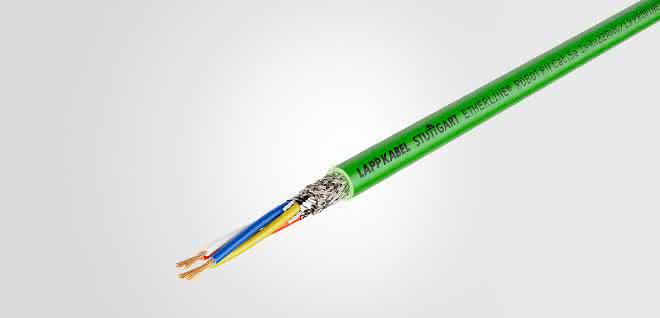
So what makes a data cable a Profinet-compliant type R robot cable? It is primarily the mechanical requirements: 5 million vertical torsion cycles at ±180°/m, 5 million cycles in the horizontal drag chain at accelerations of up to 10 m/s² and speeds of 3 m/s over a travel distance of 5 m, plus 1 million bends in the alternating bending test in accordance with EN 50396 with a bending radius of only 7 times the outer diameter. Lapp has developed the new Etherline Robot PN Cat.5e for this purpose. It is suitable for industrial data cabling within or on robots, in cable assemblies or freely laid. It offers a high load capacity, durability and reliability in data communication with data rates of up to 100 Mbit/s.
The cable is also suitable for use with sophisticated welding robots. The developers paid particular attention to the right choice of cable construction. Thanks to the filling elements and reliable materials such as the robust PUR outer sheath, the Etherline Robot PN Cat.5e not only meets the requirements for mechanical stress, but also complies with important certifications and standards such as UL conformity in accordance with AWM Recognized. This enables it to be exported to the North American market as a component within a machine or system.
The new cable was tested in the modern Lapp test center. One example is the continuous monitoring of the electrical transmission parameters in accordance with IEC 61156-6 during the test sequence for drag chain tests. Here, highly flexible Etherline data cables are tested fully automatically at fixed intervals and changes in over 20 critical transmission parameters are detected. Particularly in the test phase of prototypes, this allows conclusions to be drawn about weaknesses in the structure, which can be improved in the next development stage. At the end of the test phase, the robot cable had neither damage to the outer sheath nor were any impairments detected in the transmission-critical electrical parameters.
The new Etherline Robot PN Cat.5e is manufactured by CEAM Cavi Speciali in Monselice, Italy, one of the leading manufacturers of data cables for industrial Ethernet and fieldbus and part of the Lapp Group.
Christian Illensser, Product Manager at Lapp


You might also be interested in
Intelligent sensor technology for the packaging industry
At Interpack 2026, Sick will be showcasing its portfolio of sensor, automation and AI-supported solutions for secure and digitally networked packaging processes in the consumer goods, healthcare and pharmaceutical industries.
 read more...
Sales growth in a turbulent market environment
Thanks to innovations and a focus on strategic industrial markets, Sick was able to moderately increase its sales in the 2025 financial year. In a turbulent market environment, the company was able to maintain its position and gain market share with...
read more...Photonic microchips with 3D connector
How a 3D system makes photonic chips industrially viable
A research team from Heidelberg is developing a 3D-printed "connector" for photonic microchips. The solution promises a low-loss, standardized coupling of glass fibre and chip - and could fundamentally simplify the production of photonic integrated...
read more...Advanced material retrieval system
Steute shows nexy wireless network with extended connectivity
Steute's Leantec division is presenting an enhanced version of the nexy wireless network with improved connectivity and additional cybersecurity functions. The background to the further development is the increasing use of automated guided vehicles...
read more...Detecting air bubbles in liquids
EBE is launching a capacitive bubble sensor on the market that reliably detects air bubbles and liquid breakages, regardless of the liquid and the condition of the hose.
read more...Miniature acceleration sensors
Structural tests on printed circuit boards
The Z22198 family consists of very small triaxial accelerometers from Kistler that measure vibrations in three orthogonal axes.
read more...Positive development in sensor and measurement technology
In the first quarter of 2025, the sensor and measurement technology industry recorded sales growth of three percent compared to the previous quarter - according to the results of the quarterly member survey conducted by the AMA Association for...
read more...Sick extends contract with CEO
The Supervisory Board of Sick has extended the contract of CEO Dr. Mats Gökstorp by 5 years. The company also announced that Feng Jiao has resigned from his position as Chief Sales Officer at his own request. Markus Scaglioso has been appointed to...
read more...Kistler and Keller Pressure deepen partnership in China
The Kistler Group is intensifying its cooperation with Keller Pressure. By signing the agreement, the two companies are reaffirming their commitment to strengthening synergies and developing the Chinese market in a targeted manner.
read more...