

Lighting
LED luminaires for heavy industry
Modern LED luminaires are the first choice when it comes to modern, efficient illumination of large production halls in industry. They promise a long service life with low maintenance requirements.
However, practical experience shows that these expectations are often not fulfilled in heavy industry. An LED strip light from Deutsche Lichtmiete defies even the toughest conditions.
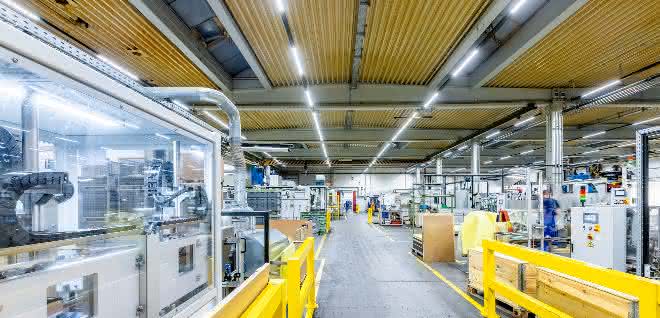
The Swiss technology group Feintool develops and produces tools, presses, plants and systems as well as high-precision parts and components using forming and fineblanking processes. The company is also active in Germany, the Czech Republic, Japan, China and the USA. With its technologies, Feintool is paving the way for sustainable and efficient mobility solutions, among other things. The criteria of sustainability and energy efficiency also had top priority with regard to the planned lighting refurbishment of the company's own sites.
At Feintool System Parts Obertshausen in Hesse, outdated metal halide lamps (also known as HQL lamps) not only resulted in high energy consumption in the past, but also required an enormous amount of maintenance. "In addition to frequent breakdowns, the covers had to be constantly cleaned," says Dirk Eckgold, responsible for maintenance and repair, describing the situation. There was no question of converting to modern LED technology - especially as work is carried out around the clock in Obertshausen and the lighting is therefore in constant use.
Vulnerability of plastic covers made of PC
In addition to their high energy-saving potential, LED luminaires also stand for a long service life - provided there is no corrosion damage or stress cracks in the plastic covers, which could cause them to fall down. The cause of stress cracks lies in the material properties of the covers. These are usually made of polycarbonate (PC). This has many advantages: PC is not only light and transparent, but also extremely heat-resistant and impact-resistant. In addition, PC is resistant to diluted acids, many oils and greases. However, there is one not insignificant weak point: mineral oils. These are often used in heavy industry, for example in the coolants and lubricants of large milling and drilling machines or lathes.
Under its own brand Concept Light, Deutsche Lichtmiete has launched Steel Buddy, an LED strip light that has been specially developed for the mineral oil-containing environment of heavy industry. In addition to the standard use of corrosion-resistant metals, this product uses a cover made of polymethyl methacrylate (PMMA), which makes the Steel Buddy particularly resistant to mineral oils. "This not only increases safety, but also increases the service life enormously," says Stella Dreyer, Head of Research and Development at Deutsche Lichtmiete.
The advantages of Light as a Service
In addition to the eight production halls in Obertshausen with a total area of 23,000 square meters, Feintool has also converted the lighting at its Swiss headquarters with its partner from Germany. In addition, the lighting in Jessen in Saxony-Anhalt is currently being refurbished, and further locations are being planned. "The conversion was always carried out during ongoing operations, even at weekends, so there were no restrictions whatsoever," says Eckgold.
He sees a major advantage not only in the high product quality, but also in the Light-as-a-Service concept. Feintool did not have to make any investment for the conversion with Deutsche Lichtmiete, which means the company can protect its liquidity. "Even if there is a breakdown, we don't incur any additional costs," says Eckgold. "Maintenance, service and, if necessary, replacement lights are covered by the monthly rental fee."
Savings through intelligent control
The overall lighting costs are significantly lower than before the conversion due to the considerable energy savings, especially as the new lighting system also enables intelligent control. Depending on the amount of daylight, only as much artificial light as necessary is added. "Even on cloudy days, we can still use the natural light that comes through the skylights and side glazing," says Eckgold. By controlling the lighting individually depending on the incident daylight, the company generally achieves additional savings of up to 15 percent.


You might also be interested in
Predictive maintenance in retrofit
Predictive maintenance pays off. This is because early detection of impending failures means that systems can be serviced in a targeted manner before production downtime occurs. But how complex is it to integrate such a maintenance concept into an...
 read more...
Maintenance instead of replacement
The circular economy starts with the machinery
Sustainability in industry starts with machines, says our guest author from Deguma: How maintenance, modernization and the 5R strategy save resources, energy and CO₂.
read more...3D printing for unplanned requirements
The material fails and the machine suddenly stops? Then you need to take the right measures to be able to resume production quickly. Material failure in the form of faulty components or material wear in the frame are a risk for any production.
read more...High demands in terms of safety, application and robustness
Demanding work in the electrical trade and energy supply as well as smooth processes in production require innovative and customized measurement technology that scores points for safety, ease of use and resilience.
read more...Car meets e-bike: riding with lubrication-free polymer bearings
Studies show that the proportion of pedestrian and bicycle traffic is increasing in urban areas. With the JetBike, JetBike GmbH from Braunschweig presents a mixture of e-bike and car and relies on lubrication-free polymer bearings from Igus.
read more...Hydraulic hub for more efficient servicing
Bosch Rexroth presents a digital toolbox for service and maintenance. With a comprehensive range of digital services, the Hydraulic Hub simplifies and accelerates the service and maintenance of hydraulic products and increases machine availability.
read more...Arnold Umformtechnik expands after-sales...
Faster help with VR glasses
Arnold Umformtechnik is expanding the after-sales service for its machines to include digital remote services. The focus is on data security, simple operation and clear processes.
read more...147,000 euros per hour: high costs for German companies due to unplanned downtime
According to the "Value of Reliability" study, 67% of industrial companies in Germany experience unplanned downtime at least once a month. This costs the German economy 147,000 euros per hour. Nevertheless, reactive maintenance concepts are not...
read more...Maintenance starts with a maintenance planner
Legal requirements stipulate that machines and systems must be serviced regularly. The maintenance work serves to ensure occupational safety and economic efficiency.
read more...