

Electronics housing for the mounting rail
IoT electronics cleverly packaged
The requirements for future-oriented automation devices are diverse. Today, device manufacturers are looking for highly flexible and multifunctional enclosure systems. A new system therefore offers graduated sizes, extended connection technology and optional bus connectors.
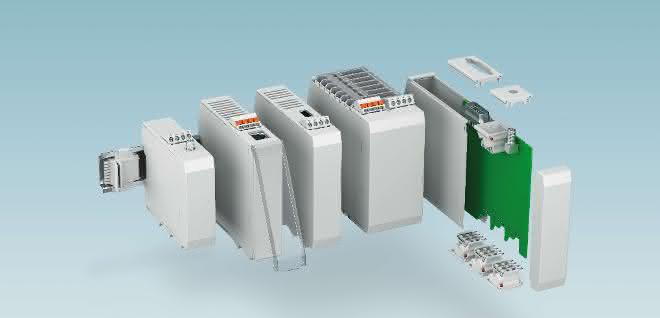
The electronic circuit only becomes a device when the assembled PCB is installed in the empty electronics housing. The built-in PCB is protected by the housing and can be mounted on the mounting rail in the control cabinet, where it fulfills its function as a device after electrical wiring and commissioning. In addition to protecting the electronics and easy mounting, the connection technology plays an important role. Conventional enclosure concepts often only offer the device manufacturer connection options that are limited to PCB terminals and base strips with plug connections.
Contemporary packaging also for new circuits
In order to provide the PCB with additional connection options, cut-outs and milled recesses must be made in the housing to accommodate the signal and communication connections. For reasons of space and geometry, often only the cover surface of the empty housing is suitable here. Cables that are connected to USB, D-Sub and RJ45 sockets via a plug must then be routed in an arc into the cable ducts at the rear.
The requirements for an empty electronics enclosure also depend on the respective application - from process, factory and building automation to control and regulation technology through to power supply and safety applications. Design and coloring are just as much a part of the decision for an enclosure as technical requirements - such as the PCB surface area that can be installed and the connection technology. Ease of handling and assembly also play a role.
With the ME generation of enclosures, Phoenix Contact launched a compact modular electronics enclosure in the shape of a cup in the mid-1990s. Fifteen years later, the modular and side-by-side stackable ME-Max enclosure was introduced on this basis. In order to offer newly developed circuits and devices a contemporary "packaging" with a new connection concept, Phoenix Contact launched the Industrial Case System - ICS for short - onto the market.
Freely positionable communication connections
In addition to multi-pin codable plug connections, the PCB of the ICS housing can also be fitted with standardized housing elements for integrated communication connections, such as RJ45 and USB for Industry 4.0 applications or D-Sub and antenna connections. A new slide-in technology allows the assembled PCB to be inserted and locked into the housing quickly and easily.
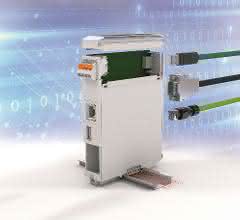
Based on standard housing widths of 22.5 mm, the ICS housing with the new width gradation in the basic width of 25 mm now offers enough space to be able to arrange relays, electrolytic capacitors or other high-profile components on the PCB. The 20 mm version enables a higher housing density on the mounting rail. A 50 mm wide housing variant will be added at the end of 2019. The heights and depths of the enclosure are based on the installation space in the enclosure in the range from 77 to 132 mm. The heights and depths are also being extended. The ICS enclosure with the inserted PCB can be closed with a closed enclosure cover or with a transparent hinged cover using a detachable latch.
With the option of inserting two PCBs in a housing with a basic width of 20 or 25 mm or up to four PCBs in the housing with a width of 50 mm, the PCB surface area that can be fitted can be doubled or quadrupled from around 10,000 to 20,000 mm² and even 40,000 mm² in an ICS housing with standard dimensions - 100 mm high and 110 mm deep. The PCB can be designed with a functional earth contact (FE) towards the mounting rail and with contacts for the 8-pin T-Bus 8 mounting rail bus connector.
In addition to multi-pin headers, which are coded with each other via the corresponding connectors, communication connections such as RJ45, USB, D-Sub or antenna connections can be freely positioned on the PCB side using covers - so-called fillers - with functional cut-outs and inserted into the housing in any position and housing level. Time-consuming milling work or subsequent machining for the cut-outs of such connection technologies is then no longer necessary.
8-pole mounting rail bus
The cable outlets for these connections are no longer located on the side of the housing cover, but are arranged on the side of the housing in the ICS concept. This means that they are located in the immediate vicinity of the cable duct and the mounting rail, where the other connectors of the individual wires are also routed to the housing. The cables are then fed directly into the cable duct above or below without the need for complex cable loops or kinks. The housing cover can still be designed with a USB cut-out or similar for a parameterization or configuration interface on the head end.
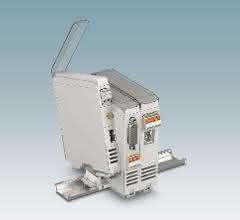
The mounting rail bus concept has also been extended. Thanks to the contact spacing of 2.54 mm, the new T-Bus 8 mounting rail bus element can now accommodate eight PCB contacts: either eight parallel contacts or a combination of parallel and up to two serial contacts as standard. As this T-Bus has the same technological principle and mating face as the ME-IO front connection housing, both systems can be combined. Tests have also shown that the T-Bus 8 is suitable for communication frequencies of up to 100 MHz.
The housing is individualized by the colour scheme alone: numerous standard colors are available to choose from. The housing, cover, connection technology and panels can also be combined with different colors - in a closed design or with functional cut-outs. Individual printing in different positions is just as possible as machining for drill holes, cut-outs and openings.
Industry 4.0 and online configuration
Using an online selector and configurator, the ICS enclosure can be assembled online in just a few steps according to individual customer requirements. The user-friendly selection and configuration of all individual components with drag and drop is also possible on mobile devices. Using a selection menu, the user first chooses the enclosure size with color variants and the corresponding enclosure cover in a closed design or with a transparent hinged cover. The connection technology is then selected: Basic connector strip with codable plugs with push-in or screw connection, T-Bus 8 system with parallel and serial contacts as well as FE contact. Last but not least are the communication connections, which are positioned on one or two PCBs per housing base width.

For each selection, the housing is displayed in detail on the screen. Finally, the PCB layout is available for download as a 3D file in a selectable file format. The configuration can also be saved in intermediate steps and called up and continued later. Finally, the individual components are exported to a parts list and transferred to the shopping cart for ordering.
Dipl.-Ing. Joachim Gräfer, Product Marketing Electronics Enclosures, Device Connector Solutions, Phoenix Contact / am


You might also be interested in
Helu makes its first trade fair appearance under a new brand name
Helu Kabel will be presenting itself as Helu for the first time at Hannover Messe 2026, showcasing system solutions, Heluchain cables and new industrial luminaires.
 read more...
Strategic realignment with brand relaunch
In future, Helukabel will trade as Helu
The Helukabel Group is parting with part of its name: in future, the company will only operate under the Helu brand. With this step, the specialist for electrical connection technology is underlining its strategic development from a classic cable...
read more...Modular plant construction for corrugated board
Insight into the production of corrugators at BHS Corrugated: Automated, modular and equipped with Helukabel components.
read more...Best quality for the steel
Conditions in the steel industry are harsh and inhospitable. The machines used must be able to withstand the demanding environmental conditions in order to deliver the best quality at all times.
read more...If the standard cable is not sufficient
Lapp offers cables for countless applications - but not for all of them. From time to time, the developers have to modify a standard cable or develop a special cable.
read more...Slight decline in sales, strong investments
The Lapp Group has not been spared from the weakening global economy. However, the company only recorded a slight loss in the past 2024 financial year.
read more...Electrical connection technology
Cables and wires for industrial automation
Heukabel offers system solutions for cable routing from a single source. The subsidiary EKD Systems specializes in tailor-made cable drag chains made of steel, stainless steel and plastic, which are used in moving machines and systems as well as in...
read more...Lapp relies on Ultramid from BASF
Mobile charging of electric vehicles
The automotive industry is currently undergoing the biggest transformation in its history. The boom in battery electric vehicles in particular is presenting the industry with major challenges. Lapp, as a supplier of cables and connection...
read more...Cable handling application
At this year's Motek, ArtiMinds Robotics is showcasing a robot-based automation solution for the sensor-assisted assembly of flexible cables in connector housings.
read more...