

Mechanical engineering | Case study
Cordless in brush production
Around three hours' drive from Keba's headquarters in Linz, Wöhler operates a production site that specializes in the development and manufacture of machines for optimizing brush production. While searching for a handheld control unit for these machines, the team came across Keba's Safe Wireless HMI panels. For the developers, these fulfilled two key requirements: ergonomic operability and wireless operation.
The region around Pelhřimov, where the headquarters of Wöhler Bohemia is located, has long been considered the center of brush production. A wide variety of brushes are produced there - from toothbrushes and paintbrushes to chimney sweep brushes. Founded in 1994, Wöhler Bohemia s.r.o. is part of the German Wöhler Group, which was founded in 1932. For decades, the name Wöhler has stood for products in the fields of measuring and testing technology, technical brushes and special machines for the manufacture of paint rollers and brushes.
The site in Pelhřimov was originally focused on developing services and solutions for the parent company. The company is now expanding both its product portfolio and the number of markets in which it is active.
For a long time, Wöhler purchased the HMI devices indirectly from Keba via another supplier who sold them under its own logo. However, this supply relationship ended. Jaroslav Markvart, CEO of Wöhler Bohemia, says: "We had to look for alternatives as our previous supplier was no longer supplying Keba products." The company finally came into direct contact with Keba at the automatica 2020 trade fair. This led to an immediate collaboration. "That was an advantage for us. We got to know the entire product portfolio and also discovered Keba's Safe Wireless concept during these discussions. We were not aware of this before."
Freedom of movement during commissioning
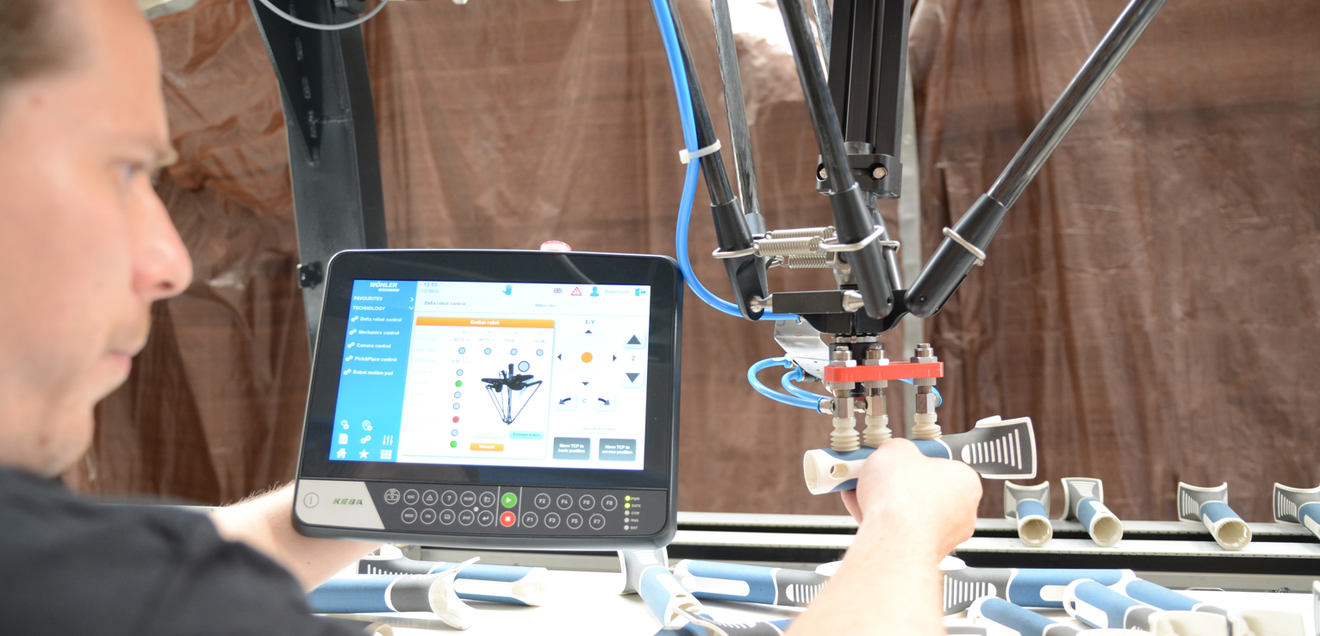
A current development project in Pelhřimov is a machine with a delta robot. When commissioning new products, operators must be able to move around the robot cell while configuring and programming the system via an HMI device. At the same time, they keep an eye on the areas where adjustments need to be made. "A cable would be a real burden for the operator as it would limit flexibility and hinder freedom of movement," explains Markvart.
From the company's point of view, a wireless operating device offers practical advantages here. Markvart says: "The advantages of the Safe Wireless concept are obvious. We will offer it as an option, almost as an accessory, for every machine. We only offer HMIs from Keba, not products from other brands. The Safe Wireless panel has a good chance of becoming the new standard."

Markvart also describes the commissioning of the devices: "No other provider can deliver a solution that is so easy to install and operate and also has a secure wireless concept. When we received the first HMI, all we had to do was connect the power, set up the IP address and configure the visualization on the HMI - and it was ready to use. That's what we call easy to use."
The KeTop panels can also be adapted to corporate design and functional requirements. For Wöhler, this aspect has so far played a subordinate role, as the company mainly manufactures individual machines or small quantities. "To make this attractive, you need different quantities. This could fit in with our future strategy as we continue to develop our product range," says Markvart.
Competition and cautious markets
At the same time, Wöhler is working on expanding its business. "Current market trends are forcing us to do this," explains Markvart. One factor is competition from Chinese suppliers. "The price difference is around 30%, but I'm sure the difference in quality is less than that. So we have a gap here that we have to respond to with new products and innovations."
One of the company's advantages lies in the customized design of its machines. In many cases, these are custom-made products.
At the same time, Wöhler is observing a reluctance to invest in some customer segments. "Wöhler's machines and solutions are designed for large volumes and high throughputs and are tailored to the needs of suppliers to the construction industry. Here, projects are being put on hold or postponed, which makes planning very difficult," says Markvart. "That's why we are expanding our portfolio to include smaller machines with less complex designs and technologies, while at the same time opening up new markets."
This also shifts the requirements for development. Customers define the quality requirements for brushes and the desired machine cycle times themselves. "It's our job to solve this in the most intelligent way possible," says Markvart.
The company is also looking into offering automation and assembly solutions for other industries. This is based on experience in mechanical engineering and process optimization. Robotics is also playing an increasingly important role in development projects.
Cooperation as a factor
As a medium-sized company, Wöhler says it relies on short communication channels with partners. Markvart describes the collaboration as follows: "Communication with Keba is fast and the employees are very helpful. They support us in the growth of our company by finding solutions together with us. I am therefore certain that the future of Wöhler will be linked to Keba."


You might also be interested in
Software-Defined Manufacturing Enters Industrial Practice
More than 100 experts from industry and technology gathered at Xentara Connection Day to discuss software-defined manufacturing, Physical AI, AI, Edge AI, and the modernization of existing production facilities.
 read more...
Artificial Intelligence in Manufacturing
Trumpf and IPAI Are Expanding a European AI Network for Industry
The high-tech company Trumpf is an official partner of the IPAI AI network in Heilbronn. Together, the partners aim to exchange experiences, develop new AI applications for industrial use, and advance the development of artificial intelligence in...
read more...Case Study: Networked Manufacturing Platform for Toolmaking
Using a networked manufacturing platform, Escha GmbH & Co. KG, a manufacturer of industrial fastening technology, has comprehensively modernized its toolmaking operations.
read more...From ERP System to AI Platform
RNA, based in Aachen, manufactures up to 2,000 custom-designed feeding systems annually and handles all order processing through a central ERP platform.
read more...Predictive Maintenance in the Powertrain: Stöber Is Gradually Expanding Its Approach
Step by step, the company is continuing to develop predictive maintenance: from monitoring to predictive maintenance to smart powertrains.
read more...Eric Goos Appointed to the Board of Sumitomo Drive Technologies
Sumitomo Drive Technologies EMEIA continues to expand its leadership team: Eric Goos has been appointed to the board and will serve as managing director of Cyclo Drive Germany GmbH.
read more...The AKIMI Research Project at WZL
Agent-Based AI Aims to Simplify Robotics for Small and Medium-Sized Businesses
The AKIMI research project is developing an agent-based AI designed to significantly simplify the setup, programming, and reconfiguration of robotic systems for small and medium-sized enterprises. The goal is to make robotics more flexible and...
read more...Soft grippers for delicate foods
Irregularly shaped, fragile, and varying in size and weight: products such as potatoes, baked goods, and dairy products push mechanical grippers to their limits.
read more..."As rebar gets thicker, automation has to keep up."
Larger wire diameters, greater performance, higher efficiency: How can rebar processing machines be adapted to changing market requirements using new drive technology and an open automation architecture? A user report.
read more...