
Simulation of handling solutions
Siemens PLM Software and Schunk: OEM partnership
As part of an OEM partnership, Siemens PLM Software and Schunk want to radically simplify entry into the world of simulation of handling solutions. To this end, Schunk has put together an attractive entry-level package consisting of the Mechatronics Concept Designer from Siemens PLM Software, a component library of digital twins from Schunk and corresponding support for their use.
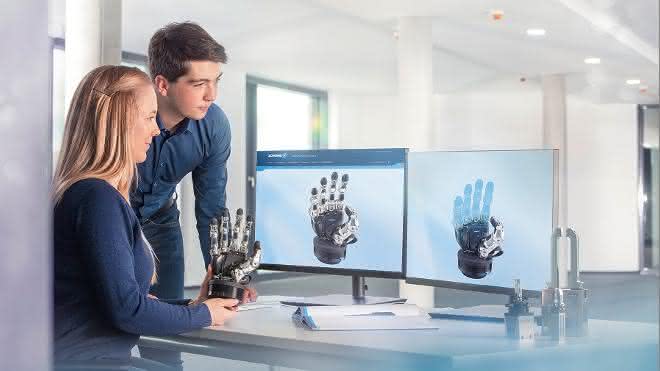
The tool can be fully integrated into Siemens NX. Designers, programmers and project planners can test the full version of the simulation software free of charge for six months. Licenses for the Mechatronics Concept Designer can now also be purchased from Schunk independently of the starter package.
"In future, nobody will have to spend days calculating cycle times or weeks commissioning handling solutions," says Managing Partner and CEO Henrik A. Schunk. "As part of our digitalization initiative, we have set ourselves the goal of making it as easy as possible for plant manufacturers and integrators to enter the highly efficient world of simultaneous engineering and virtual commissioning." Essentially, the aim is to simulate complete assembly systems in three-dimensional space and to digitally map the entire engineering process from concept to mechanics, electrics and software through to virtual commissioning in a single system. "Even experienced designers are amazed at the advantages of engineering with the Mechatronics Concept Designer and the efficiency effects that are possible," reports Henrik A. Schunk.
Simultaneous engineering
"In our opinion, no other simulation software is able to cover the plant development process as comprehensively as the Mechatronics Concept Designer," emphasizes Schunk. From design in the CAD program and simulation to virtual commissioning and the real connection to the control system, the system covers all phases with only minimal media breaks. Whereas in conventional engineering, mechanical, electrical and software programming are carried out sequentially one after the other and commissioning only begins at the end on the assembled system, the Mechatronics Concept Designer combines all three disciplines in one interface and thus makes it possible to parallelize all activities. Simultaneous engineering accelerates the entire system development process, minimizes complexity, increases flexibility and saves a great deal of costs at the end of the day. Changes can be adopted and checked for feasibility within a very short time. Comparable follow-up projects can thus be realized much faster than was previously possible.
From a single source
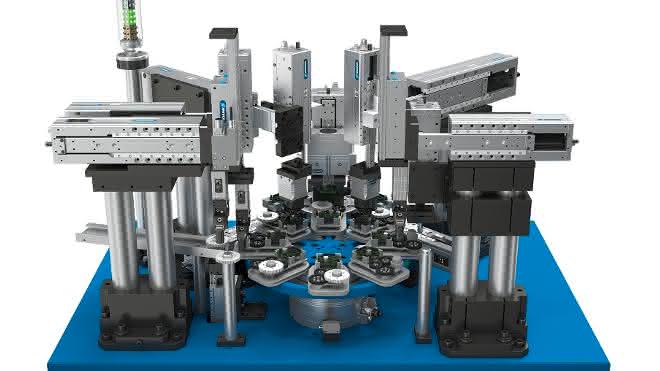
As the simulation software, the component library, the real components and the support come from a single source, it is said that a particularly time and cost-efficient introduction to the simulation software is possible. To this end, Schunk has created its 24V mechatronics program for high-performance assembly as digital twins, so that simple assembly systems can be simulated even without extensive software knowledge. In the first step, the component library contains the Schunk EGP parallel grippers, the Schunk ELP linear modules, the EGS gripper swivel modules and the ERS rotary modules. In the medium term, all gripping system and clamping technology components from Schunk will be available as digital twins. The digital twins contain the CAD solid model with all geometric data for modeling in Siemens NX, CAE data (EPLAN), a kinematic behavior model and a physical model in which the stroke, the extension and retraction speed, the acceleration, the jerk, the nominal force and the mass are stored. There are also PLC function blocks for virtual commissioning to simplify the software and hardware in the loop (SiL/HiL) scenarios.
Interface to the real control system
In addition to a process sequence, the software provides a Gantt diagram in which all phases and dependencies are displayed. Even during the planning phase, it is possible to identify where sequential movements are necessary or parallel movements are possible. The behavior of the virtual model can be tested on real controllers, such as Siemens Simatic S7 or Beckhoff, via automation interfaces so that plug & work-capable handling solutions can be implemented. To ensure maximum design freedom, component libraries from other manufacturers can already be integrated during the free test phase. If you want to delve deeper into the software, you can use the library support from Schunk in addition to training courses from Siemens. kp


You might also be interested in
ebm-papst is growing again thanks to AI and data centers
ebm-papst returned to a growth trajectory in fiscal year 2025/26. Air Technology, data center applications, and artificial intelligence are driving revenue and investment.
 read more...
SPE on the Verge of a Market Breakthrough
Single Pair Ethernet (SPE) has moved beyond the conceptual phase and is increasingly being implemented in industrial settings. The focus here is not only on higher data rates and simplified cabling, but above all on the issue of system integration...
read more...More than 900 exhibitors already registered
Around six months before the start of the trade fair, more than 900 companies have registered for SPS 2026 in Nuremberg. The trade fair focuses on industrial AI, cyber security and digital transformation.
read more...Virtual PLCs in practice: How vPLCs make production systems more flexible and scalable
The increasing networking of IT and OT is fundamentally changing industrial automation. The IT/OT Integration Summit shows how modern technologies can make production environments more efficient, flexible and future-proof. The event will focus on...
read more...Sales growth in a turbulent market environment
Thanks to innovations and a focus on strategic industrial markets, Sick was able to moderately increase its sales in the 2025 financial year. In a turbulent market environment, the company was able to maintain its position and gain market share with...
read more...Siemens presents new AI agent
Siemens is launching 'Eigen Engineering Agent', an AI for automation technology. The solution is integrated into the TIA Portal, has been tested with over 100 companies and is designed to significantly accelerate engineering processes.
read more...Schaeffler keeps sales almost stable
Schaeffler generated revenue of EUR 23.5 billion in 2025 and increased EBIT before special items to EUR 936 million. At 266 million euros, free cash flow was significantly above the prior year and forecast. Net income remained negative due to high...
read more...Advancing artificial intelligence together
Helukabel is stepping up its activities in the field of artificial intelligence and is now a member of the IPAI. The innovation and collaboration platform for companies, research facilities, institutions and administration has set itself the goal of...
read more...New impetus for ifm sales
Two new positions were filled at ifm at the start of 2026: Markus Wolf becomes Managing Director Sales Germany, Sven Quant takes over the position of Central Managing Director in the Process Sensors division within the ifm Group.
read more...