
Outlook for 2018 remains positive
Schaeffler: Group profit increased by 14 percent in 2017
Schaeffler, the global automotive and industrial supplier, increased its revenue to 14.0 billion euros in 2017 (prior year: 13.3 billion euros). This corresponds to growth of 5.9 percent at constant currency. The EBIT margin before special items amounted to 11.3 percent in 2017 (prior year: 12.7 percent).
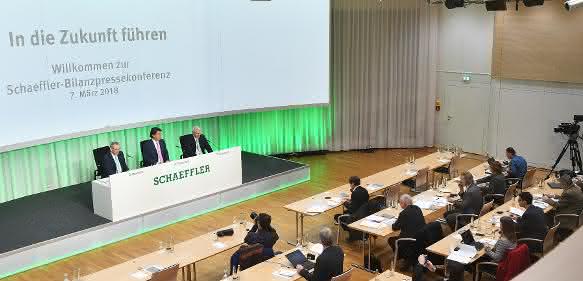
According to Schaeffler, the decline is primarily due to the expenses for the "Agenda 4 plus One" program for the future. Nevertheless, net income attributable to shareholders increased by approximately 14 percent to 980 million euros (prior year: 859 million euros), reaching the highest level in the Schaeffler Group's history.
In the 2017 financial year, the Group increased its investment spending by 127 million euros to 1,273 million euros (previous year: 1,146 million euros). At the same time, around 3,500 new jobs were created. The number of employees rose to more than 90,000 by the end of 2017 (previous year: around 86,700). Free cash flow for 2017 amounted to 488 million euros (previous year: 735 million euros) due to the high level of investment. At the same time, net financial debt was further reduced. With its "Agenda 4 plus One" program for the future, Schaeffler is systematically focusing on the future. Despite the current uncertainties, the outlook for 2018 remains fundamentally positive.
Currency-adjusted sales increase by 5.9 percent
Both divisions and all four of the company's regions contributed to the positive sales trend in 2017. While sales in the Automotive division increased to 10.9 billion euros (previous year: around 10.3 billion euros), which corresponds to currency-adjusted growth of 5.9%, sales in the Industrial division rose to around 3.1 billion euros for the year as a whole (previous year: 3.0 billion euros). This corresponds to currency-adjusted growth of 5.7%.
Thanks to a strong second half of the year, the Automotive division once again outperformed the market, i.e. global production of passenger cars and light commercial vehicles. With market growth of around 2.1% in 2017, this results in an outperformance of 3.8% for the year as a whole. The Automotive division's strong growth for the year as a whole was driven by both Automotive OEM (currency-adjusted growth of 6.5 percent) and Automotive Aftermarket (currency-adjusted growth of 3.2 percent). The Industrial division is back on course for growth. Industrial applications in the "Power Transmission" (including electric motors, hydraulics and transmissions), "Offroad" (agricultural and construction machinery) and "Raw Materials" (raw materials extraction and processing) sectors in particular contributed to this with double-digit percentage growth.
All of the Schaeffler Group's regions contributed to the positive revenue growth in 2017. At 24.1 percent, the Greater China region again contributed the largest increase excluding the impact of currency translation. Asia/Pacific increased by 5.6 percent excluding the impact of currency translation. Currency-adjusted sales in the Americas increased by 4.6%. Europe grew by 1.4% on a currency-adjusted basis.
EBIT margin before special items of 11.3% in 2017 (previous year: 12.7%)
Earnings before interest and taxes (EBIT) before special items amounted to 1,584 million euros (previous year: 1,700 million euros). On this basis, the EBIT margin before special items amounted to 11.3% (previous year: 12.7%). Special effects amounting to 56 million euros mainly comprised restructuring expenses. The decline in the EBIT margin was mainly due to the additional expenses in connection with the "Agenda 4 plus One" program for the future. These amounted to around 160 million euros in 2017, which corresponds to around 1.1% of sales. The objective of the program for the future with 20 initiatives is to sustainably align the Schaeffler Group for the future.
Group profit increases by around 14 percent to 980 million euros
Despite the operating burdens, net income attributable to shareholders increased by approximately 14 percent to 980 million euros (prior year: 859 million euros) due to the improved financial result. This is the highest net income the Schaeffler Group has ever generated. Based on the positive business development, the Board of Managing Directors will propose to the Annual General Meeting to increase the dividend by 5 cents to 55 cents per preference share. This corresponds to a payout ratio of approximately 35 percent (prior year: approximately 34 percent) based on net income attributable to shareholders before special items.
Around 1.3 billion euros invested, 3,500 new jobs created
In 2017, the Schaeffler Group increased its capital expenditures by 127 million euros to 1,273 million euros (prior year: 1,146 million euros). The capex ratio, i.e. capital expenditures in relation to consolidated revenue, amounted to 9.1 percent (prior year: 8.6 percent).
At the same time, the Schaeffler Group created 3,489 new jobs in the past financial year. As at December 31, 2017, the number of employees worldwide was 90,151, up 4 percent on the prior year. In Germany, the number of employees increased by around 500 to 31,700.
Klaus Rosenfeld, CEO of Schaeffler AG, commented: "The Schaeffler Group invested more than ever before in 2017. These investments, including as part of our future program 'Agenda 4 plus One', will ensure further profitable growth and increase the value of the company. This is also the basis for returning the operating result before special items to the long-term average of 12 to 13 percent and achieving the financial ambitions set for 2020."
Net financial debt further reduced, balance sheet quality further improved
Net financial debt was reduced by around 266 million euros over the course of 2017. As at December 31, 2017, they amounted to 2,370 million euros (previous year: 2,636 million euros). The leverage ratio before special items, i.e. the ratio of net financial debt to EBITDA before special items, thus improved from 1.1x to 1.0x in 2017.
Free cash flow amounted to 488 million euros in the 2017 financial year (previous year: 735 million euros). This figure includes net payments of around 27 million euros for M&A activities. Excluding this burden, free cash flow was slightly above the outlook for the 2017 financial year of around EUR 500 million.
"In 2017, we succeeded in further reducing net financial debt, thus creating additional financial flexibility for the Schaeffler Group. This is a prerequisite for being able to grow externally in the future," said Dietmar Heinrich, Chief Financial Officer of Schaeffler AG.
Future program "Agenda 4 plus One" on track, three divisions in future
The "Agenda 4 plus One" program for the future was developed and launched in 2016. The aim of the program is to successfully align the Schaeffler Group with the challenges of the future and thus create the conditions for further sustainable, profitable growth. In 2017, the program was expanded to 20 initiatives.
Positive outlook for 2018 despite uncertainties
Despite the uncertainties for the 2018 financial year, Schaeffler anticipates revenue growth of 5 to 6 percent excluding the impact of currency translation. At the same time, the company expects to generate an EBIT margin before special items of 10.5 to 11.5 percent in 2018. The Schaeffler Group also expects to generate free cash flow before cash in- and outflows for M&A activities of approximately 450 million euros in 2018.
The group expects the Automotive OEM division to continue growing faster in 2018 than global production of passenger cars and light commercial vehicles, which is expected to grow by approximately 2 percent. On this basis, the Schaeffler Group expects the Automotive OEM division's revenue to grow by 6 to 7 percent excluding the impact of currency translation in 2018 (2017: 6.5 percent). This expectation is supported by the orders acquired in the 2017 reporting period, so-called lifetime sales, totaling 11.5 billion euros. Furthermore, an EBIT margin before special items of between 9.5% and 10.5% is expected for the Automotive OEM division in 2018 (2017: 10.8%).
The Aftermarket business will also continue to grow - based on stable growth in the global vehicle population with an almost unchanged average age. Based on its own market observations, the Group expects sales growth before currency effects of 3% to 4% for the Automotive Aftermarket division in 2018 (2017: 3.2%) and an EBIT margin before special items of 16.5% to 17.5% (2017: 19.0%).
In the Industrial division, the positive trend in incoming orders in combination with economic conditions in individual sectors indicates that sales revenue will continue to rise in 2018. On this basis, the company expects to achieve currency-adjusted sales growth of 3% to 4% in the Industrial division in the 2018 financial year (2017: 5.7%). In addition, the Industrial division is expected to achieve an EBIT margin before special items of between 9% and 10% in 2018 (2017: 8.0%).
Klaus Rosenfeld, Chairman of the Board of Management, concluded: "For 2018, we have resolved to further accelerate the implementation of our 'Agenda 4 plus One' with the 20 initiatives. With this program, we are well equipped to actively shape the challenges of the future. We want to create value in the interests of our customers and business partners and increase our competitiveness. To do this, we want and need to become more agile, faster and bolder." kp


You might also be interested in
Electromechanical spindle drives made to measure
Stabilus now also offers "Industrial Powerise Actuators" of type IPR40 as a customer-specific solution from batch size 1. Design engineers can individually configure forces, stroke lengths and speeds.
 read more...
Motors, gearboxes and encoders: Faulhaber expands Ø 16 mm portfolio
Faulhaber is expanding its portfolio with new DC motors from the SXR and GXR family, a 16 mm planetary gearbox and the IEX3 magnetic encoder for compact drive solutions.
read more...Gear technology for angular gearboxes
Customized gearing solutions for high-performance drives
Framo Morat presents the "speeroX gearing", a concept for high-ratio angular gears. The article explains the structure, functional principle, fields of application and material options of the technology.
read more...Low-noise gearbox models from Faulhaber
Faulhaber is expanding the GPT family with two high-performance models that impress with their whisper-quiet operation: the "22GPT LN" and the "32GPT LN".
read more...Compact printed matter
Producing complexly shaped bodies of consistent quality from ceramic bodies is a science. A special machine manufacturer produces high-performance extruders for this purpose. The company is now using new, space-saving planetary gear units from...
read more...Automation and industrial robotics
Customized gearbox solutions
At Automatica, SPN Schwaben Präzision will be showcasing various gearbox solutions from the fields of robotics and automation.
read more...Drive technology 2025
Drive technology is the heart of every production process. Nothing moves without it, and no machine can do without drive technology components. From frequency converters, electric motors and gearboxes to clutches and brakes. Who offers which...
read more...New drive solutions for industrial automation and robotics
Faulhaber presents drive solutions with the new GXR and SXR motor family, which offer high efficiency and flexibility in combination with powerful gearboxes and encoders. These optimized components open up new possibilities for applications in...
read more...Drive technology 2024
Drive technology is the heart of every production process. Nothing moves without it, and no machine can do without drive technology components. From frequency inverters, electric motors and gearboxes to clutches and brakes. Who offers which...
read more...