
Qualified professional tests
Tackling the skills shortage with MySkills
The shortage of skilled workers is forcing companies and employment agencies to rethink. The focus is shifting to "unskilled workers". The MySkills job test now provides information about their skills: from unskilled workers to skilled workers.
The urgency of the shortage of skilled workers is always linked to the economic situation. In times of double-digit growth rates, the pressure on companies to find and recruit skilled workers and employees is enormous. In times of a sideways economic trend, this urgency generally diminishes. However, the shortage of skilled workers will not disappear completely, as the baby boomer generation will be retiring in the next few years. This means that not only expertise but also manpower will be leaving companies.
Another problem for companies is that they are unable to fill their vacant training positions. They are therefore short of young talent. But where can industry and other sectors find suitable people?
Vocational tests show qualifications beyond certificates
Who doesn't know the people who have a special talent for craftsmanship but have not completed vocational training? Incidentally, 70 percent of so-called "unskilled workers" already perform the tasks and standard activities of skilled workers. They have many years of experience, but cannot demonstrate this with training certificates. As a rule, they can only prove their skills when a company gives them a chance to do a trial job. This applies to German-speaking people as well as refugees, for example.
This is where MySkills from the Bertelsmann Stiftung comes in. In cooperation with the Federal Employment Agency and other vocational training centers, a test procedure has been developed that records a person's professional skills. The advantage: it is divided into different fields of activity that are geared towards actual professional practice as well as the current German level of training. The computer-aided and video-based test is carried out in job centers or at the employment agency. In order to overcome language barriers, the test is already available in various languages: German, English, High Arabic, Persian/Farsi, Russian and Turkish. In around four hours, the participant answers around 120 questions on specific professional situations.
Metal technician test - high level of difficulty
One example: A MySkills test has already been created for the metal technology specialist job profile in the field of construction technology. Here, specific fields of activity are tested using images, video and text. "The test questions were put together in such a way that you can really see whether someone has practical work experience in the various fields of activity or not," explains Frank Menge, senior training supervisor at the Reckenberg-Ems training academy and MySkills test developer. "This ranges from the manufacture of components with hand-held tools and machines to the turning and milling of individual parts, the assembly and disassembly of assemblies and metal constructions, the forming and cutting of sheet metal and pipes and the welding of components and assemblies of all kinds."
Menge is one of many representatives of the guilds, chambers, training supervisors, company owners and company representatives from trade and industry who have worked on the specific questions and test requirements. The test for metal technicians in construction technology is divided into five vocational fields of activity:
- Manufacturing components with hand-held tools and machines
- Turn and mill individual parts using machine tools
- Assembling and disassembling assemblies and metal structures
- Forming and cutting sheet metal and pipes
Welding components and assemblies
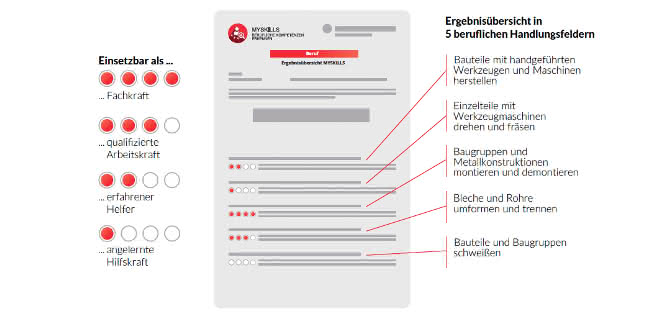
The participant can achieve a maximum of four points in each of the fields of activity and thus show what kind of work they are qualified to do: One point qualifies them as a semi-skilled worker, two points as an experienced helper, three as a qualified worker and four points as a skilled worker.
Menge: "It is important to interpret the results of the test correctly. Because the test is difficult. If someone comes with a test result of two points in one area of activity, then employers can already deploy this candidate in this area under supervision. With three points in individual fields of activity, you have someone who can really do something and can be directly deployed independently. For someone like this, the path to becoming a specialist is not far away. Four points is only achieved by a top skilled worker or perhaps an A candidate from vocational school."
For companies, MySkills is an opportunity to find skilled workers outside the set norms. "For employers, the MySkills test increases the likelihood that an applicant already has compatible skills in certain fields of activity," says Menge. "In future, employers can also make specific inquiries at the employment agency or job center if they are looking for someone with certain skills. This means they have a lower investment when looking for employees, the risk of a bad hire is reduced and they can find employable talent that they would otherwise never have found due to the language barrier."
Post-qualification possible
MySkills does not replace a qualified degree, that much is certain. However, the vocational test offers people with no qualifications the opportunity to find a job based on their skills. As a rule, companies submit requests for skilled workers to the employment agency. This agency carries out the MySkills tests and suggests workers to the companies on the basis of the test results. In addition, the test participants themselves are given a job-specific test sheet with their results, which they can use to send unsolicited applications to companies.
There is then the opportunity for further training in the job itself. However, post-qualification in the fields of activity is the responsibility of the company; the employment agency can provide support if required. Test participants can take examinations through further training either within the company or via the Chamber of Industry and Commerce - right up to the final examination in the respective occupations.
First success stories
The test has already proven that it works in practice. However, the initiators do not expect the first reliable figures until next year. However, examples show that MySkills is a success: MAN relied on the test procedure as part of the integration of refugees and was thus able to recruit qualified specialists (see videos below)
Frank Menge is also convinced of the success of the tests: "People who can do something are desperately needed everywhere. And MySkills shows very precisely what people can do in a job, even if they don't have a certificate."
Get active!
If you are interested in MySkills, we recommend the employment agency's website: arbeitsagentur.de/myskills. On the site you will find information about the tests, for which occupational groups the tests are already available and contact points for questions and requests. If you cannot find the test for the occupational group you require, you can also take action yourself: Talk to the person responsible about the missing test or join forces with several companies and request a test in the occupational field you need. In the past, this has accelerated the development of one or two MySkills tests! So: Get active!
Further links:


You might also be interested in
Protection against electrostatic discharge
StoFloor ESD KU 614 from StoCretec: dissipative flooring with the latest technology meets all ESD standards, is economical, extremely durable, mechanically and chemically resistant. The surface can be adjusted to be slip-resistant. The system is...
 read more...
Cables and wires from Helukabel
Food cultivation on a new level
Vertical farming - cultivation in multi-storey greenhouses - is considered one of the most exciting trends in food production. One of the pioneers in this field is the Romanian start-up Ultragreens. The company relies on solutions from Helukabel to...
read more...Further training for specialists to become security experts
With the "CESA - Certified Expert for Security in Automation" qualification, automation expert Pilz offers a two-day expert course designed to provide participants with compact security knowledge in line with the latest standards.
read more...Meaningful data on the service life of the seal
Seals prevent substances from penetrating or entering technical components. The intelligent seals from Freudenberg Sealing Technologies can significantly expand this core task in the future: the seal itself is also a sensor and becomes a "smart...
read more...Online stud configurator according to drawing
For standard bolts, with head, thread or hole
For standard bolts, with head, thread, bore or as a version with recess, mbo Osswald configurators map the standard specifications, are very easy to use, take a lot of work off the user's hands and save a lot of time.
read more...Safe palletizing with the Cobot
Verla-Pharm's medicinal products and food supplements have been available for decades. Ever-increasing throughputs result in ever-increasing logistics costs, whereby optimum utilization of the available production space is necessary.
read more...The tiger among processors
Since the move towards the Industrial Internet of Things (IIoT) and Industry 4.0 has picked up speed, processor boards and modules must be able to process exponentially growing amounts of data.
read more...VDWF publishes "Sustainability Compendium"
Nowadays, nobody can avoid "sustainability": In addition to a far-reaching presence in the media, it is also becoming increasingly important for companies in the tool and mold making industry to develop and implement appropriate concepts.
read more...More transparency and synergies with QM software
Weber, manufacturer of wood and metal sanding machines and extruders, has reorganized its quality management with ConSense IMS Professional. The software solution enables transparent documentation and more efficient processes.
read more...