
Interview with Georg Stawowy, Lapp
"The future belongs to Industrial Ethernet"
With Industry 4.0, the demands on data communication in factories are growing, particularly due to real-time communication. SCOPE editor Andreas Mühlbauer talks to Georg Stawowy, Director of Technology and Innovation at global market leader Lapp, about what this means for connection systems and what the future standards will be.
SCOPE: Mr. Stawowy, as a cable specialist, you are right in the middle of it: Why has it taken so long for fast Ethernet to find its way from offices to production and become established there?

Georg Stawowy: Ethernet has been around since 1973 and has been the number one for data communication in local networks ever since. The fact that it has taken so long to make the step into industry is mainly due to the proliferation of Ethernet standards. There are now more than 20 Industrial Ethernet systems, such as Profinet, Ethernet/IP and CC-Link IE, which all differ to a greater or lesser extent in technical details and are therefore incompatible.
The suppliers of control technology had little motivation to change this, as they make good money from their proprietary standards, as they offer good protection for their systems against competing products. However, this is currently changing. The trend towards open standards such as Time Sensitive Network (TSN) and Open Platform Communications Unified Architecture (OPC-UA) means that proprietary standards will be less accepted by customers in the future.
Users benefit from reduced system integration costs thanks to standardized communication interfaces. The future in factories therefore also belongs to Industrial Ethernet and open protocol standards based on it. The market is currently growing at over 20 percent per year, while fieldbus systems are only growing at six percent. In 2018, the number of Industrial Ethernet systems installed in factories exceeded that of fieldbuses for the first time
SCOPE: What are the technical requirements for implementing this on the cable side - particularly with regard to time-synchronized networks, i.e. TSN - and how has Lapp implemented this?
Stawowy: For TSN to work, cables must reliably transport data from A to B, so there must be no data loss or disruption en route. TSN will be used in particular in very real-time-critical applications. These are, for example, drive systems that work with a very fast control cycle. If the data packet is corrupted on the cable route, the drive control system is thrown out of sync and the machine produces rejects. In such a case, TSN can no longer repair anything, because incorrect information remains incorrect even if it is delivered on time.
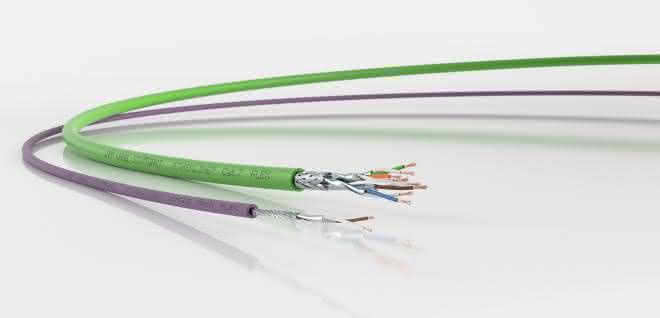
The Ethernet cable in a TSN system is therefore primarily important for error-free and reliable transmission. With our industrial Ethernet cables, this is ensured by shielding with a high degree of coverage and tight tolerances for transmission-relevant parameters such as the characteristic impedance. Last but not least, a suitable design is important to ensure long-lasting use in moving applications, at extreme temperatures or under chemical stress. This is only possible with high-quality cables designed for industrial environments, such as those manufactured by our subsidiary Ceam in Italy.
TSN is of course primarily a function of the switches. Lapp will be launching a portfolio of TSN-capable switches on the market. Another trend is single-pair Ethernet. Not every sensor has to be connected via a cable with four pairs of wires; one pair of wires is often sufficient. Such cables are thinner, cheaper and easier to process. This will also accelerate the triumph of Ethernet and standards such as TSN.
SCOPE: Couldn't the industry have adopted TSN earlier? The entertainment industry has shown that it works.
Stawowy: TSN was actually invented in the entertainment industry. In concert halls, for example, it is used to precisely equalize the travel times of sound from the loudspeakers so that there are no echoes. However, the fact that it works there does not mean that it can be transferred one-to-one to industry. Perhaps it wasn't necessary until now, because digitalization and Industry 4.0 - and therefore higher requirements for real-time transmission - have only become an issue in industry in recent years. Companies and standardization committees are currently working on establishing TSN in the industry. Once again, the delay was certainly due to the fact that many providers of industrial data communication had already developed real-time communication standards. With TSN, a manufacturer-independent standard is now available. The components for this will be sold in larger quantities, creating cost-cutting potential. The many networking standards will converge into one standard, and then TSN will also quickly become established.
SCOPE: Another topic that will probably keep us busy in the future: the demand for DC voltage. Many manufacturers could be pleased that a huge market would emerge: new switches, new cables and much more - an expensive affair at first. On the other hand, some alternative energy sources, such as solar cells, supply DC voltage. Is this primarily a good business idea or a technically worthwhile prospect?
Stawowy: Above all, it is a matter of common sense. Converting between alternating and direct current results in huge losses in economic terms. There are pilot projects in industry that show that production facilities can save energy in the double-digit percentage range by consistently switching to direct current. Offices and homes with a DC supply would also save considerable amounts of energy. An energy grid consistently designed for direct current would achieve an overall efficiency of 90 percent, compared to around 56 percent today.
Even with a higher efficiency of ten percent, the two largest lignite-fired power plants in Germany could be shut down. This would save 63 million tons of CO2 - twelve percent of German CO2 emissions. For nitrogen oxides, it would even be 29 percent. However, it is clearly too early to talk about major sales expectations. There is still a lot of research and development to be done. Lapp is supporting this, for example by researching ourselves and together with partners from the academic world how the increasingly rectified electromagnetic fields of direct current affect the insulation and jacket materials of cables. It is possible that other materials will be required for DC cables.
SCOPE: How have digitalization and the increasingly high demands on individual products, but also the demand for complete systems, changed your business? Will Lapp have to break new ground in the future if technologies and markets continue to change?
Stawowy: That's right, technologies and markets are changing. The pace is also increasing with digitalization and Industry 4.0. Lapp has always been good at spotting such trends and setting them itself. You have already mentioned one trend: The demand for complete systems is growing. Our customers are seeing that the requirements for connection technologies are increasing and that they don't always have the expertise in-house to keep pace.
Our customers also want to concentrate on their core competencies, for example the construction of machines. They therefore order complete connection systems from us. In order to better meet this demand, we have created our Ölflex Connect program, which combines our assembly business, from standard servo assemblies to ready-to-install energy chains. Sales of these solutions are growing at an above-average rate, at around 17% in the past financial year.
Of course, this is not the end. Lapp sees itself as a leading provider of connection technologies for industrial data communication. Here, too, it is important that all components are optimally matched to each other, and customers are increasingly buying complete system solutions. For us, this means that we have to offer active components as well as cables, for example. This is why we have had robust switches for industry in our range since last year, and our range of active components will continue to grow.
SCOPE: Won't significantly fewer cables be needed in factories in the future? A lot of things could be done wirelessly.
Stawowy: I'm often asked whether the trend towards wireless doesn't mean the end of the cable. That is by no means the case. Industry 4.0 is actually increasing the demand for cables, because everything is networked with everything else. Wireless technologies in industry are interesting for places that are difficult to access, mobile machines or moving machine parts, for example. But these will remain niches for the foreseeable future because the reliability of the connections is not as high and the possible data transmissions are lower than what cable-based connections can achieve. But here, too, we are seeing increasing demand and will therefore be adding wireless products to our range.


You might also be interested in
High data transparency for production and logistics
Leuze SmartID-Edge controls a network of identification systems and sensors for track-and-trace requirements in production and in the supply chain. Secure communication between 1D scanners or 2D camera systems takes place at edge level using OPC UA...
 read more...
OPC UA Robotics Companion Specification published
Industrial robots are central elements of digital and networked production. It is therefore important that robots can communicate smoothly with each other and with other systems, regardless of the manufacturer. The VDMA OPC Robotics Initiative has...
read more...MVTec presents machine vision portfolio
MVTec Software is presenting its comprehensive machine vision portfolio at this year's automatica in Munich. From June 27 to 30, 2023, the company will be demonstrating the importance of machine vision as a key technology in automation.
read more...Via REST to DataSpaces and Metaverse
In recent years, the OPC Foundation has positioned OPC UA over MQTT as a standardized implementation of edge/cloud communication up to IoT providers such as AWS and Azure.
read more...Plug-and-produce with smart subsystem
The mechanical engineering company KMS Automation standardizes pressing and joining applications with the Smart Function Kit from Bosch Rexroth. The mechatronic subsystem simplifies machine design, increases process quality and shortens...
read more...Bosch Rexroth launches high-performance bundle
Manufacturers of CNC laser and plasma cutting systems are aiming for significantly shorter development times and faster time-to-market. The MTX CNC system from Bosch Rexroth supports this, for example with functions for simple engineering.
read more...Controllers with OPC UA server
Baumüller relies on OPC UA as an interface for the transfer of data between different participants, such as visualization or edge controllers, and has developed the ProDataX software tool for communication via the control technology to the drive...
read more...Controllers with OPC UA server
Baumüller has implemented the areas of data access, security and methods within the standardized OPC UA interface and provides an OPC UA server for its controllers with the ProDataX software tool.
read more...MES solutions in mechanical engineering
A medium-sized machine tool manufacturer successfully networked its production facilities with the company software.
read more...