
Expansion in Deggendorf
GFH expands office and production space
The laser micromachining specialist GFH has recorded continuous growth averaging 50% in recent years. The company is now increasing its production capacity and expanding at its Deggendorf site.
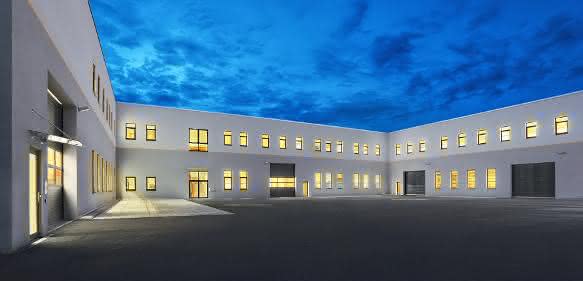
The existing 1,100 m2 company building was extended to 2,600 m2 in order to increase the office and production space and expand the portfolio. The company attached great importance to sustainability and energy-efficient building technology in both the design and implementation. The ground-breaking ceremony for the extension took place in November 2016. The construction work went according to plan and the ground floor and upper floor were ready for occupation in early fall 2017. In June 2018, the new building, which was financially supported by the Bavarian Ministry of Economic Affairs and the European Regional Development Fund (ERDF), will be inaugurated as part of the company's 20th anniversary celebrations with around 800 invited guests.
"In view of the increasing demand for our high-precision laser micromachining systems and the fact that our existing spatial capacities were completely exhausted, we decided to build an extension in spring 2016," reports Managing Director Anton Pauli. Apart from the need for additional production and administration space, the optimization of the material flow was an important reason for the new building at the Großwalding-based company.
Planning for the 1,500 m2 extension began at the start of 2016, with the ground-breaking ceremony taking place just a few months later on November 16. One of the main challenges of the project was to make the best possible use of the available space and to coordinate all planning and construction phases in terms of time and space so that there were no production downtimes. The first floor was occupied as early as August 2017, followed by the upper floor in October 2017, thus restoring regular operations.
The upper floor of the extension houses, among other things, the precision assembly of opto-mechanical assemblies, an area that had been outsourced before the expansion for space reasons and has now been brought back into the company. In these premises, particular attention was paid to creating cleanroom-like conditions, for example in terms of air purity and temperature control. "For this reason, we had appropriate air conditioning installed as well as antistatic floors with a synthetic resin coating," explains Pauli. This will enable us to react more quickly to new specifications and guidelines in the area of opto-mechanical assembly and precision manufacturing in future and have the department classified as a cleanroom with little effort." The optical tables installed there are characterized by their honeycomb cores, which ensure active vibration compensation. This is an essential prerequisite for ensuring that the opto-mechanics - such as the special trepanning optics - can be fitted with the appropriate optical components and adjusted with micrometer precision.
"In order to be able to carry out the mechanical precision production of key components in-house, we are planning to set up a corresponding area in the coming months," says Pauli. "Another fully air-conditioned area is available for this purpose." In order to guarantee the precision of a few micrometers and optimum quality required for the production steps there, a temperature consistency of +/-1K with a temperature stratification of 1K/m is absolutely essential. For this purpose, an air conditioning system with a special air heat pump from the manufacturer Panasonic was installed, which works with innovative three-pipe technology and had already been installed in a previous version in the existing building. "This technology is characterized by its very high energy efficiency and we have the option of networking the systems in the two parts of the building and using one as a redundant backup system for the other. "With this air conditioning system, we are now able to use the waste heat from our machines via the cooling water and thus control the temperature of the entire building with minimal additional energy consumption," - explains Pauli. The building envelope itself was also designed for the capacity of the air/heat pump and provided with full thermal insulation in order to reduce temperature losses via the outer walls to a minimum. In addition, the entire interior lighting of the building is automated and controlled by presence and motion detectors. The lighting technology automatically adjusts the light intensity of the LED lamps to the daylight conditions so that the same brightness prevails in all rooms at all times. The Bavarian Ministry of Economic Affairs and the European Regional Development Fund supported the construction project.
"Thanks to the new building, we can now produce up to 50 laser micromachining systems per year, which corresponds to an increase of 100%," concludes Pauli. "In addition, we are now able to increase our own added value thanks to the new in-house production and raise the production of components as a service to a new level." The building will be inaugurated in June 2018 in a festive setting with around 800 invited guests. kp


You might also be interested in
Plagiarius 2024 negative prize
On January 26, 2024, the Plagiarius campaign awarded its dreaded "Plagiarius" negative prize for the 48th time to manufacturers and retailers of particularly brazen counterfeits and fakes.
 read more...
Ivalua honors winners of the Generative AI...
AI-supported "add-ons" for buyers within 48 hours
Ivalua, provider of cloud-based spend management solutions, announced the winners and innovations of the first Generative AI Innovation Cup. The competition took place in December 2023. It was open to all Ivalua partners and employees - more than...
read more...Efaflex celebrates 50 years of high-speed...
The emphasis is on "fast"
Since day one, Efaflex has wanted to use new technologies as early as possible and drive progress in the industry. This year, the family business is celebrating its 50th anniversary under the motto "Fast Forward".
read more...Security of supply even during power outages
In the winter of 2022, Germany was worried about energy shortages. The drugstore retailer dm did not paint any horror scenarios, but nevertheless saw the possibility of controlled, temporary, regional power cuts (brownouts).
read more...Safety technology in mechanical engineering
Modules with new functions
Euchner's product highlights at EMO 2023 include the communication-capable solenoid interlocks.
read more...Transforming the paper industry towards climate neutrality
Together with partners from industry and research, Voith is developing a project for the optimization of energy and material flows in paper production. The aim of the research project is to develop a digital framework that enables effective process...
read more...Up to 95 percent less flue gas thanks to direct extraction
The requirements for occupational safety measures and safety technology are also constantly increasing in welding technology. The Technical Rules for Hazardous Substances (TRGS) stipulate that welding fumes and harmful substances must be extracted...
read more...Competitive advantages with large machines
Whether 3D-printed components for machines and systems, prototypes or aids for design: additive manufacturing is almost indispensable for modern companies in mechanical and plant engineering and automation if they want to play in the premier league.
read more...Transport technology from the modular system
Many transport tasks can be realized with the help of linear technology. Pre-configured solutions are available to simplify the interaction between the linear unit, motor, gearbox and controller. This minimizes the effort required for research and...
read more...