
Roller chains for pallet lifters
Tsubaki roller chains secure the ice cream supply
At a German ice cream manufacturer, the higher capacity utilization of the production facilities in summer led to the premature failure of the roller chains for the pallet lifters. Tsubaki installed a Neptune chain, which was specially designed for ambient conditions with a high moisture content.
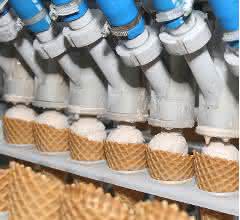
When the drive chains on the pallet lifters failed prematurely during the seasonal increase in production in the summer, the ice cream manufacturer contacted the engineers at Tsubaki, the manufacturer of drive and conveyor chains in the premium segment. They asked for a more reliable option that would allow them to maximize the service life of their chains.
Challenges in modern ice cream production
Ice cream manufacturers make up a large proportion of the food and beverage industry. Their ice cream machines must guarantee high capacity utilization to ensure that operations are economical and can withstand strong competitive pressure.
The ice cream machines are also operated in an environment with temperatures well below freezing in many places. For example, ice cream is cooled to a holding temperature of around minus 25 degrees Celsius for storage. In addition, the sometimes high humidity poses an increased risk of corrosion for the machines, which has an impact on their service life.
These conditions can be exacerbated by the seasonal demand for ice cream. While ice cream producers often reduce operations in winter, they increase available production capacity in summer to meet demand. This and the environmental conditions can cause equipment to break down prematurely. The standard chains installed are particularly susceptible to this. When the ice cream manufacturer increased summer production from five to seven days a week, the operators on site noticed that the roller chains installed on the pallet lifters were not lasting long enough. The pallet lifters move heavy loads in a warehouse with temperatures below freezing.
Nickel-plated 16B-1 roller chains were used in the pallet lifter to lift loads of up to 800 kilograms. The lifter itself is driven by a 1.5-kilowatt motor with 32 revolutions per minute. With a production schedule of five days a week, the average service life of such a chain is around two years. When production was switched to seven days a week, the average service life of the installed chains fell to just six months. The inner links of the chains broke due to increased fatigue caused by the increased stress and low temperatures. This resulted in more maintenance work and higher repair costs for the palletizer.
Initial inspection provides information
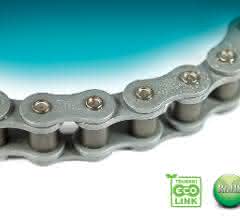
After an initial inspection, the Tsubaki engineers worked closely with the ice cream manufacturer's engineers. They selected a new drive element, the RS16B-1 Neptune roller chain. Compared to the nickel-plated chain originally used, this offers 20 percent greater fatigue resistance. In addition, the Neptune roller chain has a special coating that provides protection against condensation in the low-temperature bearing.
Using the Neptune chain, the engineers were able to improve the service life of the drive element during the more intensive production period and avoid premature breakage of the chain links. Maintenance costs for the palletizers were reduced, repair costs minimized and uptime maximized. The Neptune chain was specifically designed to operate in harsh, low-temperature environments and enabled the German ice cream factory to efficiently meet summer demand. as


You might also be interested in
Lifting oven grates
Bharat Forge CDP is a supplier of forged chassis and engine components as well as non-automotive systems. Since 2020, the company has been working with Kito-ER2 electric chain hoists to lift furnace grates in the production hall.
 read more...
Mobile and intelligent handling solutions
Scaglia Indeva has been developing and producing industrial manipulators and handling solutions for more than half a century. The company will be presenting its latest products for logistics at LogiMat.
read more...Mink at the Hannover Messe 2023
Transportation on brushes
Technical brushes from Mink are suitable for the gentle transportation of sensitive workpieces. According to the manufacturer, the adaptability of the brushes to different surfaces ensures part quality and avoids rejects.
read more...Partial automation in wood processing
Rescue from the staff shortage
The Schnurr company in Nordrach in the Black Forest has been processing wood for almost 170 years. Today, the company is a sought-after partner when it comes to individual wooden packaging or sawn and planed wood.
read more...Products for better ergonomics
At Intec, Scaglia Indeva will be presenting innovative ergonomic products for intralogistics. The focus is on products for better ergonomics, smoother work processes and protection of employees against overload.
read more...New pallet roller for the warehouse
Conveyor technology specialist Rulmeca is expanding its range of conveyor rollers for pallets and other heavy goods with the XPS series.
read more...Individual energy management
When a Festoon cable carrier system for a crane system with a travel distance of 30 meters was to be replaced, Tsubaki Kabelschlepp designed a complete package consisting of chain and cables, guide channel including substructure and an individual...
read more...Plan and manage maintenance
The health and safety regulations and statutory inspection guidelines for operating equipment in companies are strict and extensive. As a result, it is not easy to keep track of all inspection regulations and periods in day-to-day operations.
read more...Fully automated conveyor system for battery systems
With a fully automated and flexibly expandable conveyor system for truck loading, a manufacturer of battery systems in the electric automotive industry is meeting the increasing demand.
read more...