
Torque motors
Eliminate disruptive forces
In high-precision surface processing, conventional torque motors can cause deviations of several micrometers due to interference forces. These inaccuracies are unacceptable for the highest quality standards. A new motor design prevents these quality-reducing influences and enables even higher machining accuracies.
When machining with very rigid and direct-driven rotary axes in ultra-precision milling, grinding and gear cutting machines, visible defects can occur on workpieces. This is known as the phenomenon of short-wave surface defects. They can often be recognized by optical effects on the surfaces, such as regular stripes or shadows. Grinding stars on the end faces are also indications of this type of defect. Such deviations in accuracy of less than one micrometer to a few micrometers lead to quality problems on high-precision workpieces in mould making, lens end machining or for top-quality gearing parts.
These deviations occur in rotary axes and rotary tables due to the slightest tilting of the axis or clamping surface. This is caused by pulsating axial and radial forces resulting from the magnetic fields of the torque drive. They act as interference forces and moments on the bearing via a lever arm. These loads, which are relatively small for the bearing, cause axis misalignments and tilting in the sub-micrometer range, which can leave the described marks on the workpiece surface. In the case of grinding stars in particular, the error period is usually due to the number of poles of the motor. The phenomenon is by no means new, but the surface qualities today are so high that the effects can become visible on the machining marks. In addition, the requirements for shape tolerances and surface qualities have increased so much in some industries that the cost of reworking is too high and the market demands a solution.
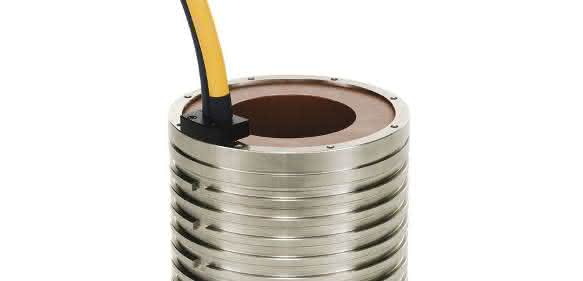
In order to avoid the resulting surface errors in ultra-precision manufacturing, the engineers at INA - Drives & Mechatronics (Idam), the direct drive specialist within the Schaeffler Group, have developed a "double" motor structure. This structure balances out the interference forces and torques that occur within the motor.
The new SRV series torque motors are based on this principle. Despite their more complex design, they can directly replace standard torque motors on the market. Air gap diameters from 89 to over 460 mm and magnet heights from 25 to 200 mm are available for the new series. Speeds of up to 14,000 min-1 can therefore be achieved.
According to Schaeffler, when using the new torque motors, there is no longer any measurable introduction of pulsating motor-related axial and radial forces into the machine structure. The machined surfaces show no optical defects and can be realized with very high dimensional and shape accuracy. am


You might also be interested in
SurfaceTechnology Germany 2026
Challenges and trends in surface technology
Surface technology is facing challenges: high energy costs, a shortage of skilled workers and increasing digitalization. From May 5 to 7 in Stuttgart, SurfaceTechnology Germany will offer insights into the latest innovations, practical specialist...
 read more...
Foundry modernizes plant park with continuous wire belt shot blasting system
The Spanish foundry Funosa is modernizing its equipment fleet with an RDGE 1250 wire belt continuous shot blasting machine from Rösler. Focus: sand removal from heavy iron castings, energy efficiency, ease of maintenance and ESG strategy.
read more...Solutions for surface treatment
Lasers make batteries safe
At the parts2clean trade fair, Trumpf will be presenting manufacturing solutions for surface processing in automotive production, including the TruPulse 5050 nano short-pulse laser and the PFO33 scanner optics.
read more...Superfinish as the key to precision
In many areas of industry, surface quality determines the service life and performance of components. With the superfinishing process, roughness values of less than Ra 0.05 µm can be achieved.
read more...Superfinishing for all batch sizes
If particularly smooth and clean surfaces are required in metal processing - a so-called superfinish - this usually requires a separate processing step and can often be costly and therefore an economic challenge.
read more...Diamond tools with cold forming
No more grinding, honing and lapping
The production of smoothed and hardened surfaces on workpieces with hardnesses of up to 65 HRC is a demanding task.
read more...Gentle movement: Brush systems for sheet metal processing
While Kullen-Koti's brush plate systems are part of the basic equipment of many sheet metal processing machines and systems, the company's satin finishing brushes are used in many disciplines of mechanical surface treatment of sheet metal products....
read more...Trade fair for additive manufacturing continues to grow
With the further expansion of the process chain and a large number of special topics, Formnext is continuing its pace of growth in its fifth year and consolidating its position as the leading trade fair for additive manufacturing and modern...
read more...Small grinder for coarse and fine grinding
According to the manufacturer, the new small grinders in the LSF-29 series from Atlas Copco Tools offer greater precision and durability as well as ease of use and individual productivity compared to their predecessor models.
read more...