
DIN VDE 0100
Standardized energy efficiency in LV systems
Sales, reliability/availability, personal/operational safety, quality of products/services force standardization. Under the leadership of DIN, VDE and VDI, other committees are shaping national and international standardization in Germany.
In addition to specific product standards, overarching basic standards are of particular importance. These include the classic DIN VDE 0100 or VDE 0100 "Installation of power installations with rated voltages up to 1000 V". This installation regulation has been supplemented by the energy efficiency section EE 800. Following the example of asynchronous motors (IEC 60034-30 with efficiency classes IE 1-4), also for lamps, the evaluation of electrical systems with the aim of optimizing their losses is available for the first time. The criteria formulated in DIN VDE 0100-801: 2015-10 (VDE 0100-801, IEC 60364-8-1:2014, European harmonization document HD 60364-8-1:2015) apply primarily to new installations (commercial, industrial, residential and functional buildings, infrastructures, logistics), i.e. for planning and therefore also for clients. The latter can now define their requirements for the desired efficiency class, taking into account the local situation, and check them during system acceptance. At the same time, this opens up an option for modifying existing systems with lower-loss solutions.
DIN VDE 0100 classic
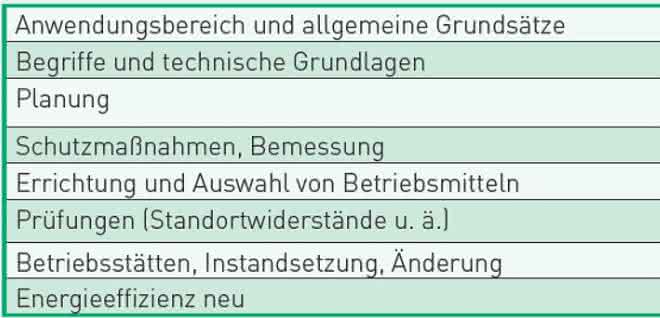
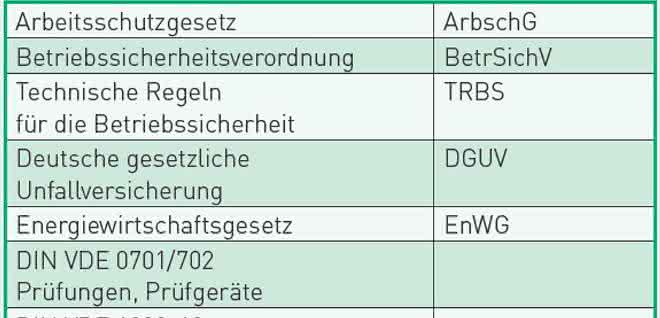
The previous standard is safety-oriented, its user is supported by laws and regulations (Table 1a+b).
DIN VDE 0100 Part 801 for standardized efficiency
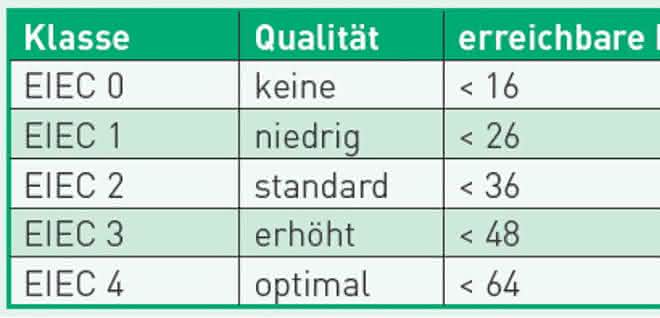
This regulation on "energy efficiency", which has been binding since 10/2015, supplements the oldest (originating in 1895) VDE standard series DIN VDE 0100. The application of the classification system described therein with five energy efficiency classes EIEC 0 - 4 (Table 2) makes LV systems more energy-efficient (not valid for products). The associated additional costs during the project planning phase remain calculable. Systems installed in this way generate minimal losses throughout their entire operating life. In addition to consumers, the focus is on cables, busbars, transformers, devices and, last but not least, measurement technology.
The standard specifies measures to be evaluated with points. Their sum is assigned to an EIEC class. In future, project planning/design will be characterized by the correct determination of this figure. Different designs can be compared more transparently. Suitable measurement technology enables the operator to monitor the system efficiency during operation and, if necessary, to correct it in the desired direction.
Systematic planning of EE
The following aspects must be taken into account:
- Creation of the load profile
- Local energy generation
- energy losses
- spatial arrangement
- Energy use (customer demand)
- Tariff structure of the supplier.
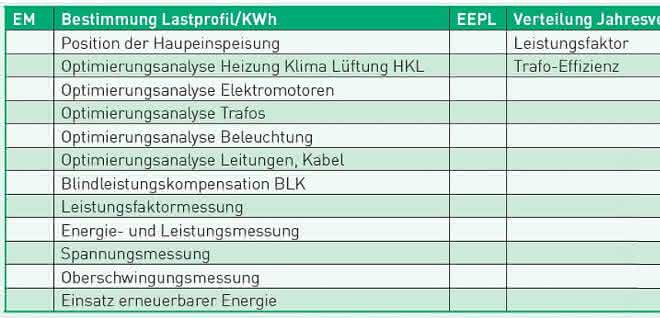
There are 13 efficiency measures EM and three EE performance levels EEPL (Table 3). At best, four points can be awarded per criterion, so that 64 points can be achieved in the highest class EIEC4.
Implementation of the measures
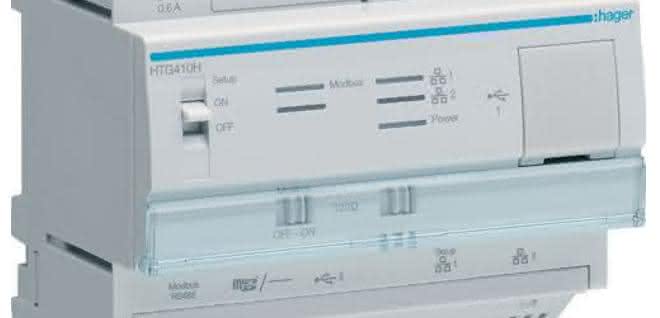
The new regulation offers four quality levels EM0 - EM4 and EEPL0 - EEPL4 for each of the aspects mentioned. Their evaluation with points is based on calculation (e.g. transformer selection, positioning), measurement (load profile, cosϕ), analysis (e.g. IE-classified motor use) or consideration (e.g. reactive power; residential buildings do not require BLK compensation, the criterion not to be considered immediately leads to four points). Planned control measurements with permanent logging of the load, for example, require special devices such as the energy monitoring server (image). It collects, stores and processes measured values from the connected products. The integrated LAN interface forwards this data to the relevant end devices (PC, notebook, tablet) via its web server functionality. Alarm messages can be sent in a targeted manner using an email notification function. The device supports visualized evaluation in accordance with DIN VDE 0100-801.
Outlook
As a step towards EE in LV switchgear, the new part of the standard - without limit values - requires a complete examination of the system. Its low loss is described in a reproducible and transparent manner for all functional groups via the scalable point evaluation resulting in the efficiency class with continuous, metrological monitoring of certain states. Determining the class is part of qualified system project planning. As a result, it minimizes internal consumption and extends the service life. The associated additional costs are usually amortized in a short time. The focal points include Determination/measurement monitoring of the load profile as a replacement for the fixed determination of the load centre of gravity from the theoretical connected load, the selection of the location of the main feed-in, the permanent optimization analyses of components if necessary and the documentation of the feed-in/transfer point. Due to the increased integration of digital technology, the safety risks to be managed are also growing.
Standard: A publicly accessible technical requirement or rule without legal status on a specific subject or subject area at national or international level. As a generally recognized, binding standard that must be observed and never violated, it represents the state of the art. With legal significance, it conveys the current technical and scientific level in a legal dispute as a binding source of knowledge.


You might also be interested in
Helu makes its first trade fair appearance under a new brand name
Helu Kabel will be presenting itself as Helu for the first time at Hannover Messe 2026, showcasing system solutions, Heluchain cables and new industrial luminaires.
 read more...
Strategic realignment with brand relaunch
In future, Helukabel will trade as Helu
The Helukabel Group is parting with part of its name: in future, the company will only operate under the Helu brand. With this step, the specialist for electrical connection technology is underlining its strategic development from a classic cable...
read more...Modular plant construction for corrugated board
Insight into the production of corrugators at BHS Corrugated: Automated, modular and equipped with Helukabel components.
read more...Best quality for the steel
Conditions in the steel industry are harsh and inhospitable. The machines used must be able to withstand the demanding environmental conditions in order to deliver the best quality at all times.
read more...If the standard cable is not sufficient
Lapp offers cables for countless applications - but not for all of them. From time to time, the developers have to modify a standard cable or develop a special cable.
read more...Slight decline in sales, strong investments
The Lapp Group has not been spared from the weakening global economy. However, the company only recorded a slight loss in the past 2024 financial year.
read more...Electrical connection technology
Cables and wires for industrial automation
Heukabel offers system solutions for cable routing from a single source. The subsidiary EKD Systems specializes in tailor-made cable drag chains made of steel, stainless steel and plastic, which are used in moving machines and systems as well as in...
read more...Lapp relies on Ultramid from BASF
Mobile charging of electric vehicles
The automotive industry is currently undergoing the biggest transformation in its history. The boom in battery electric vehicles in particular is presenting the industry with major challenges. Lapp, as a supplier of cables and connection...
read more...Cable handling application
At this year's Motek, ArtiMinds Robotics is showcasing a robot-based automation solution for the sensor-assisted assembly of flexible cables in connector housings.
read more...