
Servo drives
Small servo system for smart mechanical engineering
Wittenstein presented the second generation of the Cyber-Motor small servo drive system at the SPS. Its special features are the newly designed Cyber-Simco-Drive-2 controllers, which are around 30 percent smaller and feature a multi-Ethernet interface, CIP-Sync real-time function, STO safety function and decentralized intelligence.
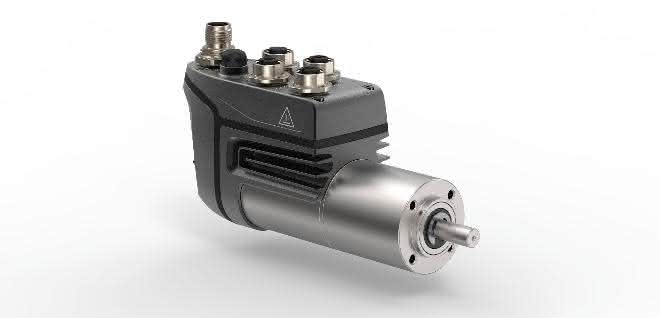
These enable the realization of a motor-integrated version as a new configuration variant. The optional integration of multiturn encoders, holding brakes and planetary gearboxes extends the functional scope of the Cyber-dynamic-line servomotors.
The newly designed controllers are available with both a CANopen and a multi-Ethernet interface. The latter allows the user to choose between the EtherCAT, Profinet, EtherNet/IP CIP Sync and, in future, Sercos III fieldbus variants.
The size of the Wittenstein drive controllers has been reduced by around 30 percent compared to the previous version. The integrated STO (Safe Torque Off) safety function fulfills the safety requirements of SIL3 and PL e for all controller versions of the Cyber Simco Drive 2.
Motor-integrated variant for the field level
The same applies to the new motor-integrated variant, the Cyber Dynamic System (CDS). A motor in size 40 mm together with a special housing design of the controller forms a compact unit that fits into tight installation spaces and eliminates the need for cabling except for the power supply and fieldbus communication. The CDS also has decentralized control intelligence for implementing independent positioning operation.
All four controller sizes from 17 mm to 40 mm outer diameter are available in an easy-to-clean standard stainless steel housing or an Inox version. The size 40 motors can optionally be equipped with a holding brake and can also be operated with a low-backlash planetary gearbox of type NP from Wittenstein Alpha 's Alpha Value Line. In terms of performance, torques of up to 22 Nm and forces of up to 2 kN can be realized with the actuators. At the same time, speeds of up to 1,000 mm/s are possible.


You might also be interested in
ebm-papst is growing again thanks to AI and data centers
ebm-papst returned to a growth trajectory in fiscal year 2025/26. Air Technology, data center applications, and artificial intelligence are driving revenue and investment.
 read more...
SPE on the Verge of a Market Breakthrough
Single Pair Ethernet (SPE) has moved beyond the conceptual phase and is increasingly being implemented in industrial settings. The focus here is not only on higher data rates and simplified cabling, but above all on the issue of system integration...
read more...More than 900 exhibitors already registered
Around six months before the start of the trade fair, more than 900 companies have registered for SPS 2026 in Nuremberg. The trade fair focuses on industrial AI, cyber security and digital transformation.
read more...Virtual PLCs in practice: How vPLCs make production systems more flexible and scalable
The increasing networking of IT and OT is fundamentally changing industrial automation. The IT/OT Integration Summit shows how modern technologies can make production environments more efficient, flexible and future-proof. The event will focus on...
read more...Sales growth in a turbulent market environment
Thanks to innovations and a focus on strategic industrial markets, Sick was able to moderately increase its sales in the 2025 financial year. In a turbulent market environment, the company was able to maintain its position and gain market share with...
read more...Siemens presents new AI agent
Siemens is launching 'Eigen Engineering Agent', an AI for automation technology. The solution is integrated into the TIA Portal, has been tested with over 100 companies and is designed to significantly accelerate engineering processes.
read more...Schaeffler keeps sales almost stable
Schaeffler generated revenue of EUR 23.5 billion in 2025 and increased EBIT before special items to EUR 936 million. At 266 million euros, free cash flow was significantly above the prior year and forecast. Net income remained negative due to high...
read more...Advancing artificial intelligence together
Helukabel is stepping up its activities in the field of artificial intelligence and is now a member of the IPAI. The innovation and collaboration platform for companies, research facilities, institutions and administration has set itself the goal of...
read more...New impetus for ifm sales
Two new positions were filled at ifm at the start of 2026: Markus Wolf becomes Managing Director Sales Germany, Sven Quant takes over the position of Central Managing Director in the Process Sensors division within the ifm Group.
read more...