
Miniature drive system
In modular format, for compact applications
A drive consisting of a stepper motor with integrated controller and encoder is ideal for compact applications and is extremely flexible to use. In addition, an operating tool supports the user in integrating the platform into their product development.
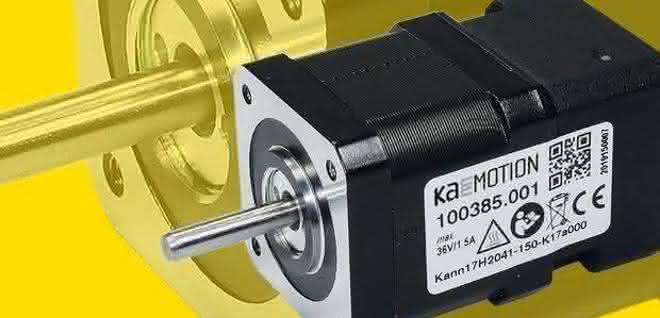
Why pay too much for too much performance when it can be done cost-effectively and tailored to the application? That was the question Adlos and Koco Motion asked themselves before jointly developing the KannMotion three years ago. The system is very flexible when it comes to adapting to the intended application. "This customization provides our customers with added value that enables them to optimize their total cost of ownership," says Thomas Vogt, Managing Director of Adlos.
The platform as a basis
The drive, which consists of a stepper motor with integrated encoder and a directly attached controller, is designed as a closed control loop. As a closed-loop drive, it has a simple design and is fully programmable. The individual adaptations of the hardware and software for customer projects are typically based on 80 percent standard modules, which are put together according to the modular principle. The compact drive system works reliably like a servomotor even in continuous operation and can be programmed via commands or sequence programs. The KannMotion is available in Nema 11, 14, 17, 23, 24 and 34 flange sizes with torques from 0.05 to 12 Nm. The supply voltage is available from 12 to 48 V and the phase current can be a maximum of 10 A. Applications can be found wherever positioning tasks, controlled continuous operation or a programmed motion sequence are required.
Reducing the number of components reduces assembly work, possible faults and wear. The latter is low anyway thanks to the direct drive, as is the noise level. Efficiency is 30 to 50 percent higher than with a conventional DC geared motor drive. The entire system is very compact due to the integration of the controller. The torque can be adjusted by setting the current. In the event of a fault, the motor can simply be replaced.
Many questions concretize the interpretation
So how should we imagine the design of such a drive? To specify the requirements, customers must first answer questions such as:
When should the motor rotate, at what speed, what torque and what force? The question of motor technology must be answered, as must the question of available installation space or mounting. Of course, a control system must be specified as well as the service life under the given environmental conditions.
The service life, heating and efficiency of a motor can be positively influenced by adapting it to the specific application. The key to success is an early exchange of information with a realistic schedule. The motor is selected and the motor technology determines the type of control. The motion profile is described and initiated based on this. Additional functions or components such as peripheral devices, display or control elements are then simply added.
The KannMotion is also designed for communication in the smart factory. It has CANopen as well as RS485 and RS232 interfaces. The drives can also be controlled with digital input and output functions (DIO). Other interfaces can also be implemented at the customer's request.
Success stories
Applications for the drive range from vegetable peelers to vacuum grippers, format adjustment, blood pumps and welding robots to musical instruments.
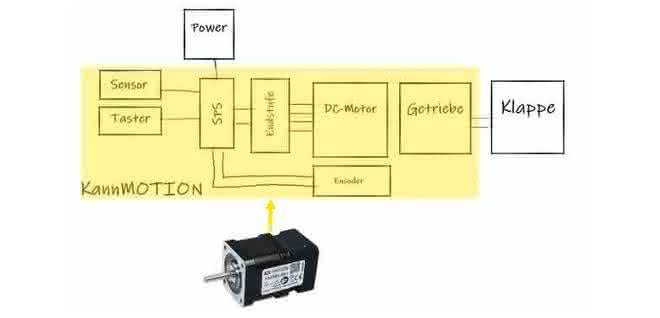
For example, a customer previously needed a control unit, an output stage, operating elements, sensors, collision protection, a gearbox, the DC motor and the cabling for its previous drive system for flap control for a sales counter for baked goods. "All these components are now integrated in the Kann- Motion," says Vogt. "The employee saves planning effort, research and reduces the number of variants."
"The bottom line is that it is always important what the customer wants to pay for the direct tailoring of the drive to the functions they need to realize. Not only the number of components or their prices play a role here, but also installation, maintenance or repair costs - the TCO," says Olaf Kämmerling, Managing Director of Koco Motion. "Unfortunately, users still focus far too much on the price of the drive itself and not on the total costs. A rethink here would be highly desirable."
Generation 2.0 and beyond
In the KannMotion Generation 2.0, improvements have been made to the mechanics, electronics and software. A completely revised tool, the KannMotion Manager, supports the user during integration.
"The biggest change is certainly the programming. Faster response times and flexible firmware that can be used as widely as possible were the goal. We have now created a development environment with which the user can implement their application either in the object-oriented Flow Chart Editor or in C code," says Vogt. "The KannMotion project has been very well received by the market. We have already been able to implement various applications in all project stages, from evaluation and final testing through to series production," adds Kämmerling.
The two cooperation partners are constantly receiving new input from their customers for the further development of the platform. For example, they implemented the control system in relation to Nema 11 in response to a special customer request. They want to continue to drive the development of the platform in the future in close cooperation with the customer.
According to documents from Koco Motion / am


You might also be interested in
Predictive maintenance in retrofit
Predictive maintenance pays off. This is because early detection of impending failures means that systems can be serviced in a targeted manner before production downtime occurs. But how complex is it to integrate such a maintenance concept into an...
 read more...
Maintenance instead of replacement
The circular economy starts with the machinery
Sustainability in industry starts with machines, says our guest author from Deguma: How maintenance, modernization and the 5R strategy save resources, energy and CO₂.
read more...3D printing for unplanned requirements
The material fails and the machine suddenly stops? Then you need to take the right measures to be able to resume production quickly. Material failure in the form of faulty components or material wear in the frame are a risk for any production.
read more...High demands in terms of safety, application and robustness
Demanding work in the electrical trade and energy supply as well as smooth processes in production require innovative and customized measurement technology that scores points for safety, ease of use and resilience.
read more...Car meets e-bike: riding with lubrication-free polymer bearings
Studies show that the proportion of pedestrian and bicycle traffic is increasing in urban areas. With the JetBike, JetBike GmbH from Braunschweig presents a mixture of e-bike and car and relies on lubrication-free polymer bearings from Igus.
read more...Hydraulic hub for more efficient servicing
Bosch Rexroth presents a digital toolbox for service and maintenance. With a comprehensive range of digital services, the Hydraulic Hub simplifies and accelerates the service and maintenance of hydraulic products and increases machine availability.
read more...Arnold Umformtechnik expands after-sales...
Faster help with VR glasses
Arnold Umformtechnik is expanding the after-sales service for its machines to include digital remote services. The focus is on data security, simple operation and clear processes.
read more...147,000 euros per hour: high costs for German companies due to unplanned downtime
According to the "Value of Reliability" study, 67% of industrial companies in Germany experience unplanned downtime at least once a month. This costs the German economy 147,000 euros per hour. Nevertheless, reactive maintenance concepts are not...
read more...Maintenance starts with a maintenance planner
Legal requirements stipulate that machines and systems must be serviced regularly. The maintenance work serves to ensure occupational safety and economic efficiency.
read more...