

Shaft couplings
Reliable and precise balancing
Shaft couplings transmit rotary movements and torques from shaft to shaft. They also compensate for tolerances and mechanical errors that would otherwise lead to damage to drive or measurement configurations.
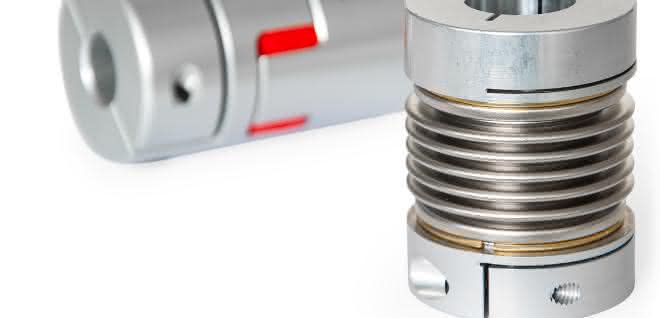
Like all mechanical components, shafts are subject to manufacturing or assembly tolerances that cannot usually be completely eliminated, even with great technical effort. If these mechanical deviations are not compensated for, they result in vibrations, noise and stiffness and ultimately shorten the service life of the connected units.
The standard element manufacturer Ganter has tackled these problems. The result is shaft couplings that are suitable for torque and power transmission as well as for position and motion control. The right type of coupling is therefore available for every application.
Despite the wide range of variations, the right designs can be found quickly. A type overview presents the most important features of all shaft couplings at a glance, while the tried-and-tested standard sheets document the details of the individual coupling standards. Further technical information on installation and application as well as information on speed, temperature, torsional stiffness, moment of inertia, etc. are summarized in a shaft coupling brochure - available in printed form or as a download.
The new shaft couplings made of aluminum or stainless steel that have been added to the product range can be fastened either positively or non-positively. Several bore diameters, different degrees of stiffness and hardness of the coupling body and an optional keyway allow the coupling to be tailored to the specific application. In general, all shaft couplings compensate for misalignments and misalignments, absorb concentricity errors and axial movements and dampen vibrations and shocks to varying degrees. At application level, a distinction is made between position and motion control as well as torque and power transmission.
The rotary motion must be transmitted very precisely and accurately for position and motion control. This requires a type of shaft coupling that operates backlash-free in the direction of rotation and has a high torsional rigidity. Typical application examples are Servo or stepper motors for linear axes, industrial robots, test benches.
In torque and power transmission, on the other hand, the focus is purely on power transmission. This requires shaft couplings that can withstand high torques and heavy loads and function permanently in harsh application environments. Typical applications include conveyor systems, pumps and agitators as well as packaging machines.


You might also be interested in
Atlas Copco takes over long-standing sales partner
Atlas Copco has taken over Heide-Pumpen. The specialist for mobile pumps has been working closely with Atlas Copco in sales and service for a long time, especially for surface pumps for construction site dewatering and wastewater detour or in the...
 read more...
Lutz Pumpen at the Achema 2024
New mobile drum pump with battery drive
The new B3 Battery from Lutz Pumpen promises mobile and safe working with aggressive liquids without having to compromise on pumping performance compared to wired versions. The battery-powered drum pump will be on display at Achema, the world's...
read more...Maintenance and Pumps&Valves in February
Final preparations are underway in Dortmund: On February 21, 2024, maintenance will start as the leading trade fair for industrial maintenance and with it Pumps&Valves as the trade fair for industrial pumps, fittings and valves.
read more...Liquid separator keeps pumps dry
Vacuum clamping minimizes distortion and enables five sides to be machined in one clamping operation. The use of cooling lubricants poses a challenge: If they get into the vacuum generator, they can cause serious damage.
read more...Spring clutches for construction machinery
Spring clutches from Torsion Control Products (TCP) are ideal for use in construction machinery where modern diesel engines are used.
read more...Protection against cooling lubricant
Liquid separator from Schmalz keeps pumps dry
Anyone clamping with a vacuum during CNC machining must protect the pump from cooling lubricant. The NLS liquid separator from Schmalz separates the cooling lubricant and returns it to the running process - without interrupting the vacuum.
read more...Which clutch for what?
Mechanical engineering and its applications are multifaceted. Every application is special and requires a perfect machine design. Individual components in the system must also be optimally designed.
read more...Energy efficiency needs electrical engineering and IT
The energy crisis makes one thing clear: it is not enough to simply screw a photovoltaic system onto your roof or purchase green electricity. Industry is faced with the challenge of reducing consumption in order to counter the rise in energy prices,...
read more...Solutions for a networked and climate-neutral industry
At the world's leading trade fair for industry, around 4,000 companies from the mechanical engineering, electrical and digital industries as well as the energy sector will be showcasing solutions for the production and energy supply of the future.
read more...