
Rolling bearing features
Select rolling bearing designs correctly
Practical application experience shows that it is possible for users to select the correct type of rolling bearing using the documentation and tools provided by the manufacturer and on the basis of comparable applications. This article provides an overview of the bearing characteristics and provides assistance for design.

When selecting a rolling bearing, two complementary factors are usually in the foreground:
- the desired service life of the rolling bearing in the application as a result of the relationship between the basic dynamic load rating and the forces occurring, their direction(s) of action and the speed,
- the size of the rolling bearing in relation to the available installation space in the application.
There are other function-critical bearing features that are not always considered with the necessary attention and can therefore lead to problems. These include the internal clearance, the cage, the lubrication and the sealing variants offered, particularly in the case of radial deep groove ball bearings. The following is an overview of these bearing characteristics and associated issues.
The nominal internal clearance is the dimension by which the two rings of a bearing can be moved from one end position to the other when not installed. For most radial rolling bearings, the radial displacement or radial internal clearance is specified, while for paired or double-row angular contact ball bearings and tapered roller bearings, the axial internal clearance is specified. The bearing clearance is summarized in bearing clearance classes that are standardized for standard radial bearings.
Important parameter: the internal clearance
The bearing clearance influences the function and performance of the rolling bearing and, with the exception of special applications, it can be assumed that a rolling bearing must have an operating bearing clearance, the so-called operating clearance. This operating clearance results primarily from the selected bearing clearance class in conjunction with the shaft and housing fits required for the application, the materials used and their coefficients of thermal expansion as well as the temperature difference between the shaft and housing during operation. As a rule, these factors lead to a "constriction" of the bearing, which reduces the nominal internal clearance and can lead to unintentional preload. As this results in considerable friction losses, additional heat generation and often premature bearing failure, the operating clearance should be considered more closely when selecting bearings.
Generally, manufacturers supply rolling bearings with a standard cage that is suitable for "normal" applications. A thorough check of the cage design is advisable under the following operating conditions:
- operating temperature. For example, the application limit of PA6.6 plastic cages is reached at a maximum operating temperature of 120 °C. In addition, metal cages or cages made of special plastics are required.
- High accelerations and low loads. In these cases, depending on the bearing design and size, lightweight plastic or sheet steel cages or ring-guided cages should be used to prevent deceleration or blocking of the rolling elements due to weight-related slip damage.
- This also applies to applications that are exposed to shocks, vibrations and high centrifugal forces.
- Lubrication situation. In general, rolling element-guided cages must be used for grease lubrication, as the formation of the necessary lubricating film in the gap between the cage and ring is not guaranteed with ring-guided cages. Oil-lubricated bearings are not subject to these restrictions. However, when using fully synthetic oils in particular, care must be taken with regard to compatibility, especially with engineering plastics and rubber.
The influence of lubrication
The selection of a correct lubricant and the classification of the performance and service life of standard lubricants used in pre-greased and sealed radial deep groove ball bearings is often underestimated. On the one hand, the best possible lubricating effect must be ensured. On the other hand, every lubricant is subject to ageing depending on the operating conditions, whereby its performance and service life are typically exhausted before the rolling bearing. The operating temperature is of decisive importance here.
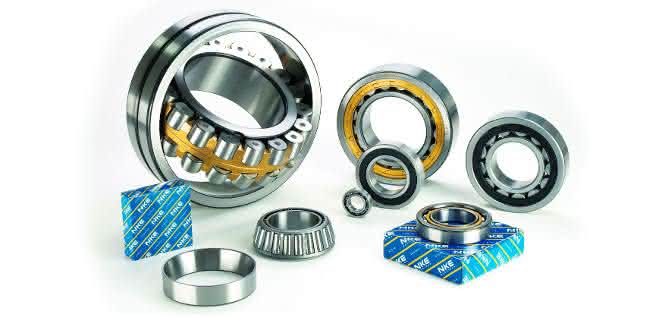
Misconceptions also exist with regard to the use and performance of the sealing variants on offer - particularly in the case of radial deep groove ball bearings. For example, rolling bearing seals that come into contact with liquids are generally not liquid-tight. This results on the one hand from the small installation space and on the other hand from the necessary compromise between sealing effect and minimization of friction. Therefore, the use of different standard seal designs must always be weighed against each other in terms of the required protective effect and the resulting friction and, if necessary, the use of special designs or upstream seals must be considered.
A "grease collar" often forms in the area of the sealing gap or the sealing lip in bearings with lifetime lubrication. This is the result of grease distribution and displacement processes in the bearing, whereby a small amount of grease escapes to the outside. This is not a quality defect, but provides additional protection, as dirt particles are trapped outside the rolling bearing.
The points mentioned are only a small but important excerpt from the many aspects that must be taken into account when using rolling bearings. Further information can be found in the relevant technical publications and the main catalog of NKE Austria. In addition, NKE offers a competence center for assistance in the design of rolling bearings and for clarification of detailed technical questions.
David Schaljo, Head of Application Technology NKE Austria / am


You might also be interested in
Housing and inserts for plenty of power
Lapp presented the expansion of its Epic Power series at SPS 2023: four new M23 circular connector inserts and three new M23 housings. The special feature: all housings can be combined with any of the four inserts.
 read more...
News and product updates from Smartgas
Portable gas analyzers for outdoor use
Smartgas is starting the second half of the year with a series of updates to existing products and a number of new products. Portable analyzers expand the range of applications, while new accessories such as protective housings and heating modules...
read more...Everything accurate in switch cabinet construction
To ensure smooth work processes, tools for processing enclosures and housings must function flawlessly and reliably. Häwa rounds off its punching range with the Multi-Press 500.
read more...Shafts and conversion parts
The Rodriguez range includes ball bushings including matching housings, shaft brackets, crossbars and supports.
read more...Cooling and temperature control units
Hygienic packaging sells safely
In few industries are the requirements for hygiene in the production process as strict as in the food sector - the health of consumers has top priority. This results in enormous challenges for all machines and components involved, especially in...
read more...Simple tool change in seconds
With the CMS, Schunk is launching a user-friendly, manual change system for quick component replacement. In addition to its simple and convenient operation, the CMS also stands out with its extensive range of optional modules and complementary end...
read more...Motion controller for small drives
Medium power range covered
Faulhaber has another housing-less and compact motion controller in its range, which is particularly suitable for integration in device construction and medical technology applications.
read more...Welding solutions in the name of resource efficiency
At the Welding & Cutting trade fair in Essen (September 11-15), Fronius will be focusing on the major drivers in welding technology. Quality requirements are increasing in all industries, but the required welding specialists are scarce. In...
read more...Safe solutions for cable installations
From thick power cables to thin sensor lines, cables and lines must be routed safely through systems and machines. A challenge that should not be underestimated, explains Jörg Sokat, Head of Product Management at Pflitsch.
read more...