
Plug & Produce
On the way to the smart factory
Plug & Produce from Industry 4.0 concepts. More individualization, smaller batch sizes, more frequent configuration changes - and at the same time the production line should be cost-efficient and competitive. Lenze has presented a modularization concept for this purpose.
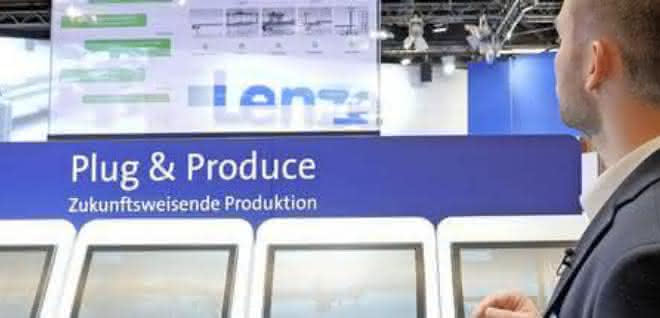
Machine builders and plant operators want to know the concrete, economically measurable benefits of Industry 4.0 and the digital transformation. With Plug & Produce, Lenze wants to show how a production line can be easily and flexibly adapted to changing requirements in the future. The basis is the modularization of the production line. If production modules are replaced, the control system previously had to be reprogrammed. With the Plug & Produce approach, this should be easier and faster.
In a moderation phase, the line is reconfigured - by uploading recipes that not only control the production process itself, but also contain information about which tasks are to be completed in which order, so that the appropriate modules can be selected and linked. The modules themselves contribute the necessary information, for example at what height transfer points, such as a conveyor belt, are located, in which position workpieces are to be delivered or how they can be output and at what speed they can be processed.
Once the plausibility check has shown that all the required skills are available, in the right place and with the right physical interfaces, the production phase can begin.
The next step towards the smart factory is primarily based on the administration shell as part of the Industry 4.0 reference architecture model (RAMI 4.0). Administration shells can exist for individual components, modules or the entire machine. The data contained therein provides information about the physics - for example, connection dimensions, service life, operating values - and about the capabilities ("skills"): Is it a drive, a network component, a packaging module or a welding system? This data forms the basis for creating a digital twin - the programming and simulation long before the physical realization of a machine.
Open, manufacturer-independent communication standards enable the modules involved and the PLC to automatically exchange Administration Shell data with each other - right through to full interaction during the production order. This requires a uniform data and information model as well as standardized semantics so that the data can be interpreted correctly. The asset administration shell fulfills the first part of these requirements. For the second part, Lenze relies on the extension of the OPC UA information and communication platform.
This concept can be implemented for mixed environments in the field. The basis for this is that all current components for mechanical engineering and automation are equipped with a management shell by the manufacturer. In addition, gaps in standardization still need to be closed. The aim is to drive forward modularization when creating control software, so that machine manufacturers can benefit from Plug & Produce and achieve a faster time-to-market with fewer resources. pb


You might also be interested in
ebm-papst is growing again thanks to AI and data centers
ebm-papst returned to a growth trajectory in fiscal year 2025/26. Air Technology, data center applications, and artificial intelligence are driving revenue and investment.
 read more...
SPE on the Verge of a Market Breakthrough
Single Pair Ethernet (SPE) has moved beyond the conceptual phase and is increasingly being implemented in industrial settings. The focus here is not only on higher data rates and simplified cabling, but above all on the issue of system integration...
read more...More than 900 exhibitors already registered
Around six months before the start of the trade fair, more than 900 companies have registered for SPS 2026 in Nuremberg. The trade fair focuses on industrial AI, cyber security and digital transformation.
read more...Virtual PLCs in practice: How vPLCs make production systems more flexible and scalable
The increasing networking of IT and OT is fundamentally changing industrial automation. The IT/OT Integration Summit shows how modern technologies can make production environments more efficient, flexible and future-proof. The event will focus on...
read more...Sales growth in a turbulent market environment
Thanks to innovations and a focus on strategic industrial markets, Sick was able to moderately increase its sales in the 2025 financial year. In a turbulent market environment, the company was able to maintain its position and gain market share with...
read more...Siemens presents new AI agent
Siemens is launching 'Eigen Engineering Agent', an AI for automation technology. The solution is integrated into the TIA Portal, has been tested with over 100 companies and is designed to significantly accelerate engineering processes.
read more...Schaeffler keeps sales almost stable
Schaeffler generated revenue of EUR 23.5 billion in 2025 and increased EBIT before special items to EUR 936 million. At 266 million euros, free cash flow was significantly above the prior year and forecast. Net income remained negative due to high...
read more...Advancing artificial intelligence together
Helukabel is stepping up its activities in the field of artificial intelligence and is now a member of the IPAI. The innovation and collaboration platform for companies, research facilities, institutions and administration has set itself the goal of...
read more...New impetus for ifm sales
Two new positions were filled at ifm at the start of 2026: Markus Wolf becomes Managing Director Sales Germany, Sven Quant takes over the position of Central Managing Director in the Process Sensors division within the ifm Group.
read more...