
Open electronic type plates
Only performance counts
An open electronic nameplate would significantly speed up the commissioning of motors
and improve their performance. However, until now
communication protocol across all manufacturers.
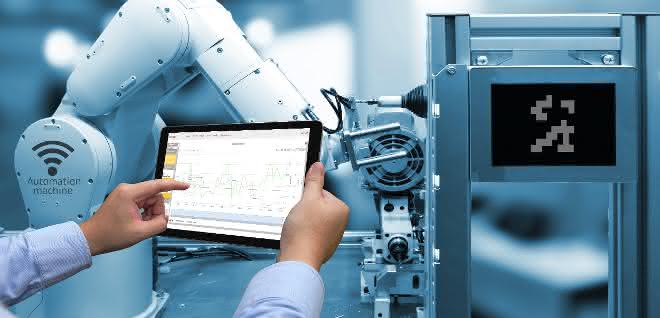
Scientists at Cologne University of Applied Sciences have found a solution in which the SCS open link engine feedback interface from Hengstler plays a central role. SCS open link was designed for high-performance bidirectional data transmission between the engine and drivetrain. The interface enables smooth interoperability between devices from different manufacturers. The research project "The engine as a cyber-physical system - electronic type plate" at Cologne University of Applied Sciences has been working on a very similar topic since 2017.
Prof. Dr. Jens Onno Krah and his colleagues from the Institute of Automation Technology have designed an open digital communication method for electronic motor nameplates that can be used by frequency inverters from different manufacturers. In this way, inverters can automatically recognize each connected motor and configure it with the appropriate parameters - the motor then operates at optimum efficiency. Until now, frequency inverters have only automatically recognized motors that are equipped with an encoder and come from the same manufacturer. Motors from competitors, on the other hand, have to be configured manually, which often leads to a loss of drive performance due to the lack of accuracy.
Machine builders should be free to choose their components
The impetus for the scientific project at the TH Köln came from the German Engineering Federation (VDMA) and the Forschungsvereinigung Antriebstechnik e.V. Both institutions want to drive forward the development of an open electronic motor type plate so that machine manufacturers can select their components according to their best performance rather than their compatibility in future. This would not only lead to more efficient machines, but would also increase competition between component manufacturers and thus further improve the quality of their products.
A universally readable electronic type plate could also be used to remotely monitor the condition of a machine's entire drivetrain (condition monitoring), enabling early intervention in the event of impending power losses. Condition monitoring is not only interesting for users, but also for the machine manufacturers themselves - they could offer condition monitoring as a service. This service would enable them to expand their value chain and at the same time increase customer loyalty.
Interface makes the nameplate possible
With this research project, the scientists at TH Köln wanted to find solutions to two problems: Firstly, the electronic type plate, which until now has only been offered by individual manufacturers for their devices, should be readable across all manufacturers. Secondly, it should also be available for motors without built-in encoders. For motors with encoders, the electronic type plate is usually stored in the EEPROM (memory) of the encoder. Here it can be read out using the encoder's own digital interface. Encoderless drives do not have this interface, so the electronic type plate must be transferred from the motor to the inverter in a different way.
In the course of their research, Prof. Dr. Krah and his team discovered that the motor cable can be used to transmit the nameplate data for these drives. An additional cable is not required. This is made possible by the open interface SCS open link from Hengstler, as the protocol can be used to transmit motors with encoders at a rate of up to 10 MBaud and control cycles of up to 32 KHz as well as motors without built-in encoders via the newly developed power interface communication. Hengstler's solution therefore meets the key requirement of the industry, which wants an electronic nameplate without extra cables.
Prof. Dr. Krah had already become aware of SCS open link during an earlier joint project with Hengstler, which involved the use of a functionally secure encoder with a digital interface. There are other single-cable protocols on the market besides SCS open link. However, the scientists chose Hengstler's interface because it is the only truly open interface: every component manufacturer can have their products certified for SCS open link.
Powerful, affordable and secure solution
The interface from Hengstler is a relatively inexpensive solution because it uses the common RS485 standard, which enables data transmission over distances of up to 100 m. SCS open link is also very robust, as the symmetrical cable structure of the RS485 data cable means that electromagnetic interference can hardly affect signal transmission.
When developing the interface, Hengstler also attached great importance to a high level of functional safety: SCS open link has therefore been certified for use in applications up to Safety Integrity Level 3 (SIL3).
On the way to a standardized nameplate
The research of the scientists at the TH Köln is now almost complete. Their conclusion: A standardized electronic motor nameplate - for motors without encoders via power interface communication - can be implemented in practice with relatively little effort. SCS open link from Hengstler provides the ideal basis for this, as any device manufacturer can use this interface.
If the interface establishes itself on the market, the choice of components for machine and system manufacturers will increase significantly. The focus would then no longer be on the question of compatibility, but solely on performance. The performance and efficiency of machines could therefore be increased by the introduction of an open electronic motor type plate. This would not only have major benefits for machine users, but also for the climate. After all, more efficient machines consume less electricity - and the majority of electricity in industry still comes from fossil fuels.


You might also be interested in
Helu makes its first trade fair appearance under a new brand name
Helu Kabel will be presenting itself as Helu for the first time at Hannover Messe 2026, showcasing system solutions, Heluchain cables and new industrial luminaires.
 read more...
Strategic realignment with brand relaunch
In future, Helukabel will trade as Helu
The Helukabel Group is parting with part of its name: in future, the company will only operate under the Helu brand. With this step, the specialist for electrical connection technology is underlining its strategic development from a classic cable...
read more...Modular plant construction for corrugated board
Insight into the production of corrugators at BHS Corrugated: Automated, modular and equipped with Helukabel components.
read more...Best quality for the steel
Conditions in the steel industry are harsh and inhospitable. The machines used must be able to withstand the demanding environmental conditions in order to deliver the best quality at all times.
read more...If the standard cable is not sufficient
Lapp offers cables for countless applications - but not for all of them. From time to time, the developers have to modify a standard cable or develop a special cable.
read more...Slight decline in sales, strong investments
The Lapp Group has not been spared from the weakening global economy. However, the company only recorded a slight loss in the past 2024 financial year.
read more...Electrical connection technology
Cables and wires for industrial automation
Heukabel offers system solutions for cable routing from a single source. The subsidiary EKD Systems specializes in tailor-made cable drag chains made of steel, stainless steel and plastic, which are used in moving machines and systems as well as in...
read more...Lapp relies on Ultramid from BASF
Mobile charging of electric vehicles
The automotive industry is currently undergoing the biggest transformation in its history. The boom in battery electric vehicles in particular is presenting the industry with major challenges. Lapp, as a supplier of cables and connection...
read more...Cable handling application
At this year's Motek, ArtiMinds Robotics is showcasing a robot-based automation solution for the sensor-assisted assembly of flexible cables in connector housings.
read more...